Fish and People
Published 6:00 pm Wednesday, May 22, 2002
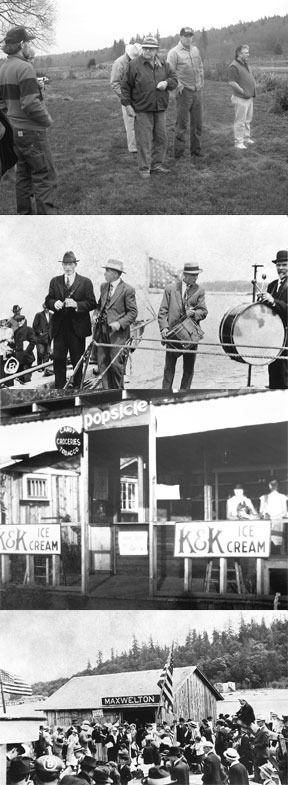
When the students of South Whidbey Intermediate School released salmon fry into Maxwelton Creek in April, they were part of what is now a 10-year tradition and a major community collaboration to restore salmon runs to the Maxwelton Creek basin.
At the same time, two new initiatives are being launched to help preserve and restore habitat and water quality in the Maxwelton watershed so the salmon fry can thrive.
The entire scenario is the child of the Chums of the Maxwelton Salmon Adventure, started in 1991 with the first salmon fry release by South Whidbey schoolchildren. In the interim, the Chums have received funding for a number of projects designed to improve habitat and water quality by developing a better understanding among watershed constituents.
The funding includes $133,000 for a feasibility study exploring future alternatives for both the residents and salmon of the lower reach.
The Salmon Adventure has also received a $37,000 public involvement and education award for a publications project called A Journey through the Maxwelton Watershed.
Coordinated by Nancy Waddell and researched and written by island writer Ann Linnea, the book will capture the natural and social history of the watershed through oral histories and research, resulting in a booklet to be shared with all landowners and the larger South Whidbey community.
The project will build on previous work with watershed landowners, said Laura Fox, administrator of the feasibility study and largely responsible for securing the funding for both projects.
“They told us they wanted to document the history of the watershed and use it as a tool to develop a watershed-wide plan,” Fox said.
Spanning the history of the valley, from its early fishing culture and turn-of-the-century farming to the present, the book will also be an element of the visioning plan for the future, part of the context of what formed the watershed.
“I have been reading newspaper articles and many books,” Linnea said. These include, she said, Lorna Cherry’s books about early South Whidbey, Dorothy Neil’s “By Canoe and Sailing Ship They Came,” Richard White’s “Land Use, Environment and Social Change,'” Kellogg’s “A History of Whidbey Island,” “Sails, Steamships & Sea Captains,” by the Island County Historical Society, and “Formative Years,” by Nancy Donnelly.
Linnea has already conducted interviews with many Maxwelton residents who have stories to tell, among them Virginia Price, John Williamson and Becky Green Williamson, Bud and Clark Silliman, Todd Peterson, Florence Quade, Roy Hagglund, Myron Brixner, Seth and Connie Mackie and Dave Anderson.
Still to come are interviews with Darrell Green, Evelyn Varon, Olive Grubb, Claudia Vander Pol, Esther Erickson, Bill Steiner, Les Hagstrom, Willis Bohnke, Lucille Nourse and others.
“Some of my interviews have led me to some information that seems new,” Linnea said. “For example, Myron Brixner mentioned a journal kept by the homesteader on the Parson’s property who described fish in the creek, elk being shot, and other things of this nature. I’m trying to track this journal down.”
And Waddell mentions a story about a ship that is still buried in a peat marsh.
“I guess it’s possible,” she said.
The project is intergenerational in nature, calling for a fifth-grade unit of study on the watershed, complete with timeline and map. An artist will work with students to create a permanent (but traveling) mural of the timeline.
“We also want to take the stories ‘on the road,’ speaking to community groups, using the Salmon Adventure as a vehicle to bring together longtime residents and new people,” Waddell said. “We’d like to get these audiotaped and replayed, the way the Bayview Live series was.”
Anyone with Maxwelton Valley history to share is invited to contact Waddell at 579-1272 or e-mail history@
salmonadventure.org.
As for the feasibility study, this, too, is being conducted as a community project involving Maxwelton landowners, Salmon Adventure staff as well as board members, hydrologists, engineers and fisheries biologists.
“The study is designed to identify ways to improve fish passage and habitat while reducing the flooding and siltation problems affecting landowners,” Fox said.
One of these is Bob Blasko, a farmer in the lower valley and a commission for Diking District 2, under whose jurisdiction the governance of the tide gates falls
Blasko says he wants to see a permanent solution developed for the returning salmon but, more urgently, he wants to ensure that the lower reach is maintained for agricultural use.
Many of the farmers feel “stuck between a rock and a hard place,” Blasko said.
“You’ve got farmers down here with 100 feet of property adjacent to the creek, with a 20-foot buffer along the creek, and this adds up to a lot of land,” he said.
A county-mandated critical areas ordinance requires the buffer.
“Family farms, many of them like my own, are struggling, and we get no financial compensation for land that gets taken out of our control,” Blasko said.
Two public meetings have already been held by the feasibility study group, one about the lower Maxwelton Creek and the other about groundwater in the Maxwelton watershed, featuring speakers from the state Department of Fish and Wildlife and a hydrogeologist from Island County. Future meetings will be announced.
Fox said a hydrologic model will be developed to help the group understand the potential effects of various alternatives in planning the future of the watershed. She said she feels confident that the Salmon Adventure will be able to find the funding to support whichever solution the community chooses for implementation at the end of this two-year project in September.