Joan of the Stars
Published 9:00 am Monday, December 18, 2006
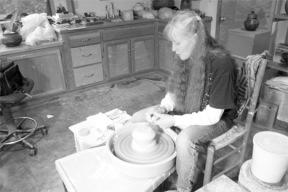
Joan Govedare grew up in a boarding school for boys where her father was a teacher. She spent hours hanging out in the “pot shop†watching the boys make pottery, but never threw a pot herself.
Ironically, today Govedare is a prolific potter with 36 years of experience as a ceramic artist and a pot shop of her own in Freeland called Night Sky Studio.
And she was recently the subject of a short film by Jacqueline Toma entitled “An Offering To The Stars,†which aired last month on public television.
Govedare started throwing pots in college and struggled with the art form in the beginning.
“I was not a person who learned to do pottery easily,†Govedare said. “I’d say it took me about 15 years to learn how to center a medium to large piece of clay.â€
But Govedare continued to teach herself.
And when she discovered that she was not able to control the glazing process as well as she liked, she started painting her pots instead, which allowed her to learn about color and control what the pots looked like in the end.
Her art would take another turn after a family crisis.
When Govedare’s father, a well-known, professional astronomer, was dying of cancer, she took care of him for a year. She said that he could hardly walk during that time but the one thing he would do was get up out of bed at night to show her the stars.
Govedare said she had never painted stars on her pots before that, but her father’s love of the night sky inspired her.
“He paid for my studio, he taught me the stars and I brought home pots to show him.â€
Since her father’s passing in 1987, stars have become the most consistent element in her work. Every pot she paints has a shooting star or an actual constellation on it. Thus the name Night Sky Studio, where she creates her work.
This, she said, is in honor of her loving father.
Govedare’s pots are one-of-a-kind creations made from a white clay called Vashon White which has a beautiful milky hue before it is fired.
The smoky finish on certain pots is the result of an ancient firing process called Raku. Following a bisque firing, the pots are fired again in a Raku kiln where they reach a temperature of about 1,800-degrees Fahrenheit. They are then removed from the kiln and placed on a nest of pine needles in an airtight container.
Here the trapped smoke enters the clay body and turns it various shades of black. After the pots are cooled, Govedare carves and hand paints them.
Govedare is mainly self-taught but said one significant influence on her work and her life as an artist was Estella Loretto, a Pueblo woman who taught Govedare how to paint pots.
Govedare said she was mentored by Loretto for about four years while living in Spokane. Loretto also taught Govedare about sacred offerings. She recalled one time when before going on a skiing trip, Loretto gave her some cornmeal and told her to offer it to the mountain at the top of the ski run before going down it.
“Everything was sacred to her. She was a Pueblo. She taught me a lot about how to live a deeper life,†Govedare said.
“Potters all over the world always offer something to their kilns because pottery is fragile and can break. It’s an old tradition that you have kiln gods and little things sitting on your kiln. Potters offer things to the kiln.â€
It is with this sharp sense of spirituality and ritual that Govedare offers symbols of her rich family heritage to her kiln, tying the outer life of her artistic endeavors to her inner life.
Govedare said she grew up in a very loving family. She has a tree outside her home that she planted when her mother died. And she uses the collected leaves from that tree and the petals of roses that have been given to her as offerings to her kiln.
Each time she prepares to fire a pot, Govedare offers three leaves representing herself and her two sisters, and two rose petals as symbols of her parents.
Govedare is passionate when she speaks about what she does and what has been given to her.
“My life in the studio is an offering every day,†the artist said. “Everything I do in here I do with a lot of positivity because I think we need as much of that as we can get right now.â€
“My inner life is as important to me as my outer life. It’s my inspiration and I wait with a pencil in my hand for it to come,†she explained.
Her newest series of pots is named Kurma Samastrita, which loosely translated means “dwelling in the force of the goddess.†It is a fitting title for a woman who creates art inspired by her life of studying the stars, the I Ching, yoga and meditation.
But although Govedare embraces the spiritual side of her work she remains light-hearted and is quick to laugh.
Her sense of humor and ability to not take herself too seriously seems to be the key to her youthful charm. Govedare is 54 but looks 10 years younger and could be the poster girl for following one’s bliss.
When she advises fledgling artists she sprinkles it with a dose of reality. Enjoy living on less while you’re making it as an artist, she said. Being an artist means you get to live what you love. If you love it then eventually you will be rewarded in kind. Her message: Love the art and it will reciprocate.
“I would like to be remembered as a person who has given love through my work,†Govedare said. “In my own little humble way, those little pieces of art are going to release good energy for a long time.â€
Govedare’s work is available at the Gaskill/Olson Gallery in Langley. She has recently launched a new Website at www.nightskystudio.net.
The film “An Offering to the Stars†will be shown again on KCTS in the spring. Look for the “About Us†series in the television schedule listings.
You can contact Joan Govedare for a private studio appointment at Night Sky Studio at 321-3119 or e-mail nightsky@whidbey.com.
Patricia Duff can be reached at 221-5300 or pduff@southwhidbeyrecord.com.