South Whidbey School District’s records policy fuels concern
Published 6:00 am Saturday, January 31, 2015
The South Whidbey School District’s new policy of proactively identifying online people who request public records is raising red flags among some open government champions.
While it appears largely unanimous that the practice isn’t illegal, critics say the small number of requests in 2014 — less than one a month — coupled with its years-old legal battle with a former employee cast suspicion on the motives of administrators and the school board. One prominent media attorney said those factors make it appear the policy was specifically designed to scare people away from seeking public records, and a Whidbey parent and school board meeting regular said that district officials are trying to expose those deemed as troublemakers.
Toby Nixon, president of the Washington Coalition for Open Government, said the intent behind the policy doesn’t make it illegal, but it does raise a question.
“Is it wrong if the motivation of the district is to call out an abusive requester?” he said.
The answer may vary by a person’s individual views, but Nixon said the coalition considers access to public records a civil right, and agencies that use public shaming as a tool for limiting the number or scope of requests under the premise of being “transparent” are missing the point of the state’s records law.
“I think it’s contrary to the spirit of the act,” Nixon said.
Anonymous requests
Earlier this month, school administrators began including the details of public records requests in a specially created document linked to online school board agendas. It includes the names of requestors, the information sought and an estimation of the time and money the district spent to fulfill the request.
The state’s Open Public Records Act does not mandate people identify themselves when asking for public documents, and the school district is not requiring people to do so. Just to be sure, The Record submitted an anonymous request last week, and the request is both being worked on and is listed as anonymous on the district’s website.
Nixon is also a city councilman in Kirkland, one of few municipalities in the state that also identifies people who ask for public records. He helped craft the city’s online system, and says names are included for one purpose — to help people track the progress of their requests online.
“It’s not being done for the purpose of embarrassing a particular requester,” Nixon said.
The right to anonymity, however, is not made clear on Kirkland’s website. Under a section highlighting commonly asked questions, the answer to a question of whether a records request is confidential says, “No. Once the city receives a public records request, that request itself becomes a public record of the city.”
School district Superintendent Jo Moccia maintains the new policy is to keep the board informed about how school officials are spending their time, but school board members also made it clear in a recent story in The Record that they believed the practice would have the added benefit of making anyone who doesn’t have a legitimate request think twice.
The district has been fighting legal battles with a former teacher, Eric Hood, since his contract was not renewed in 2010. School board directors and administrators alike have bemoaned the subsequent increase in district legal fees, along with the time and expense of complying with Hood’s records requests. Those are resources that should be going to school programs and students, they say.
It should be noted that Hood’s lawsuits are still in litigation. However, in one case a judge did rule in his favor, ordering the district to pay over $7,000 in fines for the “untimely production of documents.”
Hood declined multiple requests for comment.
Public benefit
According to district officials, creating a document that details public records requests, including the estimated cost to the district, was a way to show where tax dollars are being directed.
Calculating a price tag based on estimated staff time, however, is a subject of criticism among some open government advocates. Michele Earl-Hubbard, president of Allied Law Group and one of the state’s leading media attorneys, says such tracking methods are ripe for problems. Besides being difficult or impossible to verify, they can be misrepresentative of actual cost due to differing methods. In 18 years of practicing media law, she said it’s become clear that governments don’t always do things the most efficient or easiest way, and that has a direct effect on price.
“Almost always, those estimates are grossly inflated,” Earl-Hubbard said.
Kirkland also tracks the time city officials spend working on records requests, but it’s a combined total — it’s not distinguished by individual. Separating out such information is too much work with too little payoff, Nixon said.
“We thought about it, but there was no public benefit to tracking the number of hours on each individual request,” he said.
In a recent interview, school board president and Director Linda Racicot said she felt that tracking such details does not place an undue burden on school administrators. It’s essentially a summary statement of the work already done, she said.
“It’s a pretty simple thing compared to the actual requests,” Racicot said.
Another key difference between the two is that Kirkland’s website posts many of the results of each records request. The idea is to make the information easier for the public to review, but also alleviate the staff time need to complete future requests.
By comparison, South Whidbey’s document does not link the results of completed requests as digital documents — it includes only the name, the request and the estimated time and cost to the district.
Nixon said it’s important to note that the district appears to be naming everyone, which is important because the records act doesn’t allow governments or agencies to single people out. Everyone has to be treated the same, he said.
At present, the district’s online document is incomplete. While all but anonymous requestors are listed, some entries include cost estimates and others don’t.
Moccia said in a recent interview that the difference is due to earlier entries in 2014 not being tracked.
Ongoing discussion
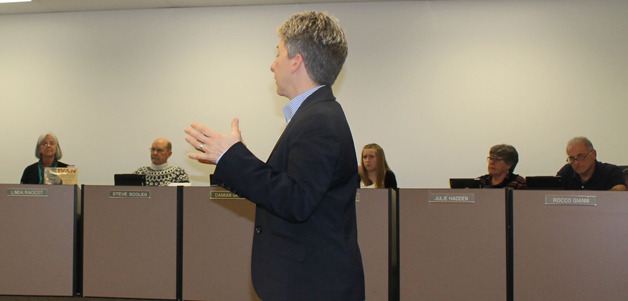
In the school board’s regular meeting Wednesday, directors, Moccia and a district attorney spent nearly an hour discussing the new policy.
Moccia reiterated the purpose is to let school board members know where district money and time are going. Addressing why the results of requests aren’t placed online, she said it isn’t that simple, that there may be attorney-client privileged data, sensitive data or student data which is protected and must be omitted prior to the record being released.
“There is no easy answer,” she said, adding that the district and their attorney are looking into methods which may be more efficient than the current system.
She added that since The Record’s story earlier this month, some citizens have questioned why the district doesn’t charge the requestor for time rather than simply for paper copies of documents.
Laura Clinton, a school district attorney, explained that the statute and case law decided by the courts is “absolutely clear” that an agency cannot charge for time, only for the cost of making photo copies. The time spent communicating with the requestor, locating and sorting through documents to determine if any redactions are necessary, and completing the request are funded directly by the school district.
Moccia said she had delegated the task of processing public records requests to one staff member, who was permitted to take up to two hours a day to work on requests.
“You’re very, very, very limited in the recovery of expenses from public records requests,” Clinton said.
Moccia told the board that it is up to them to determine whether or not they would like to continue with the current method of putting public records requests online.
Director Julie Hadden called it a “double-edged sword,” noting that she was confident everyone in the room believed in the importance of individuals having access to public records. She said that as a school district board, it is their “fiduciary responsibility” to inform the public of all aspects of the financial report.
She added that she thought it would be a good idea to notify requesters that their information would be made public in the response to their request.
Racicot noted that the Washington State Schools Directors Association has affirmed that the public records policy adopted by the South Whidbey School District, as well as the Monroe School District, is acceptable to them.
It’s justified
The school district is not without support. The Record’s initial story about the district’s new policy earlier this month sparked little outrage among readers. Public discussion on the topic and the story ramped up in later weeks on Facebook, resulting in many railing against the practice of identifying requesters, but most were from other communities.
Some of the most sympathetic ears are past and present elected officials. Neil Colburn, a former Langley mayor and city councilman, said people who abuse the records act and bombard public offices with repeated and large requests are a legitimate problem. But the law offers government no recourse.
“If you know you’re being harassed by somebody, you still have to follow the law,” Colburn said.
Identifying people who abuse the system is an equalizer, he said, and one he believes is ultimately justified.
“I think people need to stand up and take responsibility for who they are, and I don’t think that happens enough,” he said.
Furthermore, Colburn said he wants to know when the district is being sued, by whom, and when it’s being hit with repeated requests from a single individual.
“All that comes out of my tax dollars, and I want to know,” Colburn said.
Island County Commissioner Helen Price Johnson, a former longtime South Whidbey School Board director, declined to weigh in on the background
of the school’s new policy but said she doesn’t believe the practice is designed to be retaliatory.
“I don’t believe they’re intending it to have a chilling effect [on requesters],” Price Johnson said.
In general, she said all governments struggle to comply with the public records act. The vast majority of requesters are “well meaning people truly seeking information about their government,” but the “gotchas” and “people who are fishing” can be a drain on resources.
“The [public records act] was not intended to be a weapon for disgruntled folks to use against their local government,” said Price Johnson, in an email to The Record. “It is a tool for civic engagement and transparency for our public and is a keystone for our republic.”
She added that the Municipal Research and Services Center, a non-profit organization dedicated to assisting governments with collaborative consultation and research, does offer some suggestions for dealing with voluminous requests: asking requestors to narrow their searches; asking for a 10 percent fee for paper copies as electronic copies are free; and fulfilling the request in installments.
“There is no guidance for local governments about posting open records requests on a website or not,” Price Johnson wrote. “It is recommended that each agency craft policy on how they will handle public records and then follow that policy. The local school district appears to have done that.”
Targeting troublemakers
But not all South End government officials are so sympathetic to the district’s new policy. Molly MacLeod-Roberts, the clerk for the Port of South Whidbey and a district parent, said she’s been hit with extremely large records requests and went to great lengths to comply. In one case, the port set up a special computer at its office in Freeland that contained all the requested documents. The computer sat there for months, but the person never came in to review the files.
While it was a lot of time and effort for nothing, MacLeod-Roberts chalks it up as one price of public service. It’s not the place of government to question or “expose” people who are asking for information, she said, regardless of their motives or whether they even show up to collect.
And given the background with Hood, she said it strongly appears that the policy is retaliatory in nature, MacLeod-Roberts said.
“It seems like they are targeting people; this person is a troublemaker,” MacLeod-Roberts said.
A regular at school board meetings, she also complains that meeting minutes are sparse and lack context, and that meetings themselves are no longer being recorded with audio or video. Coupled with the district’s new policy of identifying requesters, she said she can’t help but wonder what the district may be hiding.
“The school district is doing the bare minimum, and I don’t consider that to be transparent,” she said.
Possible solutions
According to Nixon, the coalition recommends that government and public agencies try to post online as many records as possible to aid in general transparency, but also to reduce future workloads.
Much of the work is already done, particularly when it comes to isolating digital records, so it’s only one additional step to include the actual documents with the rest of the details of the request, he said.
Legislative changes may also be in the wind. According to Rep. Gerry Pollet, a District 46 Democrat and co-chairman of the Open Government Caucus, he expects lawmakers will consider multiple bills concerning the public records act during the current session. Municipalities and junior taxing districts often complain about the weight of the state records act, which gives birth to bills across the board, he said.
Last year the Legislature considered several, including one specifically aimed at harassing requestors, he added.
But Pollet, also a Washington Coalition for Open Government board member, said such legislation is often misguided and that governments would be better off looking at how to better comply with the existing law rather than work to change it to their benefit.
Earl-Hubbard agreed, saying few if any changes to the public records act are actually warranted.
“I don’t think we need legislative changes,” she said. “I think we need people to go back and read the law, understand the law and remember who they work for.”
Reporter Kate Daniel contributed to this story.