South Whidbey Academy students studying for a greener future | CORRECTED
Published 2:31 pm Friday, February 13, 2015
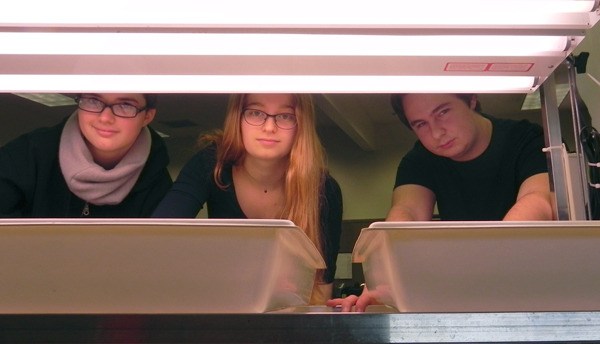
A group of students at South Whidbey Academy may not be able to save the world, but they are striving to save the land, and the communities that rely upon it.
The group, led by volunteer instructor Timmie Sinclair, is applying for the InvenTeam Initiative, a part of the Lemelson-MIT InvenTeam program, in hopes of obtaining a grant.
The project is student directed and project driven, and encourages students to delve into multiple disciplines and subjects in order to foster positive change.
For South Whidbey Academy’s students, this change is the decontamination of Ecuadorian mangrove forests and other lands which have been polluted by runoff from shrimp farms. The problem is also prevalent in Thailand and India, Sinclair said.
“Basically anywhere there is a coastal area with poor folk, shrimp farms go in, obliterate the mangroves, drain the field and put in shrimp ponds,” said Sinclair during a recent class.
Many native populations rely upon these forests for food. To compound the problem, water sources can also become polluted, forcing residents to venture for miles to access another water source.
Adah Barenburg, a member of the team, said that the project has been quite a long process.
To begin, each student researched and wrote their own project proposal independently. Afterward, students with similar project ideas paired up to determine which was more likely to succeed. After more research, the students presented their projects and decided which to pursue as a class.
“It’s really interesting,” she said.
Sinclair explained that the objective is to develop a plan and invent a device which would add nutrients to ground — rendered infertile due to chemical runoff.
Due to the high demand for shrimp worldwide, shrimp farmers cut down trees and pump the shrimp into man-made ponds, releasing the water, which has been contaminated by pesticides and hormones, back into the sea. The contaminated area is typically about the length of a football field around each farm, Sinclair said.
The fish become toxic, the soil infertile.
“It’s the same problem we’re having with the runoff from our roads here,” said Rocco Gianni, school board legislative representative, who was visiting the class.
The students are in the process of developing a machine which would use sunlight to heat water and “steam bathe” the soil, then adding in “biological soup” to an agar.
“They are trying to rehabilitate the soil. …This is not a fast process, but it is way faster than biology and entropy,” Sinclair said. “We’re trying to give Mother Nature that little push since we choked her out. We thought it would be nice to give her CPR.”
“It’s kind of like giving the vitamins instead of the cough medicine,” Gianni added.
 The team has been divided into groups, each responsible for a different part of the complex process.
One has been assigned the task of discovering what ingredients to place in the “biological soup,” the blend of revitalizing nutrients to be administered in hopes of rehabilitating the soil. They have begun collecting coffee and tea grounds due to the high nitrogen content of these ingredients.
Another group of students is the “contamination crew.” These students are responsible for testing the soil in order to determine what is needed.
They will use the soil of the school field to test out their hypotheses. The soil, Sinclair said, has been treated with pesticides and will therefore make a good test subject.
“We have to start in our backyard,” she said.
Once they’ve established the efficacy of their experiment, they will be able to adapt it for the mangrove forest soil.
A third team is working to design the robot and conveyor belt system which will distribute the nutrients.
Ideally, the robot will be powered by either solar energy or steam. They are utilizing a MakerBot 3-D printer to print small prototypes.
Aside from their scientific studies, the students have also been tuning in to international and national news. This has been difficult, Barenburg said, due to the numerous reports of violence and injustice worldwide.
Student Taylor Capiola explained that students present discussion topics — such as LGBTQIA rights, police brutality — to the class each Tuesday. Lately, they have been focusing on issues relevant to Ecuador, in correlation with their invention.
“I listen to the radio now, and I’ve never done that before,” said Barenburg, adding that she has also reached out to writers, scientists and a photographer to inquire about their perspective on shrimp farming and the pollution of natural resources.
“It’s amazing that they care enough to reply back to a student,” said Barenburg.
Once the students have completed their studies and fleshed out their plan, they will submit the project to the Lemelson-MIT Program where it will be judged, along with others from around the country.
A committee will select up to 35 educator finalists to attend the Lemelson-MIT Program’s annual EurekaFest event in June at MIT to meet current InvenTeams and educators.
After EurekaFest, the finalists will be eligible to submit a final InvenTeam grant application.The grant is for a maximum of $10,000. InvenTeam grant recipients will be announced in October. Grant recipients will then be able to complete and implement their project.
Update: An earlier version of the story contained inaccuracies. The name of the program is the Lemelson-MIT Program. The South Whidbey Academy students are applying for the InvenTeam Initiative and are not a part of the InvenTeam. A committee will select up to 35 educator finalists to attend the Lemelson-MIT Program’s annual EurekaFest event in June. At EurekaFest, educator finalists will be eligible to submit a final grant application. Recipients will be announced in October.