South Whidbey at Home celebrates 10 years of helping neighbors
Published 1:30 am Friday, March 13, 2026
By KATE POSS
Special to the Record
When the late Lynn Willeford founded South Whidbey at Home — SW@Home — ten years ago, the self-proclaimed “serial starter-upper” envisioned a way for island folks to age in place within the embrace of community support.
SW@Home is a membership-based nonprofit supporting older South Whidbey residents who wish to remain at home and yet still be part of the community.
Now ten years later, Executive Director Beth Herrild, who has held the post the past year, is looking toward celebrating Willeford’s legacy. Herrild said she supports SW@Home’s mission of cultivating a sense of “fierce inter-dependence,” rather than remaining “fiercely independent,” which can leave folks without a support base when one is in desperate straits.
“We’re going back to Lynn’s original vision,” Herrild said. “It wasn’t her vision that people wait till they’re in crisis. Hers was, it takes a village. We can weave this year’s anniversary celebrations with that village concept in mind.”
This month, for instance, SW@Home hosted a screening of “Wine, Women and Dementia” at the Clyde Theatre. The theater was nearly full with senior-aged locals and their caregivers. The documentary honestly and humorously portrays the village of caregivers and their challenges of caring for family members with dementia. Blake Willeford and his son Brooke own the theater and continue to support many of Lynn’s missions with its “Magic Jar” donations. Lynn married Blake in the 1970s after working at the theater and often telling others ‘I swept my way to the top.”
About the film, Herrild noted on SW@Home’s webpage: “The world is grappling with a crisis as the baby boomer generation ages into dementia. The United States is no exception, with an estimated nine million Americans projected to be living with dementia by 2030. In light of this, ‘Wine, Women, & Dementia’ provides a poignant and intimate look into the human side of dementia.”
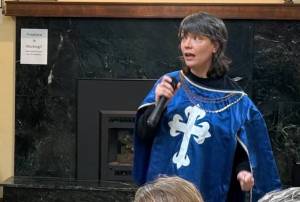
After the film, Herrild joined Aimee Vallat, an award-winning producer/director of documentaries who serves on the Healing Circles Langley board, and “Wine Women and Dementia” director and producer Kitty Norton.
Norton noted that, as part of the Baby Boomer generation, there’s a culture of sharing challenges and seeking solutions, which she did in a blog documenting her mom’s dementia care. Norton said she wanted to focus less on the tragedies and heartache of the challenges faced by her and her sister and instead celebrate the small victories with conversation and wine. After her mom died, Norton and a friend toured the country in an RV visiting caregivers who had befriended Norton through her blog “Happy Healthy Caregiver.”
Sharen Heath, whose husband Simon was diagnosed with vascular dementia and is currently in hospice care, stood up and spoke about the importance of self care.
“Is this disease going to take one of us out or both of us? It was the wonderful Phyllis Ray who first put the question to me, emphasizing the importance of self care,” she said. “These days I feel a bit like the poster child for caregivers, for spouses of dementia patients. Simon was so sharp and keen, healthy and active, lived a healthy life. There was no family history of dementia. That Simon turned out this way is still a shocker to me and all who know him.”
SW@Home hosts weekly art classes — Creative Companions Art — for caregivers and their loved ones with dementia or neurodiverse conditions. The next six-week class begins April 3.
Meanwhile, as ambassadors to members who sign up for help, SW@Home volunteers enjoy the riches of giving back to others. Currently there are more than 200 members and more than 100 volunteers with the organization.
“We say come to the village. Volunteer a little,” Herrild said. “Who doesn’t need help hooking up their printer? Our volunteers are often the same age as our members. We are trying to flip the narrative from being fiercely independent to fiercely interdependent. If you’re not fiercely interdependent, you can become fiercely dependent overnight.”
Herrild recalled one member who deflected offers of help from friends for years until she was in desperate straits. A SW@Home ambassador visited the woman shortly after she had returned from the emergency room. The woman was in a serious health crisis by that time and required immediate hospitalization. Her experience deeply impacted Herrild and the SW@Home staff.
“None of us want to be in that situation,” said Herrild. “Isolation is a problem of epic proportions. We want members to join us before they are in crisis. If you can’t shower and make food for yourself, then you need other Island resources.”
Herrild earned a master’s degree in Organizational Design and Development, which gave her tools in running nonprofits. She worked as a full-time artist in her own business “Outside the Box Creations,” providing art lessons in a box for subscribers. She sold the business a few years ago. Before that, she worked with the Universalist Unitarian church in Seattle.
“A lot of what I did there was community building, recruitment, training and nurturing of volunteers,” Herrild recalled. “Nowadays with all the stuff going on at the national level, it’s meaningful to build community here on Whidbey Island.”
Three years ago, Herrild helped develop a program bringing art to Island County inmates.
The Inside Out Program mentioned on her website notes: “Inside Out is an art program for incarcerated adults in Island County Jail. The Pacific NorthWest Art School brings the transformative healing power of art to adults both inside and outside. I helped develop this program and teach art twice per month.”
She finds the volunteer work rewarding and builds on her previous experience.
“I have a prior history of teaching classes at Purdy Women’s prison in Gig Harbor,” Herrild said. “I had gone through training and had some experience teaching incarcerated folks. When the Island County jail came to Lisa (Bernhardt, executive director at PNW Art School), I was on the school’s board, and we set up the program.”
Locals can find Herrild’s art at Cultus Bay Glass Art Gallery on Crawford Road. These days it is trees that inspire her.
“My biggest body of work right now is all about trees,” she wrote on her website..” I’m fascinated by their strength and their shapes as well as the light and shadows that fall on them at different times of day. Like people, trees aren’t perfect. Their beauty often comes from growing through difficult times or terrain and their scars make them infinitely more interesting and distinctive.Tree growth and development is not so different than our own human growth and development. Like us, each tree is unique and has its own story. It is heavily influenced by the environment it grows up in and its support systems. Like humans, trees thrive best in community. They communicate with each other. They can even warn each other of danger and funnel nutrients to the ones who have the greatest need.”
SW@Home will host upcoming programs, such as Tech Tuesdays, balance classes and a solo aging support group.
“I’m really excited about that,” Herrild said regarding the solo aging group. “The first six weeks we will participate in a program through the Village to Village Network: Aging alone together. The program shows what such a village is. It’s something I want people to understand.”
SW@Home is modeled after Boston’s Beacon Hill Village, founded in 2002 and one of the original Village to Village organizations. Having learned of this aging in place model, Lynn Willeford, was inspired to launch a similar program on South Whidbey with the goal of helping residents age in place, in their homes and with the community they know supporting their lives, and getting by with little help from their friends.
For more information, visit swathome.org.
“Wine, Women and Dementia” is available for streaming on Amazon, Google, PBS and Soul TV.