From manure pile to museum piece: Whale bones begin new journey
Published 1:30 am Friday, June 12, 2026
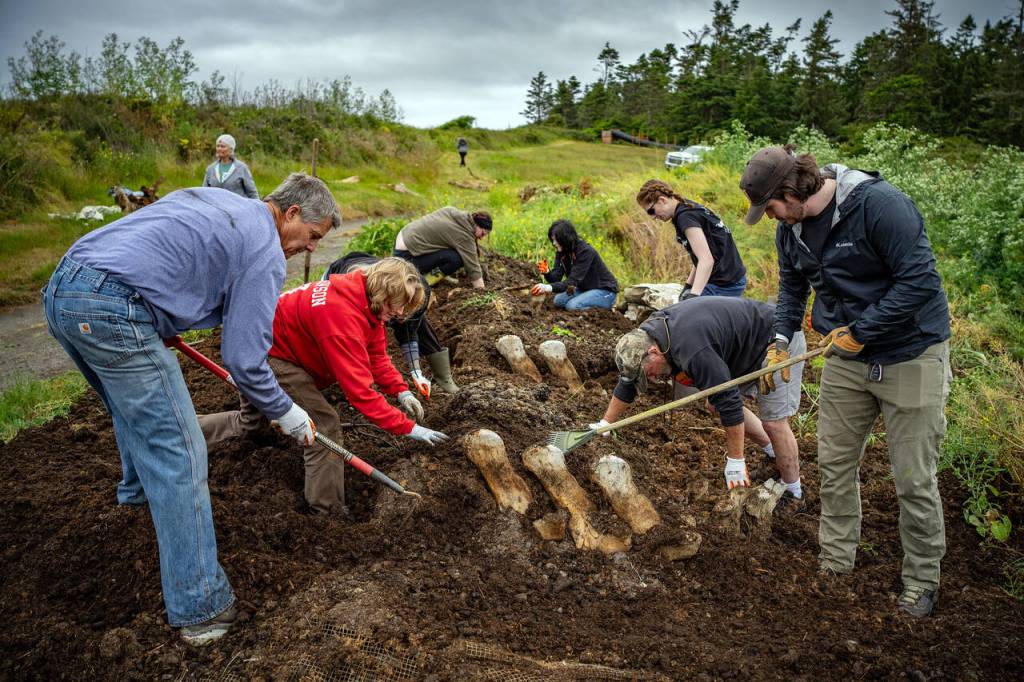
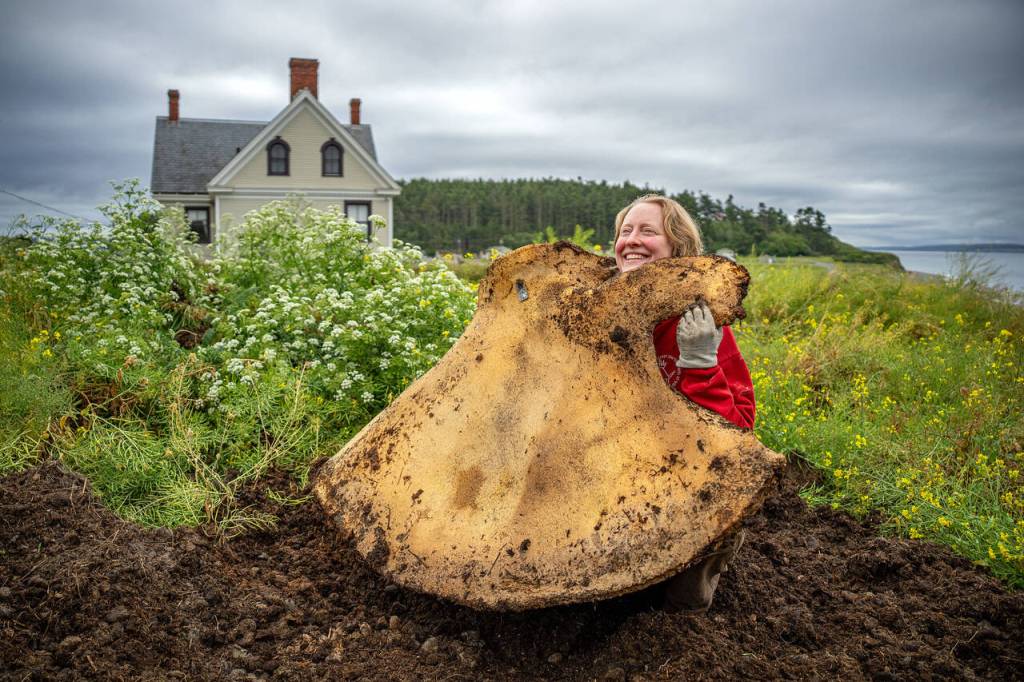
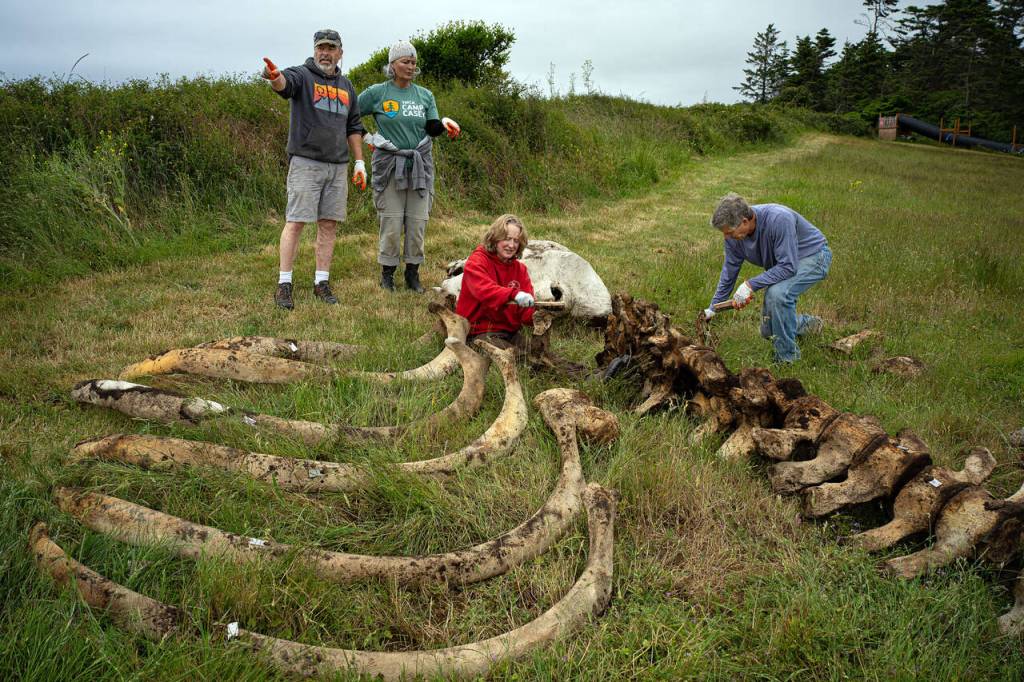



Equipped with rakes, wire brushes and a willingness to get knee deep in horse poop, a group of volunteers gathered at Camp Casey this week to preserve the skeleton of a gray whale that washed ashore in July 2025.
After spending 10 months buried in horse manure to help speed up the decomposition process, volunteers dug out the whale bones, cleaned and loaded them into pickup trucks on Tuesday, bound for an Oak Harbor property, where they will dry and bleach in the sun before the next stage of restoration.
Community support is something that YMCA Camp Casey Executive Director Jake Carlson said has become one of his most important lessons while leading this project. Around a dozen marine science professionals, educators, students and community volunteers, many of whom also participated in the whale’s flensing last August, came together for the work party on Tuesday.
“One of the things that I’ve learned just about organizing on this island is working together is kind of our superpower,” Carlson said. “Whidbey really thrives on partnerships.”
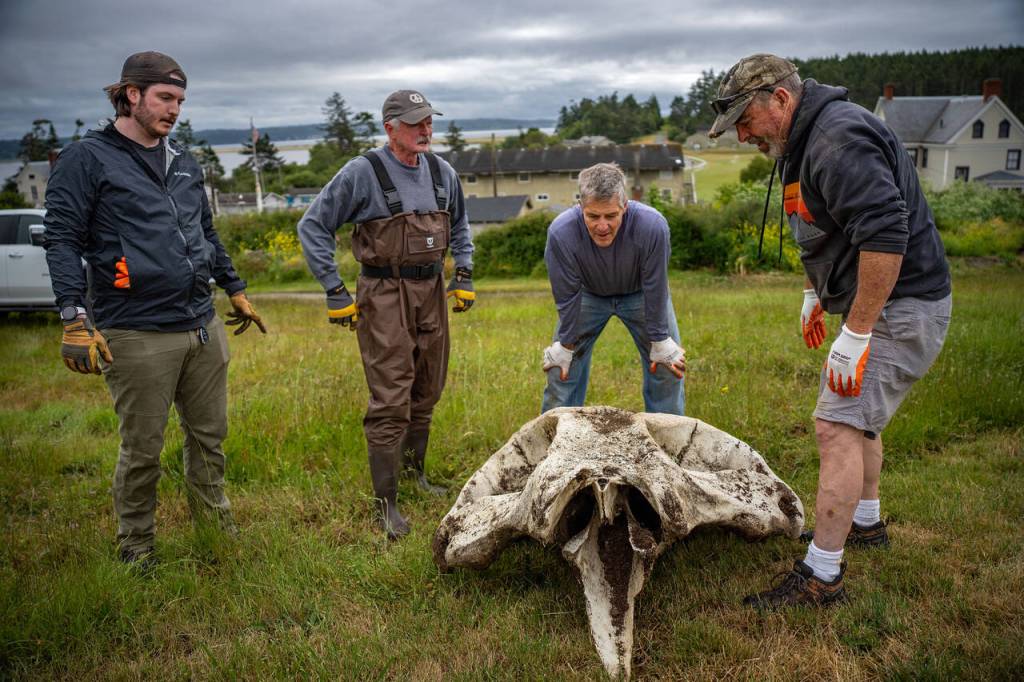
The group began by raking and pulling bones from the manure pile before shifting to scrubbing away the remaining tissue. Unlike nine months ago, the bones did not reek; instead, they had a faint earthy and musky scent to them. After a lunch break, the volunteers loaded the manure-free but still slightly copper-toned bones into six volunteer-owned pickup trucks for transport. While the spine and ribs were light enough for one person to carry, the massive skull took five men and women to lift it into a truck, not without some huffing and puffing.
Education specialist and marine mammal stranding network responder Allie Hudec said the goal of this project extends beyond preserving bones. The whale’s eventual display is expected to become a centerpiece for future learning opportunities at Camp Casey.
Lauren Hunter, STEM program manager for the YMCA of Snohomish and Island Counties, is helping develop a new Whale Camp this summer, from June 22-July 2, to teach students about whale anatomy and conservation.
“When I teach kids, I see a generation that is excited and cares deeply, and wants to see change and make change,” Hunter said. The whale skeleton will give children a tangible connection to marine ecosystems that can otherwise feel distant, she added.
“Putting your hands on the bones, seeing that your hand is the same outline as their hand,” Hunter said. “That is what really makes a difference.” Register for camp at https://snoco.recliquecore.com/programs/1025/explorer-camp/?locations=12385.
The bone cleaning project drew volunteers from across western Washington. Volunteer Amber Parsons, who holds a biology degree with an emphasis in marine science, and whose vacation home is right by Camp Casey, said she couldn’t miss her chance to be there.
“This is my world colliding, right?” Parsons said. Several other volunteers voiced the same urgency to be included, recalling responding to Carlson’s call for help as quickly as they saw his email.
Janelle Katzer drove for nearly three hours after taking a day off work to be part of the work party. For Katzer, who volunteers with marine mammal stranding efforts and is completing a bachelor’s degree relating to marine biology, the project offers a rare opportunity to combine hands-on science with public education.
Katzer said it would feel incredible to be a kid again and to see a giant whale skeleton in real life.
“I was that little girl who wanted to be a marine biologist but never changed her mind,” she said.
Equally as committed to being there, Kyra Freeman said she was fortunate not to have any finals on Tuesday, enabling her to skip school.
Though the volunteers are eager to help, the restoration itself remains a long-term undertaking. Since the whale had a tumultuous journey, rolling from Ebey’s Landing to its final resting point at Camp Casey, it is missing a few small fin bones, and chunks from its skull. These parts will have to be artificially replaced in the future.
Matt Klope, an Oak Harbor taxidermist and former Navy biologist, who has helped articulate whale skeletons before, said every bone that volunteers recovered during the flensing process has been carefully tracked. Nine months ago, he drilled holes in the smallest bones, indicating which side of the body they originated from. Meanwhile, he tagged the larger bones in numerical order so volunteers can properly reassemble them in the future.
Once cleaned and repaired, Klope hopes to lead the volunteers in articulating the whale into a lifelike swimming pose.
“We do it for the kids,” Klope said.
The project has also attracted support from regional organizations, including Sound Water Stewards, the Marine Mammal Stranding Network and Island County’s Department of Natural Resources. Jen Schmitz, Island County’s natural resources manager, said outreach and education is central to the county’s mission. Education, she said, “starts with kids,” Schmitz agreed.
As trucks pulled away carrying the newly cleaned bones toward Oak Harbor, volunteers left knowing the work is far from finished. Months of drying, bleaching, glazing and reconstructing remain before the whale can be displayed, but the project is already accomplishing one of its biggest goals: bringing people together around a whale that will continue educating people long after its death.