History repeats itself as Whidbey museums split again after brief marriage
Published 1:30 am Friday, June 12, 2026

By PATRICIA GUTHRIE
Special to The Record
After a brief reunion, Whidbey Island’s two historical museums have decided they’re better off on their own.
And change is again underway for both museums dedicated to preserving and portraying the past.
In Langley, a new organizational name — South Whidbey Center for Cultural Heritage — reflects a cultural arts approach that blends exhibits and design with new storytelling technologies. Its motto: Learning From the Land, the People, and Their Stories.
In Coupeville, a search is underway for a successor to Dalva Church, executive director of the Island County Historical Society Museum, who is leaving because of health reasons.
The South Whidbey Center for Cultural Heritage replaces the South Whidbey Historical Society (SWHS) that operated the small Langley museum, a former bunkhouse for loggers more than a century ago. Bill Haroldson, a longtime president of the SWHS, is also one of the founders of the new organization.
“This change is more than a new name,” Haroldson said. “Over the past 40 years, we have built a strong foundation of South Whidbey history. The center will engage a new generation of history enthusiasts and visitors while ensuring past efforts remain relevant, refreshed and inclusive.”
Facing diminishing support for cultural nonprofits and uncertain financial times, the two museum boards merged June 1, 2025 with a plan to share resources, technologies and artifacts. Island County Historical Society, which operates the Coupeville museum, assumed fiscal and management oversight of both entities.
Now, they are officially divorced. Again.
The split is, in a sense, history repeating itself. Up until the 1980s, the Whidbey museums had operated under one umbrella organization. But then a new group, wanting to focus more intently on the unique history of the southern end, formed a separate society.
A similar story just unfolded.
Church said the board overseeing the Langley museum asked for help last year because of waning public support and other factors.
“Our understanding at the time of the merger was that the South Whidbey Historical Society was unable to continue carrying out the work that was needed to maintain the Langley museum,” Church said, “and that there wasn’t sufficient interest in the community to form a new board, so there was a need for ICHS to help.”
The situation changed, she said, when a new group passionate about South Whidbey history formed and approached her earlier this year about taking over the Langley museum.
The board overseeing the South Whidbey Cultural Heritage Center is headed by local historian/archivist Kyle Walker, who spent years researching her family roots at Sandy Point in Langley, once the site of a Snohomish village.
Walker said the merger was entered into “with positive intentions but it became clear that each organization could better serve its communities by operating independently.”
Additionally, “ongoing research, new collections and newly identified cultural landscape features” are bringing overlooked histories and stories to light,” she said, “that could engage a new generation of history enthusiasts.”
Church, who will leave her post the end of July, said final papers were signed the end of May to officially dissolve the merger. It also engaged a lawyer, she added, “to ensure that any steps ICHS took would be for the best interests of the South Whidbey community.”
Langley’s museum will keep its name, South Whidbey Historical Museum, but with an enhanced mission to make “South Whidbey’s heritage respected and recognized, sharing genuine stories in ways that reach many people so everyone, regardless of age, feels closely connected to the community,” according to a press release. It uses the word “center” to denote a central resource and gathering place for cultural activities with staff, exhibits and educational spaces.
“The center offers hope and renewal at a time when access to our national heritage and historic resources is increasingly at risk,” said Walker, who is also a board member with the Washington Trust for Historic Preservation. “Collaboration is more important than ever to understand our shared historic identity by learning from the land, its people and their stories.”
Teaching the public about the Coast Salish Snohomish (sduhubš) people who lived in settlements from Greenbank to Clinton is emphasized in the front room of the Langley museum. It was transformed into an indigenous roots exhibit last year with consultation from descendants of the Snohomish Tribe and staff of the Tulalip Hibulb Cultural Center.
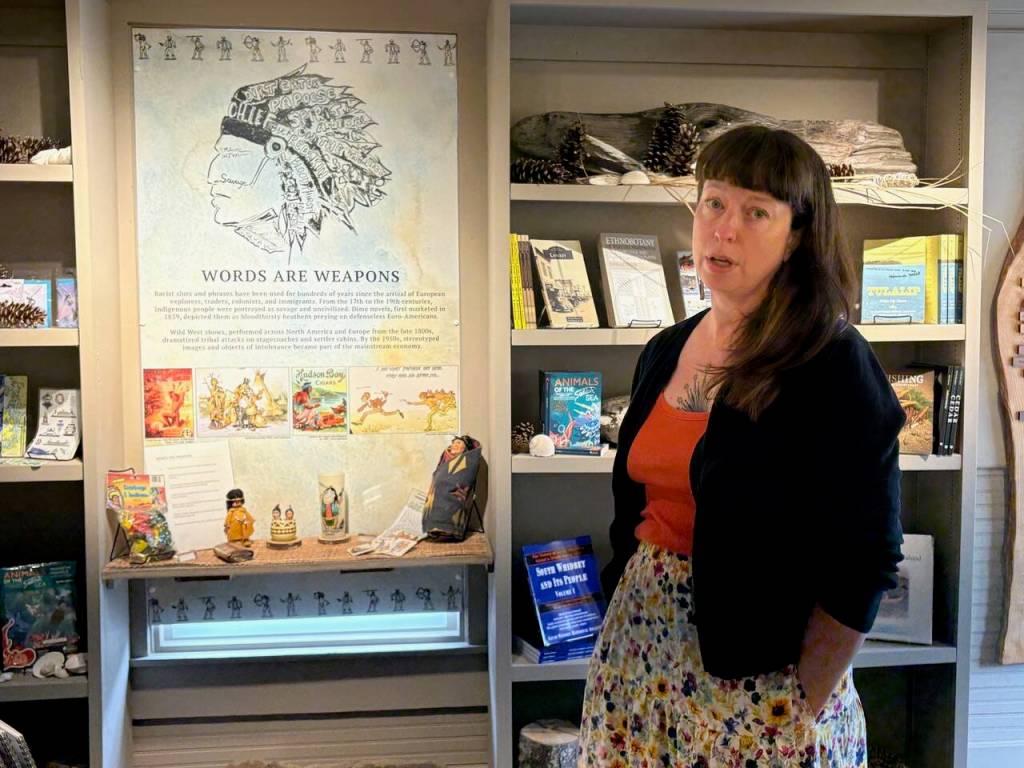
In addition to showing traditional dress, the exhibit explains what happened after the Snohomish ceded ancestral land under the 1855 Treaty of Port Elliott. An exhibit titled “Words are Weapons” reviews how racist slurs and images used since the arrival of Europeans portrayed indigenous people as uncivilized and savage.
Walker’s research is part of the front room display. Called “A Tangled Web of History,” it details how her great-great-grandparents, Portuguese immigrant Joseph Brown and Mary Shelton, or Ge-Gah-Ha, a high-born member of the Coast Salish Snohomish Tribe, settled at Sandy Point.
Other themes include exploration, colonization, logging, maritime, farming and communities told through personal stories or descendants’ collections of journals and artifacts. By embracing a broader cultural heritage mission, the new organization aims to safeguard those stories and traditions so future generations can continue to learn from the past.
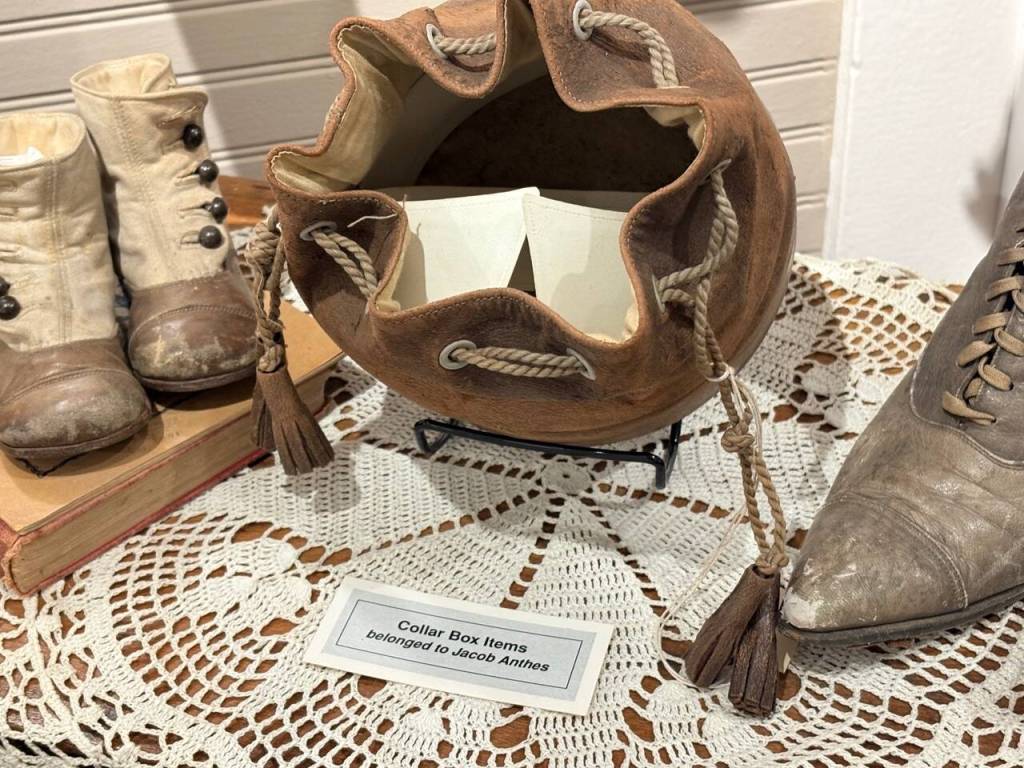
Planned new exhibits include the story of Robert Sidnor Bailey, the first colonial settler who married a woman from a local Snohomish village, and restored artifacts from the collection of Joseph Anthes, founder of Langley.
Take a look at the Anthes collection to learn how men kept their shirt collars so crisp in the olden days or how the pointy toes of ladies’ shoes stayed so pointy.
The most notable change is in the museum’s back room. Once set-up as a quaint kitchen from the pioneering days, it’s being transformed into a workshop, learning lab and community gathering space.
“There will be a work table in the middle,” said director Diane Monroe as she gave a tour of the “work in progress” areas and exhibits. “People can give small presentations here, maybe we’ll have interactive history lessons for kids. It’s exciting that we will have a space to meet in the back of the museum. It just hasn’t been utilized that way.”
Monroe pointed to many displays that are remaining, such as tributes to veterans, items showing a one-room schoolhouse classroom and the Log Cabin Heritage Site that tells the recent discovery of a hidden log cabin, possibly used by Snohomish people in the late 19th century.
“We’re changing the space. We’re not getting rid of items, we are re-purposing them,” Monroe said. “There’s so much information here. The challenge is to distill it down to make it approachable information.”
This summer, the Whidbey Telephone Museum will open next door as part of the new cultural center, showing communications before the digital age. It will be housed in the original 1913 building where Whidbey Telecom started as a small telephone company with party lines and switchboard operators. The collection of telephones from phone booths to pink Princess models is the private collection of the Henny family.
An open house for the South Whidbey Cultural Heritage Center, 312 Second St., Langley is scheduled 10 a.m.- 4 p.m. Saturday, June 20. Visitors can see the latest updates, view plans for the future Whidbey Telephone Museum and observe artist Melissa Koch in action as she creates background for a new exhibit.
Read more information at www.southwhidbeycenterforculturalheritage.org.