Protesters want Langley to pump brakes on gas station
Published 1:30 am Friday, June 19, 2026
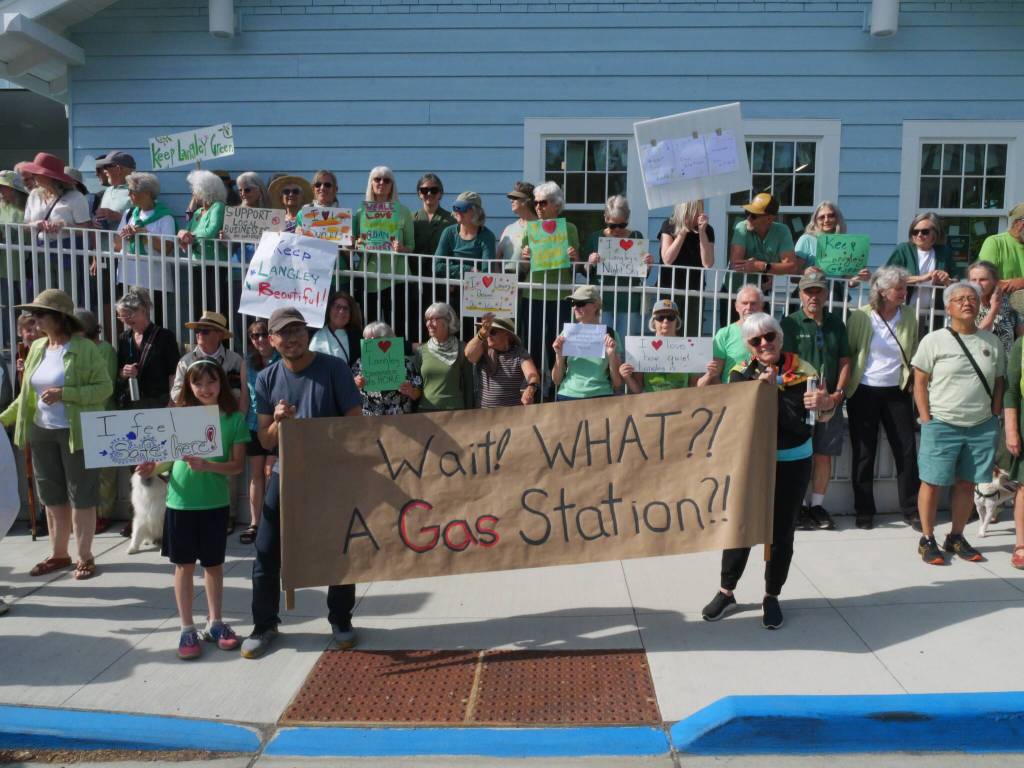
Protesters gathered in downtown Langley on Monday to oppose a proposal that could bring the first gas station in city limits in decades.
A moratorium enacted by Langley City Council on May 18 prevents that from happening at least for the next six months. But while council members and many residents have expressed opposition to the building proposal, the moratorium technically is only meant to delay processing of applications for any new service station to allow the city to create necessary, relevant design standards.
The decision on whether the gas station could actually be developed is the hearing examiner’s.
Eric Levine attended the protest and recalled a sizable crowd holding signs and chanting. He believes allowing the gas station would be uncharacteristic of Langley and that many residents share that sentiment.
“It’d be hard to find one person in town who wants this gas station,” he said.
Public comments during the ensuing city council meeting largely supported his view. Thirteen people spoke, and twelve opposed the proposal.
Parveen Cheema, whose family is proposing the project, offered a different perspective.
Cheema, a special education teacher, and her husband, a retired federal employee, already operate gas stations in Bellingham, Anacortes and Stanwood. She said the Langley proposal would include a two-pump gas station, electric vehicle charging stations, a convenience store and a commercial unit that could be used as a clinic and pharmacy. Fuel would be competitively priced, she added, and housing for families or seniors could be developed on the property in the future.
Citing state law, Cheema emphasized that moratoriums are intended to be a neutral planning tool and raised concerns about the city’s use of one in this case. Langley’s efforts to promote equality are appreciated, she said, but she suggested some opposition to the proposal may be influenced by bias.
“That work is important, because racism does not always appear openly,” she said. “It can exist through unequal treatment, barriers to opportunity or decisions that create different outcomes for different people.”
Cheema also questioned what she described as a double standard in the environmental criticism directed at the proposal.
“Environmental concerns have been raised repeatedly, yet it is difficult to see why a small, two-pump service station is being singled out when some of the strongest opposition comes from individuals whose professional careers include working for Boeing,” she said.
Other people questioned whether a gas station truly aligns with the city’s Comprehensive Plan emphasis on walkability and preserving Langley’s village character. Should a gas station bring an influx of fuel tankers and vehicles into town, one person said, the city may need time to evaluate how that would affect existing traffic patterns.
Residents also raised concerns about noise and light pollution, the stability of the bluff where the station would be built and potential health impacts on nearby residents.
Many argued that gas stations serve an outdated means of transportation and emphasized their desire to progress as a city instead of regress.
“I know Langley must grow, but let’s grow in a way that enhances healthy, connected lifestyles,” one woman said. “Let’s design for the future and not the past.”
Council members questioned whether gas stations could be banned completely in city limits, and inquired about other ways to prevent their development during the May 18 meeting. But their concerns were largely environmental.
For now, the city is tasked with creating design standards “governing specific, observable aspects of a building’s exterior” in order to ensure service stations aesthetically “achieve community planning objectives and improve the quality of the built environment,” a memorandum states.
The moratorium may be continuously renewed for additional six-month periods.