Study recommends Coupeville start small with wastewater reuse
Published 1:30 am Tuesday, March 3, 2026
How much Coupeville benefits from wastewater reuse depends on how much the town wants to invest into it.
A feasibility study recommends Coupeville start small with its wastewater reuse, then gradually expand the reuse system’s capabilities as funding permits. Irrigating agriculture and reducing or eliminating wastewater discharge to Penn Cove through reuse is possible, but costly.
Coupeville obtained a $220,000 grant from the state’s Department of Health in 2023 for the study, according to a previous News-Times story. Public Works Director Joe Grogan said in an interview that $85,000 of that grant funded the study. If the project proves feasible, he explained, the town can continue onto engineering, designing and permitting, which the remainder of the grant would fund.
Engineering consultant group Jacobs conducted the study, which is in its final draft but not yet completed. Mark Madison, a representative from Jacobs, presented several options for wastewater reuse implementation at last week’s council meeting.
In Washington, reclaimed water must meet either Class A or Class B standards of treatment and quality for non-potable reuses. Madison explained that the Coupeville wastewater treatment plant produces Class B water.
According to the state’s Department of Ecology, Class B water can be used to irrigate orchards and vineyards, food crops subject to “physical or chemical processing,” landscape in restricted areas and non-food crops inaccessible to milking animals. Coupeville’s prairies largely grow feed crops, Grogan explained, like alfalfa.
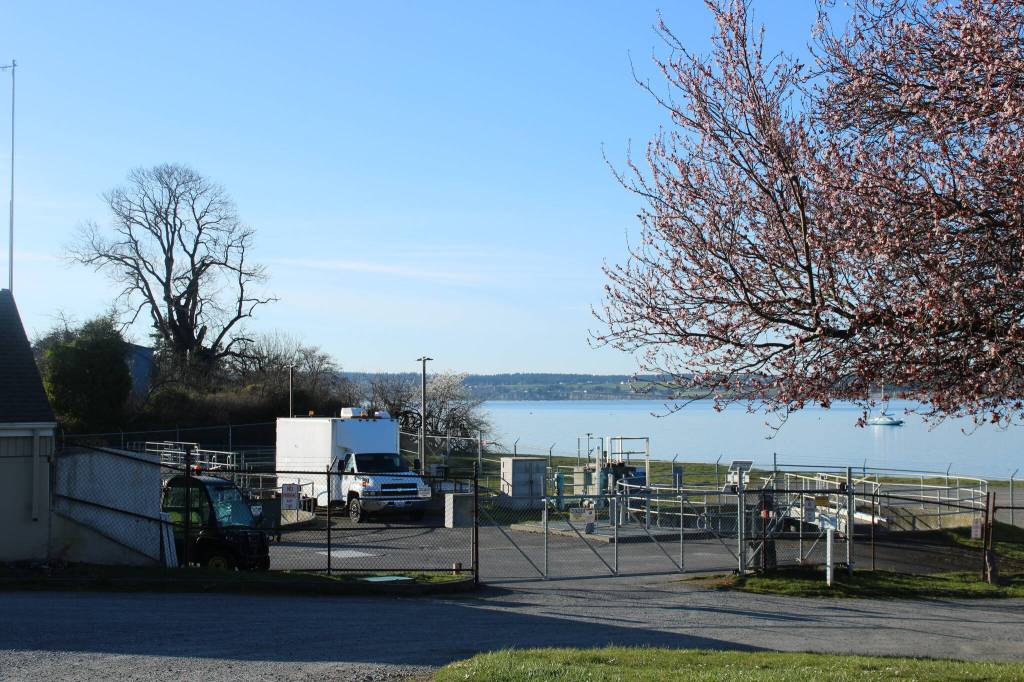
Coupeville’s wastewater treatment plant discharges wastewater into Penn Cove 24/7, Grogan confirmed. Madison explained that outfall necessitates closing the Penn Cove shoreline to shellfish harvesting. “Increasing the harvestable acreage of shellfish,” the draft reads, is listed as another of the study’s goals.
All options Madison presented utilize abandoned pipelines to transport reclaimed water. The pipelines connect the wastewater treatment plant pump station to an abandoned municipal well located near Coupeville High School. There are more than 1,000 acres of agriculture within two miles of that well, Madison added, which could benefit from the water.
The feasibility study describes three main options for implementing wastewater reuse.
Making small improvements to the pump system and stopping there would be the easiest and cheapest method of distributing reclaimed water. Construction disruptions would be minimal, and farmers could connect to an effluent pipe near the well. Discharge to Penn Cove would continue in the winter, however, when farmers’ need for reclaimed water is low.
Jacobs estimates a total capital cost of $240,000 for that project, and a yearly operating and maintenance cost of $25,000.
Reuse water produced in the winter could also be stored in an aquifer connected to the well, then extracted or directly reused for irrigation in the summer. Notably, the aquifer is not suitable for potable water production. That option would run the town $560,000 or $1.24 million depending on pump upgrades, with a yearly operating and maintenance cost of $60,000 or $100,000, respectively.
Adding a larger pump station at the wastewater treatment plant would eliminate discharge to Penn Cove and increase the “harvestable acreage of shellfish near Coupeville,” the draft reads.
Upgrading the wastewater treatment plant to produce Class A reuse water instead and adding a 350,000-gallon tank to hold effluent flow, is the final and most expensive option. It would cost $2.41 million to complete and yearly operating and maintenance would be $651,500.
Increasing the reuse system’s capacity for all flows, in this situation, would increase those prices to $3.09 million and $741,500, respectively, and eliminate outfall to Penn Cove.
Responding to a question from Henrich, Madison explained it is uncommon for public entities to sell reclaimed water because it is not valuable enough to get farmers to pay for it. Rainwater is still free, he added, and charging for reclaimed water not only creates delivery costs but also hinders efforts to make agriculture more “viable.”
Madison emphasized that grants are Coupeville’s best shot at paying for a wastewater reuse system, adding that there is vested interest in the technology’s success.
“I think you do what you can afford with grant money, because the federal government, the state government, the county government all would like to see something like this happen,” he said. “And they do have grant money that goes out to do projects similar to this.”
Council did not take any action. Grogan explained the study may not be officially completed for another month, and that the presentation’s purpose was to gather feedback from the council and the public. So far, he added, he has “not received any negative comments from any parties at this point.”