Local artist goes behind the grain in new book
Published 3:00 pm Saturday, October 22, 2005
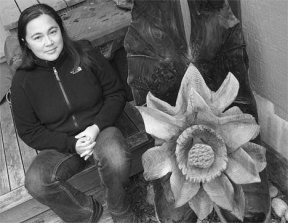
After more than a decade of working with wood, Jessie Groeschen just can’t smell it anymore.
“I love it, but I barely notice it,” she said.
Groeschen, 37, can often be found with chainsaw in hand amid a cloud of flying sawdust. She is one of a growing number of woodcarvers who find their dominant tool to be that of the chainsaw.
Walk into their studio and expect the unexpected.
Chainsaw carvers are simply different. All carvers are, Groeschen said.
“You can usually tell how a person carves by their studio,” she said.
“Chainsaw carvers are typically too busy creating to worry about any mess.”
After finding a love of working with wood in the early 1990s, Groeschen also found a desire to write about her fellow artists, their lives, their wood-chip filled studios and the art they create.
She recently published “Art of Chainsaw Carving: An Insider’s Look at 18 Artists Working Against the Grain,” through Fox Chapel Publishing.
During her time as a chainsaw wood-carving artist, Groeschen has completed more than 1,000 pieces, and her career is still in its infancy when compared to some of the artists featured in her book.
They include “Wild Mountain Man” Ray Murphy of Hancock, Maine, who’s been working with a chainsaw since 1953 and is known for his innovative techniques, daring feats and stunning detail.
Sculptor Susan Miller of Mist, Ore., has been carving since the 1960s and is known for her carousel horses, as well as large display pieces for buildings.
“She has such as delicate style in her work,” Groeschen said.
In addition to touring the artists’ homes and studios, Groeschen took her research to some of the top chainsaw carving contests in the nation.
“She made the art more accessible to a broader audience,” said Clinton resident Pat McVay, who along with his brother Mike and sister Judy McVay are featured in the book.
“Jessie traveled the hundreds of miles needed to find these artists and the unique studios they have far away from things,” he said.
These travels brought Groeschen, and her readers, to things such as the wooden woodland village created by Steve Blanchard in Salinas, Calif.
“She knows the artists, their work and their personalities and she shared that,” McVay said. “She did what I think was so important to do: She showed people that chainsaw carvers are all different, all individuals, and not the stereotypical big guy standing on the corner selling bears.”
“Some of us do make bears, don’t get me wrong. But there’s more to it than what’s perceived,” McVay added.
Groeschen first noted an interest in woodcarving in 1990.
She attended Western Washington University, where a friend convinced her to take a furniture-making class.
“Almost immediately I knew that working with wood was what I wanted to do with my life,” Groeschen said.
After college she returned to home on Whidbey. By chance she met Pat McVay — a noted woodcarver.
She visited McVay’s studio and fell in love with the atmosphere: the smell of fresh cedar wafting in the air, all the tools lying about.
She asked if he needed any help.
“The first thing he had me do was pick up pine cones from around his yard,” Groeschen said. “At first I was thinking, ‘What does this have to do with woodcarving?’ But then it all made sense.”
It wasn’t until 1993 that she actually picked up a saw and did her first carving. It was a goddess about a foot tall.
“It may have been small, but it was big in other ways,” Groeschen said.
After that she spent the next six years immersed in working with wood, studying wood and writing about wood.
“I like to get lost in the wood and see what emerges,” Groeschen said.
She ended up living in Freemont, but would travel to Whidbey on the weekends to work at a woodcarvers’ workspace in Clinton.
During that time she joined the Cascade Chainsaw Sculptors Guild and started the guild’s newsletter, “The Cutting Edge.”
But after that six years, she decided to take a break and move beyond wood. She traveled to American and European museums to study the classic art masters: Van Gogh, Rodin, El Greco and Michelangelo.
After studying artists long gone, Groeschen decided she needed to study the contemporary artists of today. She sought out chainsaw artists and wrote their stories for “The Cutting Edge.” That’s how the book came about.
“I knew I wanted to put this book together as a homage to the wonderful people who dedicated their lives to creating chainsaw wood sculpture,” Groeschen said.
While wood is her love, Groeschen doesn’t limit her art to the grain. She is also an accomplished painter and does art work in other media. She’s even worked as a painter and green’s person on movies such as “Practical Magic,” “10 Things I Hate About You” and the “Leonard Cohen Afterworld.”
And it sounds like Groeschen will have more books to come. She submitted 250 pages of work, and editors whittled it down to 160. She has stories left over and is still collecting more.
Days before boxes of the first print of her book arrived at her Langley doorstep, Groeschen returned from a carving contest in England.
“It was great, there were carvers there from all over the world and there we were with chainsaws creating this wonderful art, practically in the queen’s backyard,” she said.