Dia de los Muertos honors dead, celebrates life
Published 4:09 pm Friday, October 24, 2014
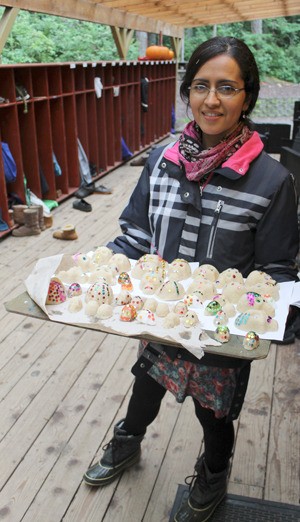
When children in the United States were affixing their monster masks and donning fantastical costumes in preparation for Halloween trick-or-treating, Illiana Lopez Salado, growing up as a child in Mexico City, was preparing for a much different kind of holiday—one in which the streets would be filled with orange marigolds and ornately painted calacas (skeletons), in which families would create ofrendas (offerings) containing each of the elements—wind, water, earth and fire—to welcome the visiting souls of deceased loved ones.
In Mexico—as well as in many parts of the United States—the days from Nov. 1-2 are spent celebrating life and honoring the deceased during Dia de los Muertos, or Day of the Dead, a holiday which has developed through a pairing of Catholic and ancient Aztec traditions.
Dia de los Muertos officially takes place beginning Nov. 1 and ends Nov. 2, although some festivities may begin Oct. 31. Nov. 1 is also known as el Dia de los innnocentes, or the Day of the Children.
Although no two cities observe the holiday in the same manner, with some being more somber than others, altars and ofrenda can be found throughout the homes of its observers from Oaxaca to Clinton. Ofrendas are both a personal and deeply spiritual method of honoring loved ones on a day which, it is believed by some, the dead are permitted to visit earth.
Lopez Salado explained that, having relocated to the United States as an adult, she and her family still maintain a traditional ofrenda each year in memory of her husband’s father. She also instructs children of the Whidbey Island Waldorf School in the Mexican tradition, helping them to create their own altar at the school.

In the midst of preparations this week, Waldorf students are crafting sugar skulls, clay dogs and paper flowers, and baking pan de muerto (bread of the dead) in preparation for the installation of the grand school altar.
Lopez Salado, who teaches Spanish at the school, beams with pride as she walks through each of the classrooms, displaying the children’s projects.
Third-grade students are creating small dogs made of clay. Salado explained that the K-9s, usually of the Xoloitzcuintle breed, are made to accompany the souls of the dead to the underworld. Second-graders are creating marigolds of paper, which according to Salado, attract the souls because of their bright orange and yellow color and sweet fragrance. Others are creating mats made of seeds, depicting pictures such as owls, flowers, dogs and crosses, while some are creating skeletons.
“They symbolize the dead, but in a fun way,” said Lopez Salado of the skeletons, a prominent part of Dia de los Muertos festivities and altars.
Each of the students contributes a portrait of a family member, friend or pet who has passed to set upon the altar. Stories are shared and pan de muerto, made by the first-grade class, is shared with the student body and faculty in a school gathering.
“They can appreciate another way of experiencing a different culture with love,” said Lopez Salado of the students’ lesson.
At South Whidbey High School, Jennifer Gochanour, Spanish teacher, is also instructing her students about the holiday, its history and traditional methods of observation.
“I think it is a beautiful, fascinating tradition both in its meaning and in the handicrafts and artwork that represent los muertos,” wrote Gochanour in an email to The Record.
She added that if the students are comfortable sharing something personal, they sometimes create ofrenda for deceased loved ones which includes papel picado, photos and objects that represent someone the student would like to honor. At times students also write letters to the deceased, a practice which is believed by some to be a method of communication between the living and visiting souls of the deceased on the holiday.
“I am careful to respect different religious and cultural opinions, but we explore the observances in other countries and try to personalize it somewhat so that students gain an essential understanding of the meaning behind the observance,” wrote Gochanour.
Langley resident Tom French, owner of Cucino Segreto, said he began observing the holiday several years ago after visiting Mexico during Dia de los Muertos. Today, he and his family set up an altar in remembrance of deceased loved ones, including French’s father. French, a professional chef, also makes traditional Mexican dishes each year as well as cookies or other foodstuffs that the deceased especially enjoyed.
“We focus on the intent, which is to honor relatives and loved ones who are deceased,” said French, explaining that his family’s altar usually includes pictures and offerings of food, cigars and other items which may have been valuable to the deceased person.
“We are not very good in this country, in our culture, about talking about death,” said French, adding that for him, Dia de los Muertos is an opportunity to recognize our own mortality and to take time for “observation and remembrance.”
Having lived in New Orleans for some time, French recalled witnessing the celebration of Dia de los Muertos with colorful, joyous festivities followed the next day by a more somber time of reflection during which residents made their way to the graveyards to paint crypts and clean grave sites.
“It is a good time to reflect on your own life, but also to acknowledge that life and death are somewhat synonymous,” he said.