Island fishing heats up
Published 7:00 am Tuesday, September 3, 2002
In a small patch of water near Deception Pass, easily viewed from the bridge, anglers catch hundreds of salmon each year.
Nestled near the park’s North Beach, the spot is simply known to veteran Whidbey Island fishers as The Hole. Now is the time of year when thousands of salmon, just before heading for home rivers to spawn, take a short rest in the large eddy created by a huge outcropping of rock. This is on the Whidbey side of the pass.
When the current is racing through the pass on outgoing tides, bait fish and salmon often rest and wait for the tide to change, rather than fight the swift currents. This eddy — roughly 300 yards long by 200 yards wide — is a gold mine for anglers trying for salmon from either shore or boat.
The water creates a fertile but challenging fishery for boat anglers. It is best attacked with small, agile boats that can react quickly to the shifting currents and other boats. The object is to hold against the current and keep the boat from getting too close to other vessels in The Hole. All boat anglers fish directly from their poles, which can cause tangles when someone with a fish on the line needs to cut through the crowd.
The majority of anglers use a 4- to 6-ounce trolling sinker, a 3-foot leader to a dodger, then a plug cut herring about 18 inches behind that. Department of Fisheries employee Don Hibner, who counts fish in the area, said this combination accounts for most of the silver salmon caught from boats in The Hole.
Some of the true patriarchs of The Hole, such as Vic Vaccaro and C. “Bergie” Bergman — who have been fishing the place since the early 1950s — simply use a plug-cut herring behind their trolling sinker. Here’s how they do it:
After letting anywhere from 20 to 40 feet of line out, they keep an eye on their rod tips, hoping for the jerking tugs that indicate the fight is on. At the same time, they watch for the other boats and the large wakes caused by the multitude of large pleasure craft traveling through the pass.
The beach anglers, on the other hand, cast and retrieve a variety of lures — mostly Buzz Bombs, a lure that casts easily and gives an angler a variety of actions depending on the retrieve the angler uses. The beach is for those willing to make a hundred casts for one good strike. But they do catch fish.
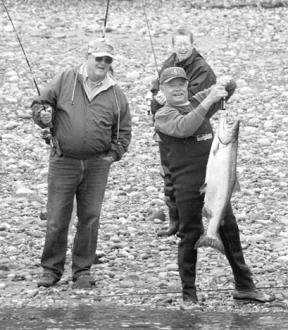
On a recent morning, Keith Wiggy of Snohomish landed a bright, 8-pound coho. West Dye of Anacortes battled for 20 minutes to land a 22-pound king that he weighed quickly before reviving it and releasing it to continue its journey. Alongside them were 15 other anglers lining the shore, men, women and children casting in hopes of catching “the big one.”
According to the old timers on the beach, salmon don’t care who is on the other end of the line. If they see something they want, they grab it.
Some anglers have grown up fishing in The Hole. Kathe Quinn, Bergie Bergman’s daughter, said she’s been fishing at the spot since before she was even interested.
“I was so young when dad started bringing me out that I took naps curled up under the bow of his boat,” she said.
Others remember the time when an angler could fish for kings in The Hole. Tony Reedy remembers those days.
“When I was 13, my mom would drive me to Cornet Bay so I could go out and fish in my friend’s boat for kings in The Hole,” he said.
So far, this year’s run of silver salmon hasn’t really started through the pass. They are coming soon, though, and when they arrive, dozens of anglers in boats and on the beach will be there to try their luck.
Longtime Hole fishermen ask that newcomers remember to bring lots of patience, and to be courteous to their fellow anglers.