The elements of surprise
Published 1:00 pm Saturday, December 23, 2006
When Jane Winslow uses a camera she could be called “the accidental artist.†For it is a spontaneity of spirit that guides her work and allows her to explore looking at life moment to moment as if nothing were beyond the here and now.
As the great dramatist, poet and painter Jean Cocteau said: “Take the commonplace, clean it and polish it, light it so that it produces the same effect of youth and freshness and originality and spontaneity as it did originally, and you have done a poet’s job.â€
Winslow, a Freeland resident, is indeed a poet as well as a documentary filmmaker, photographer, fine artist and a tenured professor at Shoreline Community College. When she is not teaching digital filmmaking – writing, directing, editing, production or any of the many skills that go into the process of digital filmmaking – she is using her still photos to capture time on a canvas.
“What I love is people – what makes them thrive as human beings,†said Winslow. “There are no set-ups in my work. It’s random – grabbing the moment when you’re in it.â€
Winslow is an artist who is able to divine the realm of the sacred out of the everyday.
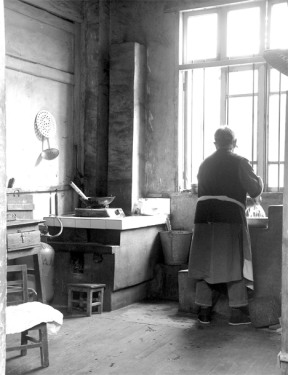
Whether it is digitally capturing the sanctity of a moment in a Tibetan monastery or simply catching a certain light falling through the window of a working class woman’s kitchen on a particular morning, she does as Cocteau says, “a poet’s job.â€
For Winslow both scenes capture the same feeling, one that plucks at the senses and the heart. In her work, life is in the details. It’s all mundane; even Tibetan monks have chores to do. But to Winslow, even the mundane can be glorious and from moment to moment there is god in between life’s crevices.
During a visit to the northern provinces of China where she took many moving and still digital pictures, Winslow started printing the photographs onto canvas or satin fabric. She said she was inspired by the Tibetan style “thangkas†(pronounced tonka) – a painting on cloth which is stored scroll-fashion for traveling or used as a wall-hanging.
Thangkas were traditionally intended to serve as a record and guide for contemplative experience. For example, they might be used to imagine oneself as a specific figure in a specific setting. One could use a thangka as a reference for the details of posture, attitude, color or clothing. Or perhaps to connote the place a figure may hold in society by whether he is located in a field, or in a palace.
In this way, thangkas are intended to convey iconographic information in a pictorial manner; a descriptive scene written with pictures rather than words.
Winslow has used the ancient art form of the thangka and tweaked it into a way of creating spontaneous renderings of everyday life on canvas or satin. The photos she uses are, by her own definition, not exceptional moments. They become exceptional only by way of having captured one moment in time that is like no other.
In this way, Winslow tries to find the spiritual within the mundane.
Walking through the streets of China, Winslow photographed a man in a gray uniform, standing in front of a bright “Chinese red†wall reading a letter.
The photograph is wonderful she said because it so unlikely and the subject is unaware of the camera. The moment for him is intimate and small; the personal world of the letter. But for the viewer it is a gray uniform against red, in larger-than-life China, a figure doing nothing much while the viewer sees all the history of China and its culture illustrated in one simple shot. It tells a story accidentally.
“To me, the most memorable moments are a complete surprise,†said Winslow.
In her poem “At the Smiling Dog Cafe,†Winslow again pursues the moment:
There is no more to life
than this day to day:
morning coffeehouse writes,
baby girl in a frog suit,
discussions of births and deaths,
the start or end of creations.
It is fitting to her modus operandi that Winslow should write of a local, beloved cafe experience. To her, the grand jaunts she took through China, the territories along the Black Sea, through great cities like Istanbul and then again, filming a peace pilgrimage in Nepal; all these travels taking her to some of the most ancient and culturally deep places on earth, were full of moments equal to that moment of a baby dressed like a frog at the Smiling Dog Cafe.
No matter where I am, Winslow said, the details of the moment are what counts in my art.
Not only does Winslow’s work capture the pleasure in any given moment but as a documentary filmmaker her ability to simplify an image lends itself to the clarity needed to translate the details of a personal story.
Winslow, along with co-producer/director Sharon Shoemaker, have done a noble service in their short film, “A Tie to the Earth.â€
This recent documentary features gay and lesbian youth who are given the chance by the filmmakers to speak out against the prejudice that has plagued them. With a supporting cast of their mothers, fathers and older well-known people who have had the same experiences, these young people are allowed to finally say out loud what they could never say to their oppressors.
The filmmakers have given a special opportunity to these people that not all gay people have; a moment to voice all the things they were never allowed to say before.
It is a powerful gift and one that suits Winslow, a woman working behind the lens of all her cameras to create moments that honor clarity of the present, like those in the film and the beauty of everyday life in her photos.
Jane Winslow’s work will be on display during the Ballard Art Walk opening Jan. 13 at the Senor Moose Cafe, 5242 Leary Ave. NW, Seattle. You can also call 331-5056 for a private showing.