Gas prices spike on South Whidbey
Published 1:30 am Tuesday, March 24, 2026
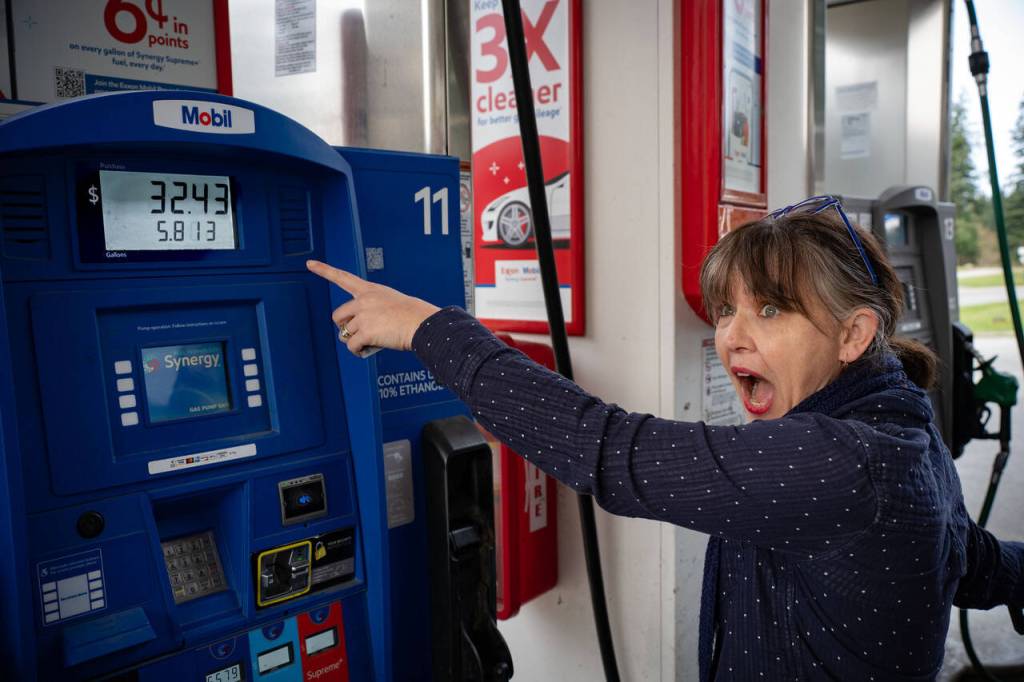
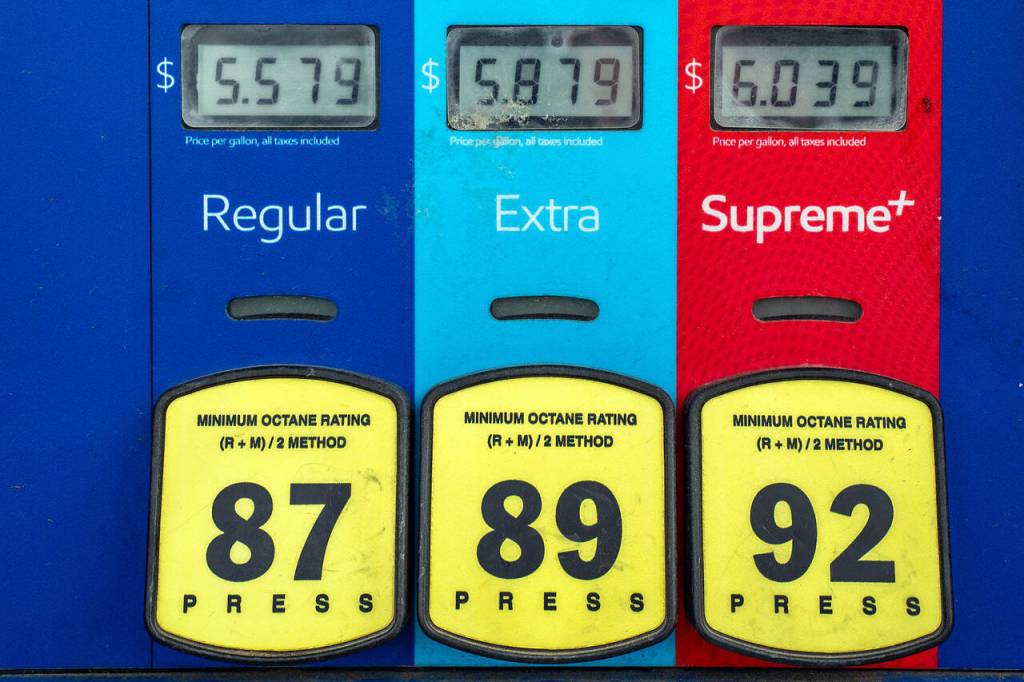
Gas prices on South Whidbey are among the highest in the nation this week.
The average price for gas at stations on South Whidbey hovered around $5.57 a gallon of regular unleaded Monday, according to GasBuddy, a national technology company that helps consumers find the best prices. A gallon of regular, no-ethanol gas was $6.12 a gallon at the Clinton Mobil station while diesel was $6.68 a gallon.
Gas prices in the nation and across the world spiked dramatically after President Donald Trump started bombing Iran. The average price in the U.S. increased by nearly $1 a gallon, or 30%, since the start of the war.
Gas prices in Washington are the second highest in the nation, just below the cost in Hawaii. The state’s fuel prices are normally in the top five in the nation because of the state gas tax, the impact of the Climate Commitment Act and state surcharges, according to the state.
Malia Keene visited South Whidbey on Monday and was surprised that gas prices were significantly higher than where she lives in Seattle.
Rep. Dave Paul, D-Oak Harbor, said South Whidbey consistently has the highest gas prices in Legislative District 10.
“We always fill our tanks in Oak Harbor,” he said.
Indeed, the gas-price picture is very different on the North End. On Monday, only two of the eight Oak Harbor gas stations reported on GasBuddy were above $5, while the state average is $5.26. The lowest cost in the state is $3.39.
The increase in costs will affect the bottom line for entities like Island Transit. Selene Muldowney-Stratton, marketing and public affairs officer, wrote in an email that “a March-to-March comparison from 2025 to 2026 shows diesel rising from $3.04 to $4.19 (38%) per gallon and unleaded from $2.85 to $3.13 (10%) per gallon.”
“Despite these increases, Island Transit remains focused on maintaining reliable service for our community,” she wrote.
Paul said State Ferries has a fuel hedging program, so the effect of the price jumps won’t be immediate.
Patrick De Haan, the head of petroleum analysis for GasBuddy, noted that prices on South Whidbey are “close to the top 10% most expensive” in the nation.
“There are stations in California that are at $6, $7, $8, even $9 a gallon,” he said, adding that competition — or lack of it — drives the prices. A station in a touristy spot in Beverly Hills is selling gas at $8.71.
De Haan said the 10% most expensive gas stations in the nation average $5.69 a gallon.
“They are on the higher end of the spectrum,” he said.
De Haan said he didn’t know if there were any unique factors that would result in gas prices on South Whidbey being so much higher than Oak Harbor’s, but he guessed it was likely just competition. Gas station owners all have the same underlying costs, but they are free to set their own prices without regulation. The company lists nine gas stations in Oak Harbor and six in all of South Whidbey.
Phil Collier, owner of Hilltop Texaco in Oak Harbor, said he works hard to get the best deal on gas so that he can try to keep his prices below his competitors. He said his station and the AM/PM often have the lowest prices in town.
Collier said a lot of people don’t realize all of the state taxes and fees that result in higher prices. He is critical of the state exempting stations on Tribal lands from paying the state tax, which allows them to undercut the market and sell gas without supporting the transportation projects funded by the gas tax.
According to the Office of Program Research, the state gas tax is currently 55.4 cents a gallon while the federal tax is 18.4 cents. While evaluating the effect of the state Climate Commitment Act on fuel prices is complex and indirect, West Coast states’ fuel prices had increased by 35 to 52 cents per gallon after the implementation of the auctions, as of mid-April 2023, according to an email sent to Rep. Paul by a staffer on the House Transportation Committee’s Office of Program Research.
In addition, Collier said he has to pay fees on each load of gas, which is 110,400 gallons. The total of inspection fees, environment fees, spill fees, Superfund fees and leaking tank fees amounts to more than $6,300.
State Sen. Ron Muzzall said the price increases come at the worst possible time for farmers since planting season is on the horizon, which is the most fuel-intensive time of year.
In addition, he said he’s most concerned about people whose wages put them in the bottom third of income.
“They have no discretionary spending,” he said. “When you increase these costs for them, they have to cut things, important things.”
Muzzall is critical of the state’s tax and fee structure which makes fuel so expensive as compared to other states. Proceeds from the gas tax, he said, aren’t even enough to keep up with transportation costs because they have plateaued due to the increase in electric and hybrid vehicles. The lack of funding has led to delayed maintenance of bridges, which is now coming due.
He’s also critical of the Climate Commitment Act because he feels that the money is funding initiatives which don’t have any real effect on decreasing greenhouse gases or improving transportation infrastructure.
Likewise, Paul said he hopes the state funnels the Climate Commitment Act funds into road preservation and other proven needs.
While some have pointed out that a price hike may decrease consumption, Whidbey Environmental Action Network sees no silver lining.
“When gas prices spike because of armed conflict — particularly a war of aggression, prosecuted at tremendous cost to people and ecosystems, by the world’s single largest institutional greenhouse gas emitter (the U.S. Department of Defense) — that’s not an environmental win,” Executive Director Marnie Jackson said in an email. “It’s a symptom of a much larger humanitarian and ecological challenge.”
She added that the “consume less” narrative glosses over hard questions about who is most impacted.
“Our path to reducing fossil fuel consumption must include environmentally just, resilient, accessible and community-centered alternative infrastructure,” she wrote. “A conflict-driven price spike cannot be celebrated.”
And while the price spike is undeniably hard on car drivers, De Haan said the even bigger concern is the price of diesel because nearly all food and goods travel by diesel-powered trucks.
“The next time you go to the grocery store, you might see inflation heating up again because the price of diesel is so high,” he said.