Park ordinance appeal to be heard in Oak Harbor
Published 1:30 am Tuesday, April 7, 2026
The state Court of Appeals is coming to Oak Harbor.
On April 21, a three-judge panel of judges will be at the Whidbey Island campus of Skagit Valley College to hear oral arguments in three cases, including Whidbey Environmental Action Network’s lawsuit against the city of Oak Harbor over a parkland-related ordinance.
Whidbey Environmental Action Network, commonly known as WEAN, is inviting the public to attend the hearing at 9:30 a.m.
WEAN is appealing Island County Superior Court Judge Carolyn Cliff’s decision to grant the city’s motion for summary judgment that dismissed the nonprofit’s challenge to the adoption of Ordinance 1999.
In 2024, the Oak Harbor City Council adopted the ordinance, which amended a 1997 city code that was passed to protect city parkland from development. The original code required a vote of the people for the city to sell, swap or otherwise dispose of city parkland. The ordinance, adopted in a 6-1 vote, loosened the restrictions by allowing city council to approve swaps of land without a public vote; the ordinance has requirements aimed at ensuring the city gets a good deal.
Only Councilmember Bryan Stucky voted against the ordinance, which he said was because of the widespread public opposition.
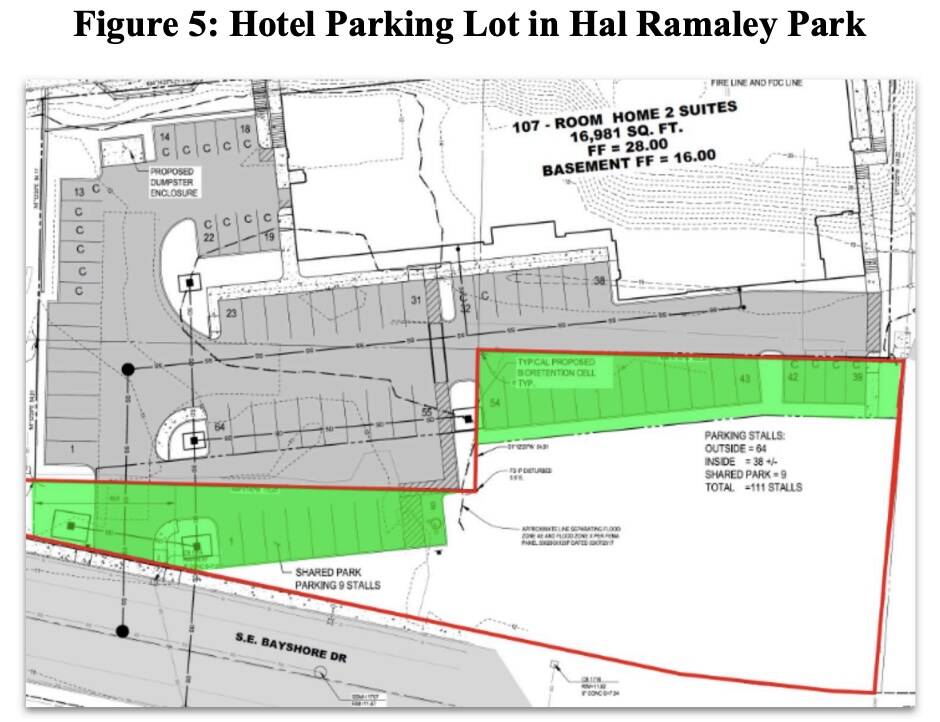
The ordinance cleared the way for the swap of 2,600 square feet of Hal Ramaley Memorial Park on Bayshore Drive to a developer to build a much-anticipated Hilton hotel with conference rooms. The project has been on hold, however, as the lawsuit makes its way through the appeals process.
The central question in the appeal is whether the city was required to do an environmental review under the State Environmental Policy Act before adopting the ordinance. WEAN argues that adoption of the ordinance constitutes a substantial nonproject action and, therefore, subject to SEPA.
“In all, Ordinance 1999 does not merely tinker with the city’s procedure for conveying public parks,” WEAN’s reply brief states. “Instead, it replaces the substantive authority that was given to the citizens of Oak Harbor in Ordinance 1110 with new work-around exceptions that allow private developers to bypass the citizen approval requirement by complying with new, substantive standards for the conveyance of city parks. The city’s representation of the public voting requirement as purely procedural is false.”
The city, on the other hand, argues in its brief that a SEPA review was not required because Ordinance 1999 is not a regulation that controls the use or modification of the environment. Only project and nonproject “actions” of the city are subject to SEPA review, the brief states. The ordinance pertains to the sale or exchange of land, not the use or modification of the land, the city argues.
“The insurmountable hurdle for WEAN is that the sale of property and the physical modification of property are not the same,” the city’s brief states. “The sale of property, no matter who buys it, has no effect whatsoever on the environment. WEAN relies on a slippery slope-type argument – arguing that a sale of property could lead to development. But transferring property does not necessarily lead to building on property. The city could transfer park property to a nonprofit organization for preservation or maintenance, for example.”
The Court of Appeals panel visiting Whidbey Island will be made up of Judge Cecily Hazelrigg, Judge Linda Coburn and Judge Bill Bowman.
In addition to the WEAN v. Oak Harbor, the judges will hear arguments in two cases out of Snohomish County Superior Court. During arguments, each side will get 10 minutes to make their case.