By LUISA LOI
Special to the News-Times
After a fire burned five acres of hayfield at a Freeland property on July 17, a local group of pigeon guillemot enthusiasts worried about the fate of the chicks nestled underneath the scorched bluff top.
In the weeks since, surveyor Mark Hickey has not witnessed any adult guillemots deliver food to the burrows that, up until the fire, were active and were believed to house two eggs. By the end of his team’s tenth survey of the year at the private beach north of Double Bluff Aug. 8, he didn’t record a single prey delivery.
Fellow surveyor Michele Sakaguchi worried the birds were unable to tend to their young due to the smoke and the flames and that the chicks were harmed from the heat penetrating into the burrows.
With only an hour of birdwatching per week and no way of climbing the bluff to check the burrows up close, the community science volunteers could only hope the little guillemots had somehow survived.
The weekly Pigeon Guillemot Breeding Surveys offer volunteers an opportunity to quietly immerse themselves in Whidbey’s nature and, as Sakaguchi said, to feel wonder and curiosity, getting in touch with their own “humanness.”
But most importantly, the surveys help understand the guillemots’ population dynamics, what role they play in maintaining a healthy coastal ecosystem, and the importance of protecting the bluffs, according to the Whidbey Audubon Society.
Frances Wood and Phyllis Kind began surveying Whidbey’s coast in 2004. In later years, with the support of Whidbey Audubon, the project expanded across the Salish Sea. Now, the Salish Sea Guillemot Network comprises eight regions surveyed by local independent groups.
The protagonists in this story, the guillemots, are slender seabirds with a black-and-white coat and bright red mouth and feet. According to Whidbey Audubon, they are the only seabirds that regularly nest on Whidbey.
Govinda Holtby, an ornithologist and volunteer with approximately 1,500 hours of pigeon guillemot surveying behind her, said guillemots are susceptible to changes in the water column as they dive to the bottom to get food, where heavy metals deposit, for example.
Because of this vulnerability, changes in guillemot populations can give researchers valuable insight into the health of bottom feeders, nearshore marine habitats and the overall Salish Sea, which makes them an indicator species.
“We know that if their numbers go down, we’ve got a real problem out there,” she said.
Whidbey has an abundance of guillemots, Holtby said, perhaps due to the sand bluffs where kingfishers dig burrows that they conveniently abandon every year, leaving the guillemots with a second-hand home where they can lay their eggs, typically two.
Over the years, however, the guillemot housing supply has been tightening. According to Sakaguchi, this is due to erosion.
Bluffs can erode due to natural reasons, such as landslides and waves. Human-made conditions may also accelerate the process, especially as more waterfront properties get developed.
Because waves need to reach the bluff to erode it, beaches can work as a buffer and absorb or minimize the impact of the waves. In exchange, the bluffs supply the beaches with sediment material. The construction of artificial barriers, however, impedes this transfer, leading to the beach getting too narrow and weak to provide protection, according to a guide on the Washington Department of Ecology’s website.
Guillemot chick burrows might be located in shallow locations relative to the top surface of the bluff, meaning they may be easily disturbed or even crushed by foot traffic, according to the guide. Because of this, homeowners are recommended to leave a buffer strip of native vegetation along the edge of the bluff.
When talking about Whidbey’s abundance of guillemots, Holtby also hypothesized the population may appear larger simply because the colonies are easy to see as they are located in areas that are easier to access, or because other locations have more bedrock where the guillemots are more hidden from sight.
Another possibility that is being explored, she said, is that the population builds up on Whidbey and then disperses to other areas in the region.
While questions remain, the surveys help inform future studies and conservation efforts, assessing a baseline against which future changes in data can be measured, according to the Salish Sea Guillemot Network.
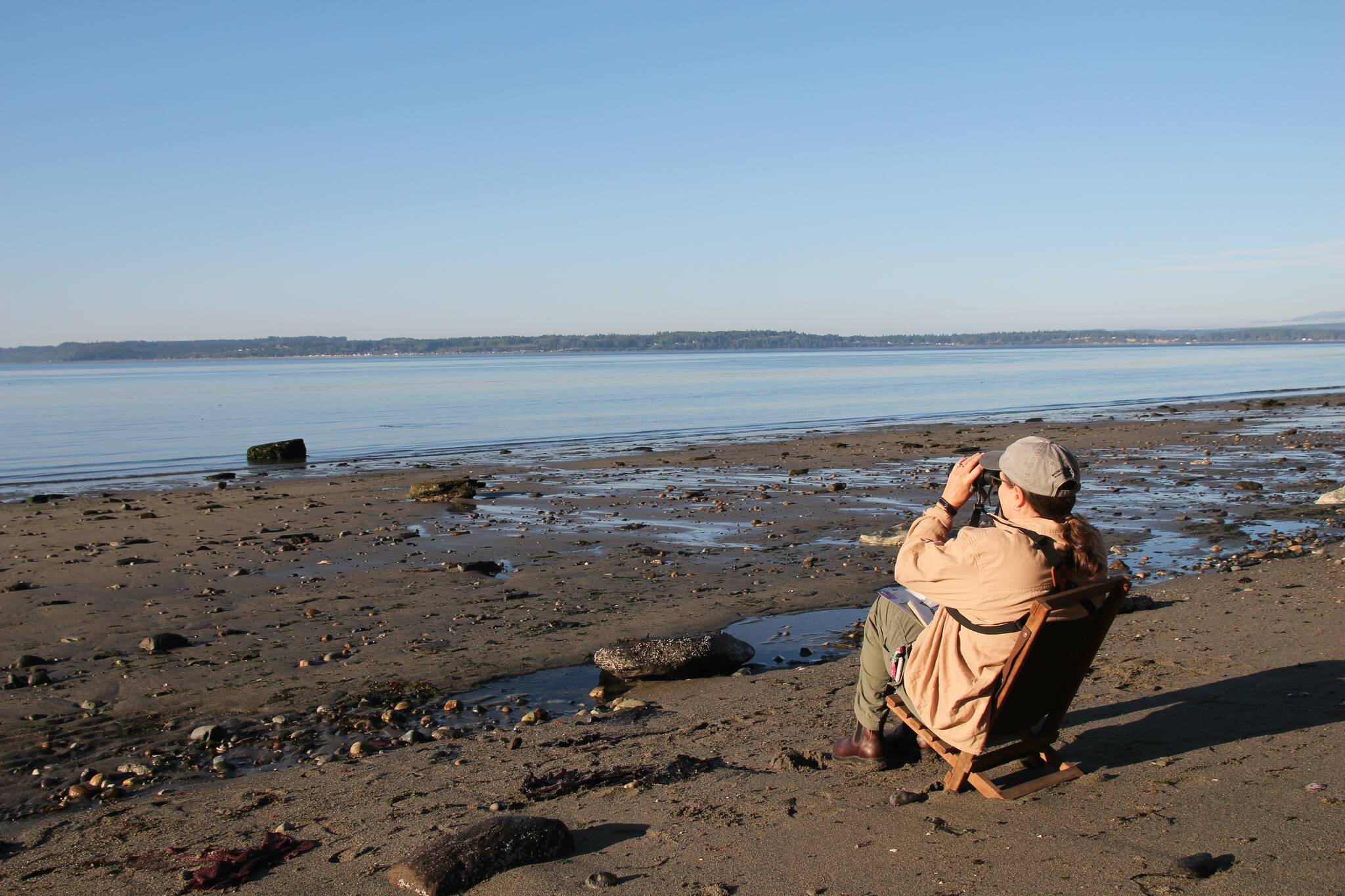
Every week during the breeding season, which takes place between June and late August, tens of volunteers visit numerous colonies located along Whidbey’s shores, bringing chairs, binoculars, pens and data sheets where they record their observations.
The data is then used by the University of Washington, the Puget Sound Ecosystem Monitoring Program and the Washington Department of Fish and Wildlife marine bird database, according to Whidbey Audubon.
For an hour, typically from 7:30 to 8:30 in the morning, the volunteers sit quietly, moving as little as possible and dressing in neutral tones to avoid distracting or scaring the guillemots away.
“We always want to dress and look like a piece of driftwood,” Holtby said.
Some colonies, such as the one they were surveying that day, can be a little skittish, as they are less used to humans on the private beach. In other locations, the birds may be more accustomed to beachwalkers and residents, she said.
Friday, Holtby sat at her 330-foot section of the beach, facing the water as she kept count of the guillemots she saw and their prey deliveries, as well as identifying any prey and disturbances (such as boats, predators and beach walkers).
At the beginning of her observation period, she counted around 13 guillemots in the water. As a couple of kayakers rowed by, some guillemots flew away. Eventually, only one remained within her area, holding a sculpin — a flat-headed spiny fish — in its thin beak. Sculpins and gunnels are the primary prey delivered to the nests.
Holtby observed the lone guillemot float on the water for a long time. Even as the volunteers walked away at the end of the survey, the sculpin remained in its beak, unmoving.
While adult guillemots can eat prey underwater, they must fly to deliver food to their chicks. Since food deliveries can make adults vulnerable to predators like eagles, they often take some time to assess their surroundings before taking off from the water.
Guillemots are particularly cautious during low tides due to anatomical challenges, Holtby said. In fact, their feet are so far back in their bodies that they walk like penguins but swim like prodigies. During a low tide, there is less water between them and the burrow to dive into in case of a threat.
For extra safety, adults are often escorted by one or two guillemots, circling around to gain altitude and flying into the holes on the wall as the escorts dip out at the last minute, she said.
Last Friday was uneventful, with none of the five volunteers witnessing any deliveries to the burrows.
Many baby guillemots have likely fledged by now, Holtby said. After spending about a month in the nest, the chicks tumble down the bluff and into the sea, where they will feed and develop feathers that will allow them to fly.
While chicks typically fledge at night, when surveyors aren’t around, Holtby can claim to be one of few people to have witnessed a chick leave its nest, an event that brought tears to her eyes as she filmed it.
Some moments can be sad too, particularly when volunteers stumble upon dead chicks, either perished from starvation or tumbling the “wrong way” as they try to reach the water, she said.
The volunteers also recalled various amusing or entertaining moments from previous expeditions that highlighted the guillemots’ quirks, including their high-pitched chatter and displays, their occasional curiosity for rocks, their habit of latching onto their fellow’s beaks while engaging in territorial disputes, and their speedy, unromantic “cloacal kisses.”
To Sakaguchi, the guillemots are awkward in a way that she likened to middle schoolers.
Perhaps their cuteness is part of why the surveys have been going on for so long, Holtby said. And as retired or long-time volunteers age out or leave, she would like to see younger generations taking an interest and joining their effort.
To get involved, make a donation or keep up with weekly updates from the Salish Sea Guillemot Network, visit pigeonguillemot.org.