Downzoning motion approved in contentious vote
Published 1:30 am Friday, December 5, 2025
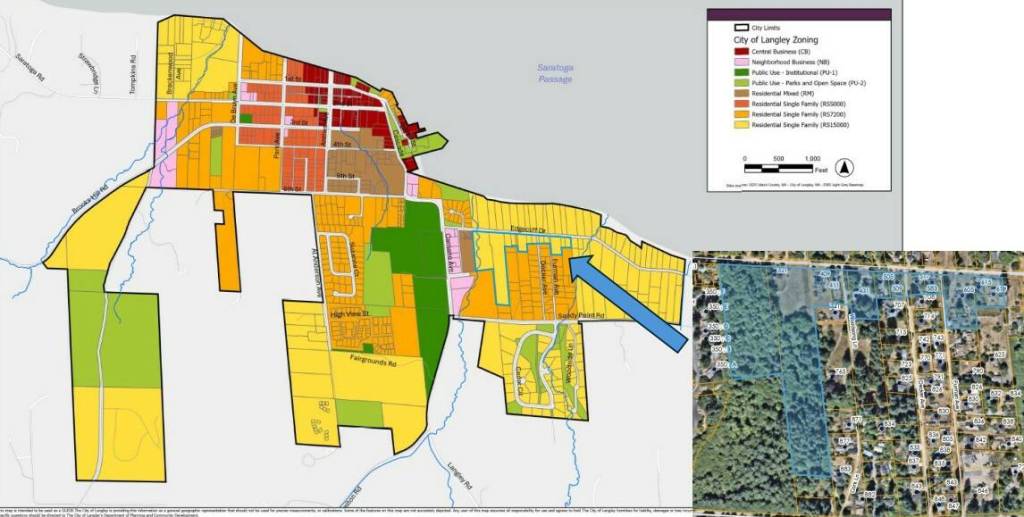

In a somewhat surprising decision, the Langley City Council went against a staff recommendation by voting 3-2 to change the zoning for a group of properties located on the south side of Edgecliff Drive.
However, the ordinance is not fully authorized until its second reading at the Dec. 15 meeting, so it’s possible council members could propose changes.
During a meeting this week, the council revisited the topic of “downzoning” the parcels from RS7200 to RS15000, as part of the city’s comprehensive plan update. The current zoning allows single-family residential use with a 7,200-square-foot-minimum lot size and free use of the city’s multi-family infill code. The proposed change would limit development to single-family homes with a 15,000-square-foot lot size, which does not allow for multi-family infill development.
Councilmember Rhonda Salerno has reasoned that this action would protect the nearby bluff from further landslide activity, a big concern for residents and neighbors. Councilmember Gail Fleming lives on one of the affected parcels but did not recuse herself from the vote because she said the change would not impact her property either positively or negatively due to its small size.
Meredith Penny, the city’s planning director, told the council that staff analyzed three development scenarios – one with RS7200 zoning, another with RS7200 and multifamily infill and a third with RS15000. Among the key findings was no difference in potential clearing of trees between RS7200 and RS15000.
With use of the city’s multifamily infill code, this could potentially result in more units of affordable housing, such as townhouses and apartments rather than just single-family homes, though Fleming argued changing the zoning would still allow for cottages, ADUs and tiny homes, and that multi-family housing does not always equal affordable.
Penny recommended retaining the RS7200 zoning designation in order to minimize impervious surface entry and tree clearing and to maximize affordability.
Councilmember Chris Carlson reiterated that he questioned the conclusions that were drawn from the science of the hydrology in that neighborhood presented by Salerno at a previous meeting, as well as the best public policy strategy for the council to achieve its shared goals of bluff protection and creating affordable housing.
“We’re talking about tightly grouped multi-family structures versus large homes that are spaced out, requiring more space to be cleared and more driveways,” he said.
Highlighting the need to create affordable housing, he urged the council not to discount the importance of a net difference of 70 potential dwelling units in this area. In addition, he advocated for exploring other measures to capture and safely transport water runoff from the site.
Salerno said she was recently contacted by someone attending a shoreline management workshop in Vancouver, Washington and was told that the city of Langley was cited as an example in one of the lectures led by a geologist. He showed photos of bluff failure in another part of the city, which demonstrated the difference in zoning for developments over a bluff. She showed the council photos of the Edgecliff bluff, one taken in 1977 and the other about 10 years ago, to indicate how many fewer trees were there over time as more development happened.
“I want you to know that I’ve been called by my fellow council people, that I’m passionate, that I’m emotional, and that I care a lot about what I say,” Salerno said, “but you know, I also present logic, and I think it’s really up to you to be logical.”
Several members of the public, including a soon-to-be-new member of the city council, spoke on both sides of the issue. Thomas Gill claimed the rezoning would represent an illegal “taking,” but Penny said she did not see it that way in this situation, and also that the city attorney had reviewed the ordinance.
Marty Kortebein, who lives halfway down Edgecliff Drive, said during the meeting Monday night that there is standing water about six inches deep presently that lies in front of three properties.
“Those of us who live on Edgecliff are well aware of the vagaries of this ecosystem, the water flowing from the wetlands, the importance of the trees that help disperse the water before it reaches the bluff and the stability of the bluff, and we are asking you to help us protect this bluff system by voting to rezone to 15,000,” she said.
When it came time for the final vote, both Salerno and Fleming voted in favor of rezoning and were joined by Councilmember Harolynne Bobis, who hadn’t said a single word during the discussion. Mayor Kennedy Horstman asked Bobis if she was sure of her vote.
“I’m not going to be here to see the effects of my vote,” Bobis responded, seemingly indifferent.
Salerno cheered and told Bobis “good job.” Immediately, Bobis said she wanted to take back her vote, and her fellow council members expressed sounds of disbelief.
The council went back and forth about the proper protocol to reconsider the vote. Finally, Bobis was asked if she wanted to reconsider, but she declined, saying she was “tired of all of this at this point.”
Carlson and Councilmember Craig Cyr voted in opposition of the rezoning. Cyr had previously been on the fence about the decision. Later, he said he supported keeping the zoning as RS7200 because that option reduces tree clearing by 50%.
Kennedy said in an email to The Record that council members may propose changes to the ordinance at the next meeting, including rezoning. It’s also possible that with three incoming members of the council in the new year, the issue could be revisited once again. The terms for Salerno, Fleming and Bobis are all coming to an end Dec. 31.