Dances connect people through music and movement
Published 7:44 am Friday, July 15, 2011
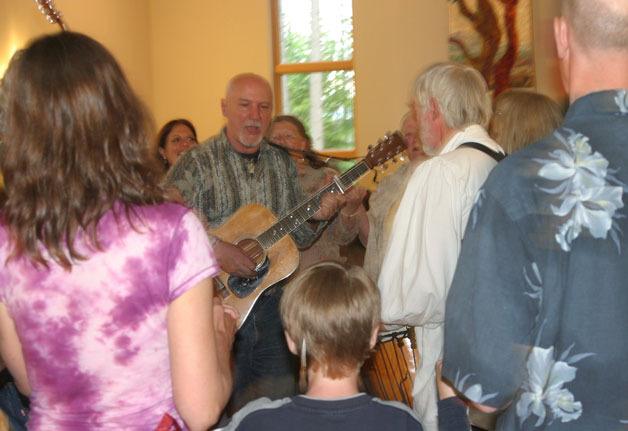
FREELAND — Stepping into the foyer of the serenely beautiful church in the woods, the energy of those gathered there was welcoming and light.
Everyone removed their shoes before entering the main hall at the Unitarian Universalist Congregation meeting hall with its cathedral ceiling, inviting wood floor and the surround of large windows that serve to let in the sunlight and the calming effect of the encompassing trees. A collection of musical instruments, along with a lit candle and incense, lay on a blanket in the center of the room.
About 35 people gathered for the Dances of Universal Peace as they do on the last Sunday of every month at the meeting hall.
“The Dances of Universal Peace are a joyous, multi-cultural way to touch the spiritual essence within ourselves and others,” said Bob Effertz, one of the dance leaders.
The dances use sacred phrases, chants, music and movements from various spiritual traditions of the world to promote peace and create an integrated experience of body, mind and spirit through those who participate. There are no performers or audience. New arrivals and old hands form a dance circle together and everyone, young and old alike, is welcome. The dances are easy to learn and are taught to the whole group each time, while the musicians remain in the center with the dance leader.
Effertz has been attending the dances for 11 years. He came to it through his interest in Buddhist meditation, which also extended to walks in the woods and singing.
“I really enjoyed the addition of singing,” Effertz recalled. “It helped me come more into my heart space and feel a sense of unity with others.”
A few years later, when he discovered the Dances of Universal Peace, he said he felt awkward at first, but eventually found that the dances helped him feel more connected to other people.
“It was like meditation to me, but with the added benefit of not feeling alone by myself sitting on a cushion. There is still that feeling of oneness and unity that comes with singing and dancing together,” he added.
At the meeting hall, it was time to begin after one of the leaders welcomed everyone and each of the participants introduced themselves to the circle.
The musicians took up the guitar, drums, bells, flute and bodrhan. The leaders took turns teaching the chants and movements to the group before each dance. The group began to warm up and the intention of the chanting and movements grew with each dance.
Longtime dance participant and leader Lisa Fladager taught a dance that celebrates the Summer Solstice, which had recently passed.
“This is the energy of Ra, the sun god,” she said.
“Feel the energy pulsing through you. This is the time of year we celebrate the solstice.”
She then began to teach the words that the dancers would repeat while they moved through the dance.
“In the solstice light I take your hand. And the grievances between us are but shadows.”
The group repeated the words and followed her instructions for the movements. Soon everyone was moving together, reaching up in a gesture toward the sun, facing the person next to them with hands pushing down and away signifying the washing away of conflict. Next they joined hands and moved in a circle with that person and turned again to the next in the line to start the chorus and movement over again.
The feeling of repeating the refrain and the movements, and moving around in the circle while the live drums maintained the beat, and the voices followed the melodic sound of the other instruments, created a palpable harmonic energy within the circle and among the group.
This feeling of harmony, of moving and singing together as a whole is the effect the late Murshid Samuel Lewis intended when he founded the Dances of Universal Peace in the late 1960s.
Lewis was a Jewish-American born in San Francisco and later became recognized around the world as a mystic, Sufi master, Zen teacher, peace activist, horticulturist and scientist. His main tenet recognized that real religion must be practical and express the deep unity that is found behind all traditions. The Dances of Universal Peace combine body-based reality with mystical peace practices. Lewis once said, “Words are not peace. Thoughts are not peace. Plans are not peace. Peace is fundamental … it is fundamental to all faiths, all religions, all spirituality. Only by including everyone do we arrive at peace, the absence of conflict.”
Lewis intended for the Dances of Universal Peace to communicate the universality of mystical experience behind all religious traditions and the importance of bringing to the world “peace through the arts.”
Some of the earliest gatherings of the Whidbey Island dances began around 1998 when Gaea Van Breda began introducing them to her friends and neighbors.
Van Breda began dancing in 1994 and has participated in dance and Sufi camps throughout the United States, as have some of the other leaders of the Whidbey Island group.
“We make friends from all over the world, and bring a lot of international leaders here,” Van Breda said.
She is one of a team of Whidbey Island facilitators who lead, play instruments and teach the dances and songs at the gatherings. The others include Linda Lindsay, Halim Dunsky, Ron Ward, Michael Sheehan, Effertz and Fladager.
Indeed, since Lewis’ introduction of the Dances of Universal Peace, the practice has become a global endeavor. On the Dances of Universal Peace website there is a schedule of international events which includes not only several North American sites, but those held in Spain, the Czech Republic, New Zealand, the Netherlands, England, Ecuador and Latvia, among others.
The dances are taught today in much the same way as Lewis presented them. No musical or dance experience of any kind is required and everyone is welcome to join. Participation, not presentation, is the focus. No special attire is required, though comfortable clothing is encouraged, and dancers do not need to bring a partner.
At the June gathering, three elementary school-aged children came and easily participated in the dances.
Rahima Rayne was there, as well, flushed pink with dancing, exuding happiness. She began the Dances
19 years ago in her Colorado community, and was pleased to be able to attend while visiting the island.
“I met a woman in Portland (Ore.) who said she had been to the dances on Whidbey Island. I told her that my daughter lives there and was very excited to come.”
Rayne was happy she did.
“It is a wonderful way to end the weekend,” she said.
More information on the local Dances of Universal Peace can be found at www.whidbeydup.com.
The next dance will be from 7 to 9 p.m. Sunday, July 31 at the Unitarian Universalist Congregation of Whidbey Island, 20103 Highway 525, Freeland. Call Linda Lindsay, 331-5471 or email her at llindsay@whidbey.com with questions.