
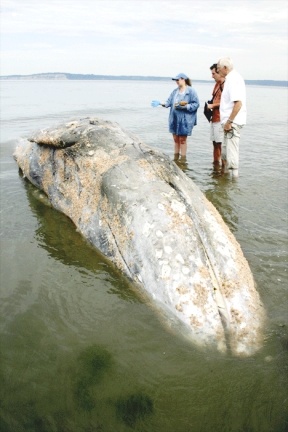
The gray whale that washed ashore Friday morning near Maxwelton Beach may have been attacked by an orca before its death.
It’s too soon to tell, however. Results of the necropsy conducted earlier this week won’t be available for a month or so.
Susan Berta of the Orca Network said the gray whale was a young male, approximately 27 feet long.
“It looks like it may have been attacked by an orca,†Berta said, noting that the bite marks on the animal matched teeth patterns associated with orcas.
The gray whale had rake marks and bites on its flukes, fins and body that were consistent with orca attack marks.
“It definitely has bites in it,†Berta said.
The whale was examined by members of Cascadia Research — who are experts on gray whales — and samples of organs and tissues from the dead whale were taken and sent to a lab in Canada.
“They don’t want to speculate on anything.
We don’t know if that was the cause of death,â€
she added.
The whale was first reported on the shore near Dave Mackie County Park in Maxwelton early Friday morning.
Berta said people in Maxwelton thought they saw a live whale either Wednesday or Thursday, and the Orca Network also received a report of a young gray whale off the south end of Lopez Island on Tuesday, July 18.
Researchers had planned to move the whale on Sunday, but when they returned to the spot where it had last been seen near Indian Point, they discovered the whale was gone, “which gave us all a scare,†Berta said.
The whale had floated north and was later found in the middle of Useless Bay.
It was taken to an undisclosed location on the South Whidbey shore for the necropsy.
On Saturday, the whale attracted a small crowd of onlookers, including visitor Al Kirby, who took a picture of his two sons Colin, 11, and Will, 8, next to the whale as Colin held a fishing pole.
Berta said two to three whales are found on Whidbey beaches every year.
“We tend to get maybe a couple, maybe
between one to three a year in this general area,†she said.
It’s usually younger whales that are found, she added.
“They tend to turn into Puget Sound because they aren’t strong enough for the whole migration. Basically, they come into the Sound to die,†Berta said.
Because the Orca Network is part of the
Central Puget Sound Marine Mamamal Stranding Network, residents are urged to call 1-866-ORCANET if they see dead whales, or porpoises or seals that are in trouble on the beach. The phone number should also be used to report sightings of live whales.
Brian Kelly can be reached at 221-5300 or bkelly@southwhidbeyrecord.com.