
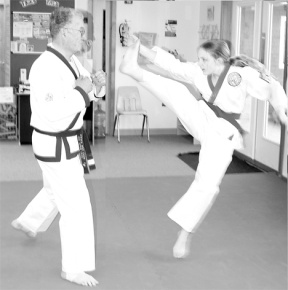
Recently, Kailee Marin’s karate instructor, Bill Blodgett of Freeland, shared a story about one of his star pupils.
“Once on a vacation with her parents in Hawaii, she was told the trip could be extended a few days. She told her dad, ‘No, I’ll miss my karate lessons,’†Blodgett recalled.
That determination has paid off as Kailee, 11, who has been a gold or silver medalist at each level of the sport’s tournaments — especially the Regional Championships — held the past several years in Wenatchee.
There are two elements in the competition: Hyungs (forms) and Dy Ryun (sparring). Competing against boys and girls in forms, Kailee has won three gold and one silver medal.
Competing in four years of sparring she has won two silver medals, one bronze, and in 2006, she brought home the gold.
Kailee recently took her examinations for black belt status in the Korean style of Soo Bahk Do, consisting of a two-day written, oral and physical appraisal of her abilities.
The Soo Bahk Do (which translates to “Way of the Striking Handâ€) form of martial arts was begun in Seoul, Korea in 1945 by Hwang Kee, who became the first Grandmaster.
Kee stressed training which consisted of Seh Bop (postures), Bo Bop (steps), Ryun Bop (conditioning) and Hyung (forms) with their myriad applications. Hwang Kee founded the Moo Duk Kwan federation with the basic ideal being the development of its participants: “Strong individuals in spirit and body make strong communities; strong communities make strong nations; strong and peaceful nations make a strong and peaceful world.â€
“The Korean method differs from Japanese and Chinese karate,†explained Blodgett, Kailee’s instructor (called a KyoSa in Korean).
“We train with fast kicks as opposed to quick hand and body movements, although those are certainly part of it.â€
The testing to become certified as a black belt can be daunting. The initial written section requires knowledge of Korean history, traditions and culture.
“You have to know this well,†Blodgett noted. “Often the student is asked about vocabulary, too, as all commands are in the Korean language.â€
Then there are five detailed questions on technical skills, followed by a graded three-hour physical appraisal.
This final part requires complete understanding and application of advanced moves. The examining board watches the candidate closely for a specific level of precision, spirit, knowledge and depth of understanding.
Then there is something called the “jumping back kick.â€
Kailee explained: “The pine board is 12 feet long, 12 inches wide and 3/4-inches thick. After you’ve learned the move you need to judge aim and distance — too far and you miss, too close and your leg isn’t extended enough to strike the board and break it cleanly,†she said.
“You need the right amount of power, too.â€
Finally, a black belt candidate must pass an endurance test — 120 fast punches in 30 seconds. Kailee did 160 in that time frame.
Kailee won’t know for several months if she passed, but she does know she wants to keep involved with karate for a long time, perhaps becoming an instructor herself.
“KyoSa Blodgett and junior instructor Brittany Wheeler have been inspirational,†Kailee said.
“And KyoSa has been very patient with me.â€
She finds the notion that karate is only for boys is ridiculous, as do her parents. “They’ve been very supportive, coming to the tests and competitions. They have faith in me and I appreciate it.â€