
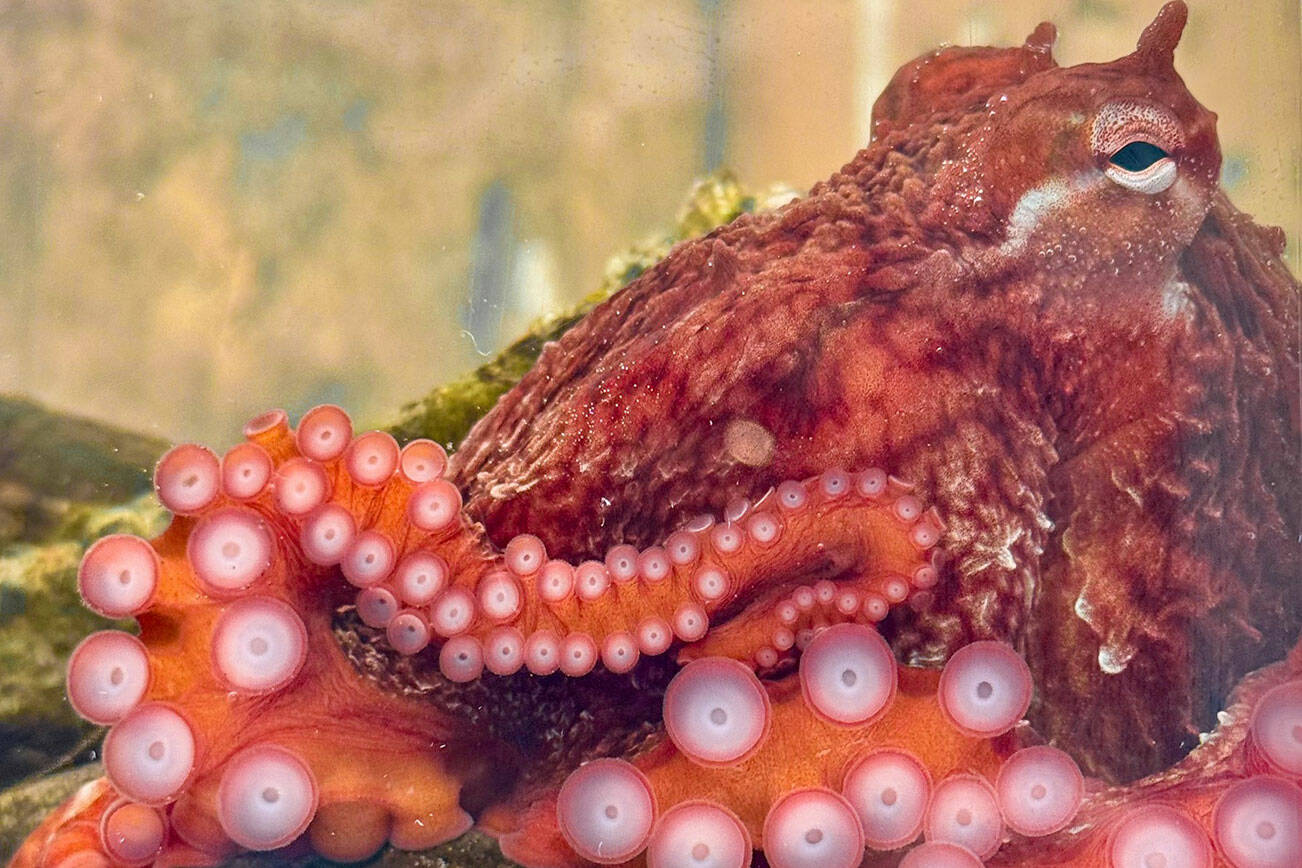
A multi-armed Whidbey resident who was living in a bottle is now an aquatic celebrity.
The juvenile Giant Pacific octopus, who was named Khahanie, is a star attraction at the Western Washington University’s public aquarium, SEA Discovery Center, which has a newly renovated octopus habitat, just in time for OCTOber — the octopus month.
A biology professor and graduate students from Walla Walla University were scuba diving at Driftwood Park in Central Whidbey this summer to gather dozens of the smaller but remarkably smart ruby octopuses that had made their home in recycled beer bottles the researchers planted in the water.
Kirt Onthank, a biology professor and octopus expert, explained that just about everything in the ocean “larger than octopuses really wants to eat an octopus,” so the cephalopods need a den to hide inside. Muddy areas like Driftwood Park, which is about a mile down the beach from the Coupeville ferry, have an abundance of clams, crabs and other things on octopuses’ menu, but not many rocky places to hide. As a result, the malleable invertebrates jump at the chance to make human-made containers their homes.
“They like to shack up in a bottle similar to the way someone might move into an apartment near their favorite restaurants,” he said.
Onthank said the divers simply pick up the bottles with the cephalopods inside and bring them back to Rosario Beach Marine Laboratory on Fidalgo Island, where they conduct research with the octopuses for a few weeks before returning them to Driftwood Park.
Rebecca Senn, a graduate student, said she found the bottle containing the Giant Pacific octopus, but she didn’t realize it wasn’t a ruby octopus until later. Underwater, she could only really see tentacles and a flash of color inside a barnacle-encrusted bottle, which isn’t enough to identify a species.
The Giant Pacific octopus, the largest of all octopuses, can grow to weigh more than 50 pounds and have arm spans of 13 feet or more, according to the Monterey Bay Aquarium.
Onthank said aquariums are often on the lookout for Giant Pacific octopus, commonly called GPO among octopus aficionados, since they are so impressive and popular. In this case, Western Washington University’s public aquarium, SEA Discovery Center, in Poulsbo was in the market for an octopus.
Bridget Anderson, the director of operations at SEA Discovery Center, said the octopus arrived at the facility at the end of September.
“We hope that while she makes her temporary home with us as an ambassador for her species, that she will inspire visitors of all ages to get outside and protect and care for the Salish Sea,” Anderson said.
The juvenile will be be moved to the newly renovated octopus habitat once she is large enough. The $300,000, community-supported project took a year to complete. In a couple of years, the aquarium will work with Washington Department of Fish and Wildlife to return Khahanie — which a Chinook word meaning “outside — to the exact location where she was found, “so she can continue her life in the wild and contribute to the future of her species,” Anderson said.
Onthank said ruby octopus, also called the East Pacific red octopus, and Giant Pacific octopus are the most common octopus species in Puget Sound. The ruby octopuses are smaller, with an arm span of up to 20 inches, but Onthank said they have big personalities. Not only are they “insanely intelligent,” he said they are “angry little octopuses” that are more likely to bite than their larger cousins. He said there are tens of thousands of them quietly living their lives in Puget Sound, with hundreds making a living at Driftwood Park alone.
The GPO, on the other hand, are not as numerous but still plentiful. Onthank said they are also very smart but have more laid-back personalities and are less likely to bite curious divers.
Both species are venomous, Onthank explained, but the bites mostly only cause uncomfortable swelling. Even though he’s handled thousands of octopuses during his career, he’s never been bit. Others aren’t as lucky.
Sadly, ruby octopus only live for two to three years while a GPO lifespan is three to five years. Onthanks said their short lifespans make their famous intelligence all the more astonishing.
Two less-common octopus species in Puget Sound live in the deep water. The smoothskin octopuses can be found in places like Burrows Bay near Anacortes. The rare seven-armed octopus usually makes news when one is found on a beach. Former News-Times reporter Ron Newberry found a seven-armed individual washed up at Ebey’s Landing in Central Whidbey five years ago, which garnered attention from scientists as far away as the Smithsonian.
Onthanks said the students used the ruby octopuses collected this summer for research into cephalopod cognition, specially inattention blindness — whether they can get distracted. Yet most of his research over the years, he said, has focused on how these crafty sea creatures will be affected by climate change and ocean acidification.
Octopuses may represent a rare success story on a warming planet. Onthanks said their craftiness serves them well.
“Everything about them is fine tuned to be adaptable,” he said.
In fact, Onthanks said he’s worried that their abilities may lead to their undoing. Octopus are already proliferating in places like southern England, where they are upsetting the lobster fishery. He hopes that growing populations — aided by global warming — won’t cause future conflicts with humans, like the kind that led to in the decimation of the North American wolf population.
As for Khahanie, people can go visit her at the SEA Discovery Center in Poulsbo. Throughout the month of October and into November, SEA is celebrating Octo Fest, which octopus-related special events and programs, including OCTO BINGO, special Octo Storytime, Paint & Sip, Leggy Lager beer and a special evening event with Shelby Van Pelt, author of “Remarkably Bright Creatures.”