
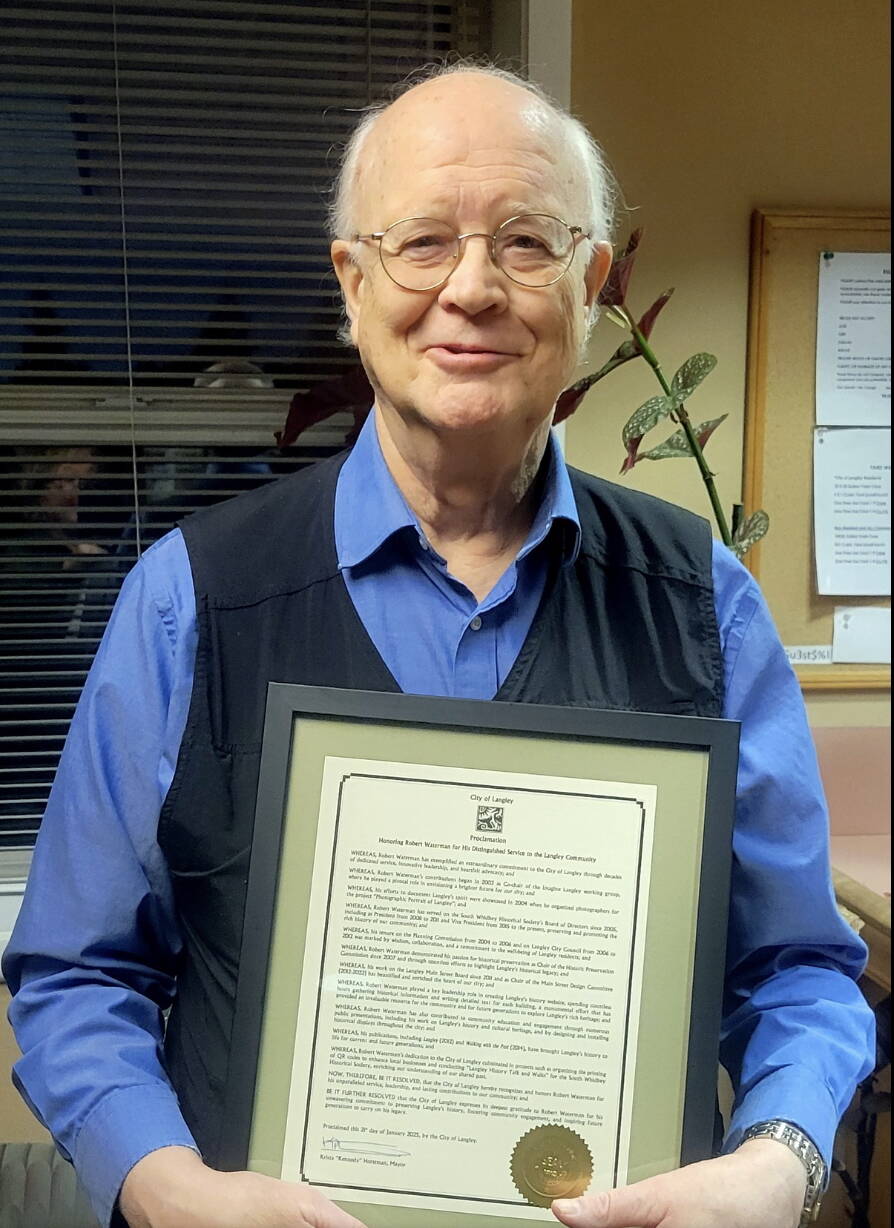
By KATE POSS
Special to The Record
Robert “Bob” Waterman, the founder of and board member of Langley’s Historic Preservation Commission, passed away in December, but his legacy continues.
A Celebration of Life service is planned for March 7 at The Dancing Fish Winery in Freeland.
Created in 2007, the Historic Preservation Commission, or HPC, maintains a register of historic places. It raises awareness about Langley’s historical sites and serves as a steward in their preservation. Eligibility for inclusion covers “any building, structure, site, object or district … if it has integrity and is at least 50 years old, or, is of lesser age and is associated with the history, architecture, archaeology and contributes to the character of the city,” according to HPC’s criteria.
Waterman, a beloved character, hosted Langley walking tours to share stories of the Village by the Sea’s dramatic history. He also helped found and later held an emeritus position on Langley’s Main Street Association, receiving the “Historically Awesome” award in March 2024. He served on the Langley City Council and as past president of the South Whidbey Historical Society, now known as the Island County Historical Society Museum.
A proponent of Langley’s colorful history, he kept the past alive. He was involved with the “Imagine Langley” campaign. It documented the city’s history and stories in order to preserve local heritage by tracking down and interviewing locals and collecting photographs. The campaign was a prelude to the city’s centennial celebration in 2013.
Take a walk along the Langley History Walk, completed in 2016, a project led by Bob Waterman with the help of the Langley Main Street Association. Exploring Langley’s 20th century roots, Frick Lane, next to Moonraker Bookstore, features “Now and Then” historic photos, composites created by renowned national photographer Rich Frishman, a neighbor of the Watermans.
Waterman organized other historical events, such as re-enactments of suffragette parades — with male hecklers in the crowd — and co-authored with Frances Wood the book “Images of America Langley,” published in 2012. He also added to the city’s digital archive on Langley History’s website.
As a result of Waterman’s efforts and that of dedicated volunteers, 10 locations in the city are currently registered as historic properties. Langley’s registered historic places receive special tax benefits. The HPC determines their eligibility.
Langley’s registered historic places include the Langley marina and Moonraker Bookstore at 209 First St. The Langley-Woodmen Cemetery, in existence since 1902, at 1109 Al Anderson Ave., is the oldest cemetery on South Whidbey. The Langley Library, whose property was deeded by then-Langley Mayor Helen Coe in 1923, was updated and remodeled, keeping much of its century-plus-old original design. Its neighbor, Langley City Hall, was originally built as a Masonic Lodge from 1948-1949. The Masonic Lodge/City Hall, located at 112 Second St., was built on land donated by Jacob Anthes, a Masonic Lodge member and original founder of Langley. Under consideration for the Langley Register of Historic places are The Clyde Theatre, built in 1937, and The Rob Schouten Gallery, formerly the Langley State Bank, at 101 Anthes Ave.
Several historic homes are also nominated for the status.
Langley’s history includes the Snohomish people’s permanent village at Sandy Point and an all-women city council during Prohibition. A salty tale from then tells of local menfolk finding a secret way to imbibe by paddling out to Baby Island, where rum runners supplied spirits.
“Robert’s passing motivates us to elevate his legacy,” said Nina Milligan, who serves on the board of Langley Main Street Association and the HPC.
Waterman and his wife Anne Waterman moved to Whidbey Island in 1998, after he retired from a career as a professor of anatomy and a pioneering medical educator at the University of New Mexico School of Medicine.
He was born in 1940 and grew up in Fort Atkinson, Wisconsin. After graduating with a biology degree from Lawrence University in Appleton, Wisconsin, Waterman was awarded a Woodrow Wilson fellowship based on an essay in which he passionately discussed his desire to teach and pursue a Ph.D. in biological structure at the University of Washington.
While in his first year of graduate studies, Waterman received a fateful invitation to an afternoon coffee at the home of his faculty advisor, Dr. Edward Roosen-Runge. At that event, a very shy, nearly speechless Waterman caught the eye of his professor’s daughter Anne, then 18 years old, who was to become Bob’s wife of 60 years. Their long and loving marriage gave rise to a family of four children.
After finishing his PhD, Waterman was awarded a five-year post-doctoral research fellowship at Harvard, then accepted a teaching position at the University of New Mexico School of Medicine in 1972. For the first decade of his tenure at UNM, he pursued a traditional professorship focused on embryology research, scanning electron microscopy and the delivery of humorous and award-winning anatomy lectures (including an infamous barn-burner of a lecture on the development of the rectum and anus that students did not soon forget).
In the early 1980s, Waterman’s professional life took a dramatic turn when he joined a small group of passionate, creative colleagues eager to develop a new, more empowering way of preparing medical students for work as primary care physicians in rural areas. Together, they pioneered an innovative approach which replaced a curriculum centered around lectures and memorization with one that engaged students in active learning through case-based problem-solving in small cohort groups. Their innovative Primary Care Curriculum is still in existence today.
The life-changing Primary Care Curriculum years unleashed Waterman’s creativity and ignited a new depth of connection with his students and colleagues. He transformed his embryology lab into a curriculum-design lab and traveled around the world with his colleagues to introduce the Primary Care Curriculum approach to rural medicine programs in places like China and the Middle East.
Upon retirement to Whidbey Island in 1998, Waterman devoted himself to learning about his new hometown of Langley, digging deeply into the stories and structures that have shaped the small city’s past and present. He served on the Langley City Council, then turned his focus to preserving Langley’s history through the Langley Historic Preservation Commission and the South Whidbey Historical Society. He also served as one of the founding board members for the Langley Main Street Association.
Always a consummate teacher, Waterman looked for ways to bring Whidbey’s history alive for both locals and visitors. His projects included the book on Langley he co-authored with Wood for the Images of America series; the many historical panels and plaques he worked to place around town; the series of “then and now” images he painstakingly created by merging historical and contemporary photographs; the “Walk and Talk” lectures he led through the streets of Langley, and the live theatrical events he helped produce to honor the town’s centennial in 2013 including a flash-mob style Suffrage march and a Langley Live play that played to a sold-out house at WICA.
Waterman will be remembered by students, colleagues, and family alike as a kind, gentle, broadly curious man with a deeply silly side, a flair for the dramatic, and a contagious enthusiasm for sharing the topics and projects that he loved.
In lieu of flowers, donations can be made in Bob’s name to the Langley Main Street Association, the South Whidbey Historical Society, or the South Whidbey High School Performing Arts Boosters (in honor of the great delight the South Whidbey Jazz Band brought to him while his granddaughters were members), or Project HOPE.