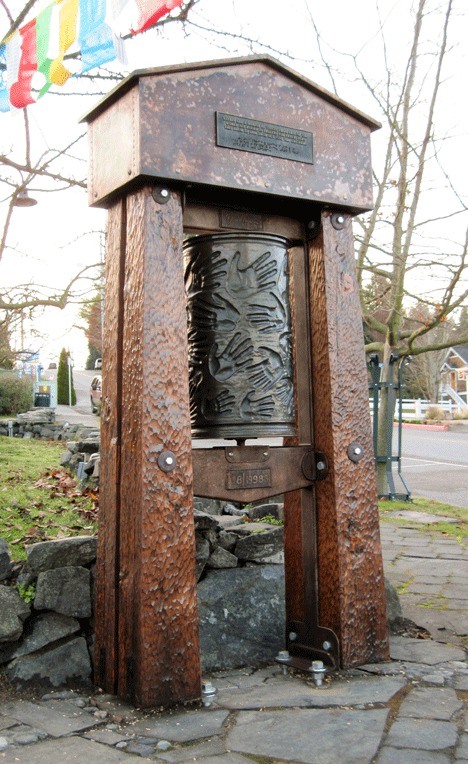
What goes around comes around, sometimes with a ring and prayer.
So goes round the newly refurbished and reinstalled Peace Wheel of Langley Park.
The wheel, the brainchild of local philanthropists Nancy Nordhoff and Lynn Hayes, was first installed in the park at the corner of Anthes Avenue and Second Street in August 1998. Nordhoff had donated the land and materials for the community gathering place to the city of Langley. After the design team of Jay and Kathleen Davenny and Byron and Dana Moffett came up with the plans for the overall landscape, a competition to create a piece of art for the park was announced.
Local artist David Gignac was chosen to create a multi-denominational prayer wheel.
“Lynn Hayes had collected prayers from every denomination; from religious leaders and from individual’s prayers of peace,” Gignac recalled.
“She wanted me to put them into the prayer wheel’s design.”
Gignac said he had seen prayer wheels before, but it was Hayes’ and Nordhoff’s suggestions that it become a place of peace — a symbolic vessel for generating peace in the world — that inspired him.
The wheel itself is imprinted with a clutch of human hands of all sizes.
“My concept was that if there is to be world peace then everybody has to have a hand in it,” Gignac said. “That’s why the wheel has all sizes of hands.”
Indeed, Jay Davenny remembers a “cast of thousands” getting their hands dirty to help complete the construction of the park.
“Nancy donated everything and was very hands-on, suggesting plants and other materials. She has always been this incredible gal, taking us kicking and screaming into the next phase of everything,” Davenny said.
“Lynn has ties to the Tibetan world of prayer and that was something she wanted for the park, so we just wove it into the design. It rings when it does,” he said.
Well, it rings if you stay long enough.
Gignac created a mechanism of gears in the wheel so that only after 60 revolutions will it chime and then reset itself.
It was the artist’s intention that people spend more time with the Peace Wheel.
“My feeling is that often, in this day and age, we want an instant reward for our actions, but peace is its own reward. Most people just walk by. This wheel has more intention toward peace. If someone spent one minute every day thinking about peace, it might do more toward that direction in the world.”
Gignac said you can spin the wheel exactly 60 times within 30 seconds and make it ring.
“I tested it,” he said.
When the Peace Wheel was first installed, Gignac liked the fact that people didn’t know what made it ring. The piece had a certain mystery and he said it was great to watch people walk up to it and match their hands with the imprints, to turn the wheel and to discover things about the sculpture.
“I loved that they had this many-tiered experience with it,” he said.
In the 11 years since the wheel was first installed, Gignac has learned a lot about the mechanics of wheels and other engineering tricks.
In 2007, Gignac was commissioned to create another wheel and had permission to use Langley’s Peace Wheel as a mold for the new piece.
On close inspection, he found that time had taken its toll on the original frame, which had since become loose. Also, the mechanical parts were wearing against each other.
He took what he learned over the course of a decade of watching how it worked and re-engineered it. He kept the same wood structure, but replaced the central core with a steel frame. He also re-engineered the chime mechanism which, he said, was fairly primitive.
“I’m thrilled with it,” Gignac said. “It’s just engineered much better and I’ve repaired it so that anyone can fix it now.”
In the main housing of the Peace Wheel, Gignac has installed two new chambers that hold a time capsule which includes the history of the piece, and another drawer that holds the tools that are needed to maintain it.
“So, in 100 years, after I’m long gone, somebody else will be able to work on it. I’m very happy about it and I feel that it is truly complete,” Gignac said.
“I’m so glad to see it back,” Davenny said.
Back in 1998, Nordhoff had said she wanted a place where people, art and nature could come together, and so it has.
It’s 2010, the wheel is in its place and the revolutions for peace begin again.