The city of Langley is being drawn into a disagreement between Island County and Oak Harbor officials over the ongoing comprehensive plan updates.
Two Island County commissioners and planning staff from both Island County and Oak Harbor are likely to attend a Langley City Council meeting Sept. 15 in order to listen to — and possibly join in — discussions about a proposed change in population projections to be used in the 20-year growth planning documents.
Langley Mayor Kennedy Horstman said she is not aware of county commissioners attending a Langley council meeting before — at least not in recent history.
“For my part, I think it’s healthy to have cross-pollination regarding county-wide collaboration,” she said in an email.
County commissioners want to adopt a lower population projection that will prevent Oak Harbor from expanding its Urban Growth Area because of a disagreement over planning for infrastructure in these areas; the Urban Growth Area, or UGA, is land outside of city limits that is designated for urban densities and eventual annexation.
The proposed change will not affect Langley or Coupeville comprehensive planning. But with Oak Harbor unlikely to vote in favor of the change, Island County needs the two other municipalities to agree to the new population projection to move forward.
Island County officials believe that Oak Harbor is required to plan for expanding infrastructure into the UGA to support housing, especially lower-income, multi-family units. Oak Harbor planners, however, argue that the city’s policy is to rely on developer-led extension of services.
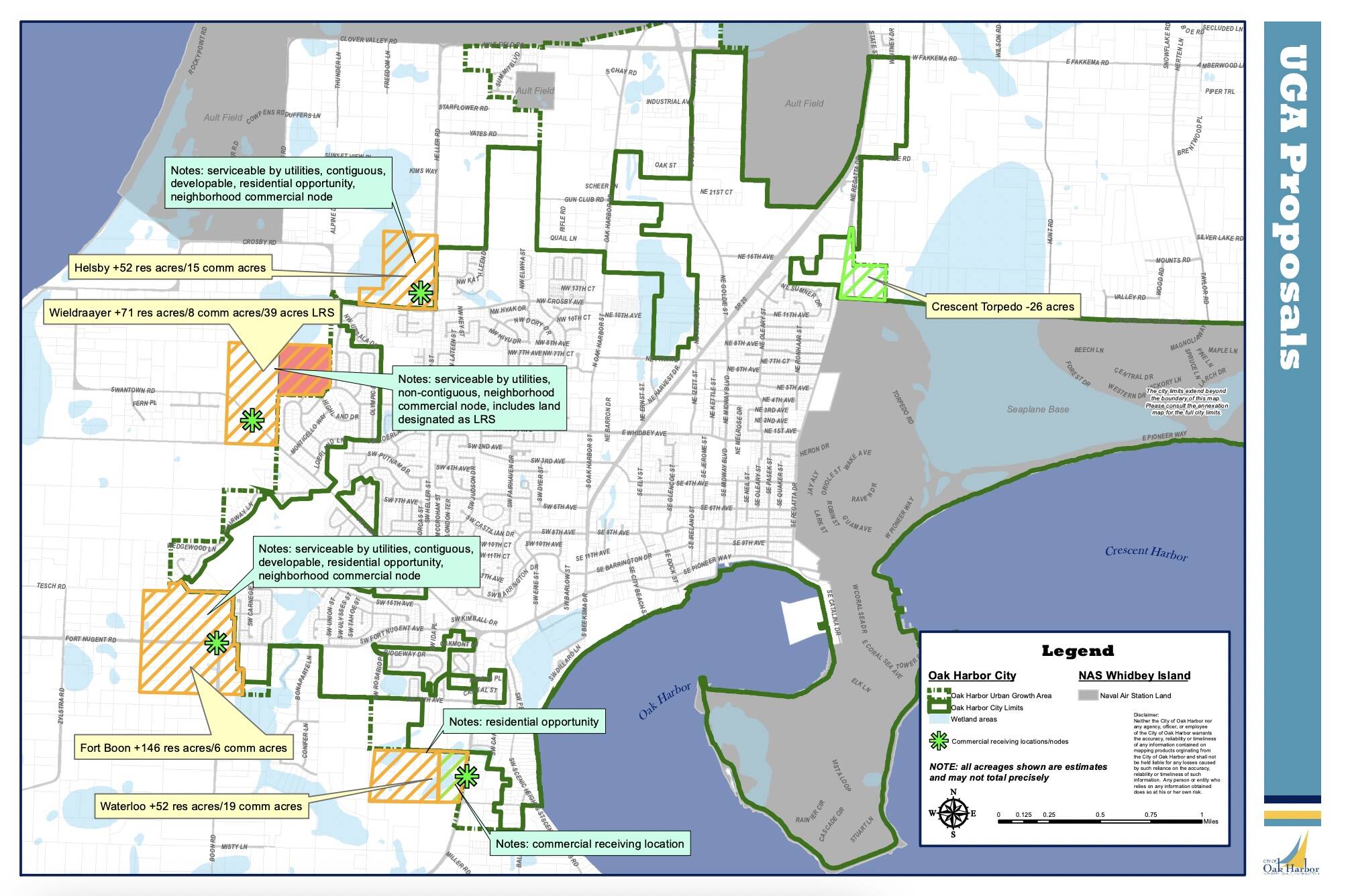
At the same time, Oak Harbor wants to expand its UGA by a total of 434 acres, according to a city letter.
Island County and the municipalities on Whidbey are in the midst of updating their comprehensive plans, as mandated by the state under the Growth Management Act. One of the cornerstones of the GMA is a focus on reducing urban sprawl, which is why expansions of UGAs are an important issue. The state and environmental groups want to limit UGA expansions to direct increased population densities within cities.
For this year’s update, state lawmakers amended the GMA to require local governments to plan and accommodate housing affordable at all income levels — which has highlighted the need for more zoning to accommodate apartments or other multi-family housing. In addition, new rules push more population growth into urban areas.
The first step in the comp plan update process was for the county and each municipality to adopt population projections. The state offers three different projections — high, medium and low. Early in 2024, the county and municipalities adopted the medium population projections that sets the current 87,000 people to grow to nearly 103,000 in 20 years.
Under the state’s direction, the bulk of the housing for population increases should be planned for urban areas, which in Island County largely means Oak Harbor. The city agreed to take 63% of the growth.
The comp plan updates are supposed to be a collaborative process between the county and municipalities, but the county is the ultimate authority and must defend the plans before the Growth Management Hearings Board or in court, according to county officials.
Early this year, a disagreement between city and county planners over comprehensive planning led the commissioners to invite the Oak Harbor council to a rare joint meeting to discuss the issue. In the end, the council agreed to zone more areas within the city for increased housing density.
But then a new disagreement arose over planning for annexation and extending urban services in the city’s UGA. County officials believed that the city’s policy — or lack of planning — is not viable and could not be defended in court.
At a county meeting, Commissioner Janet St. Clair said that the city has not been a “good faith partner.”
Without a resolution in sight and the comp plan update deadline looming at the end of the year, the commissioners decided to take the unusual step of adopting the lower population projection, which would allow county planning to move forward but would mean that Oak Harbor will not be able to expand its UGA as part of the update. County officials said that a possible expansion can be addressed in another year as part of a planning docket.
The Island County Planning Commission recently held a meeting and voted 5-3 in favor of the revision of the population projection.
At the planning commission meeting, Oak Harbor Principal Planner Cac Kamak and those working on behalf of the environmental group Whidbey Environmental Action Network, or WEAN, spoke against the population revision, but for very different reasons.
Kamak said the UGAs are already serviceable under city infrastructure plans. The sewer, water and roads are in place and only need to be extended into the UGA areas, which he said developers would need to do.
“The city cannot fund infrastructure outside of its city limits,” he said.
He said the city cannot plan for areas in the proposed expanded UGA before the areas are actually added.
“They have to be in the UGA and then we update our sewer, utility, transportation plans, those are all big plans to update, which is when we tackle the services,” he said.
Marnie Jackson, executive director of WEAN, and Steve Erickson, co-founder/consultant with WEAN, both said they disagree with Oak Harbor’s approach to relying on developer-led extensions of service and don’t think it will support affordable housing. Erickson said the policy is outdated.
“There are already areas within the city that lack sidewalks and urban services,” Jackson said. “This is evidence that Oak Harbor should not be allowed to do planning in the way it has always done but should be encouraged to expand its view of its responsibility.”
Yet Jackson and Erickson said that lowering the population projection is not the answer since it’s not consistent with GMA and will exacerbate the problem with a lack of affordable housing.
“We believe that by allowing this reduction, the county would be joining the city in avoiding the new housing requirements of the GMA,” Jackson said.