
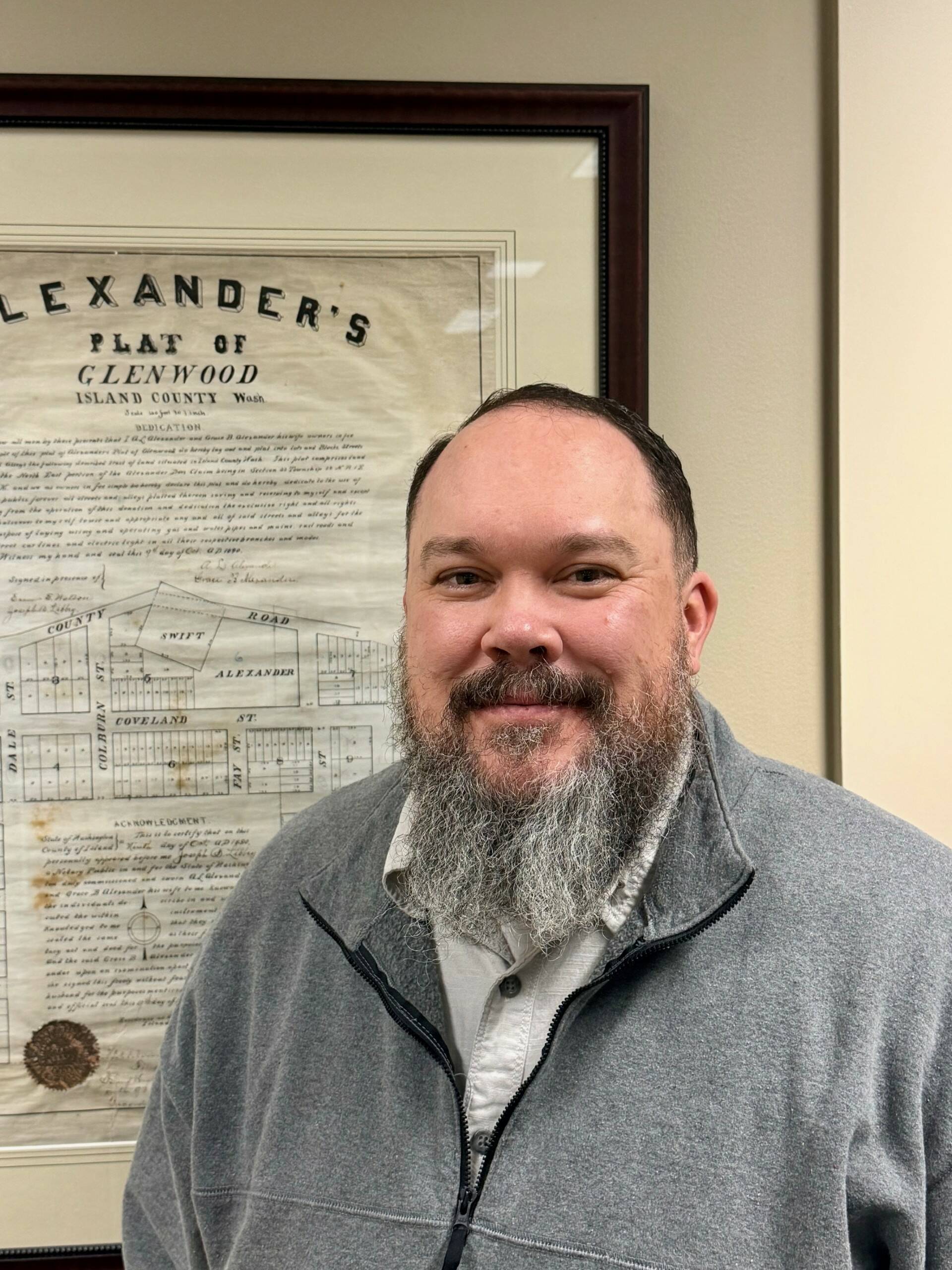
Josh Pitts started as Coupeville’s new community planning director on Oct. 20. The University of Washington graduate has plenty of experience in the field on Whidbey and is eager to continue his work with the town.
Pitts said he considers Coupeville a fascinating place.
“I really do love the community,” he said. “The demographics from the legacy families to the new generation that’s just starting to move here — it’s unlike anywhere else.”
Pitts grew up in Oregon, largely a Pacific Northwest resident between his time spent there and in the Evergreen State.
He completed his undergraduate studies at the University of Washington-Bothell, then earned his master’s degree in urban design and planning at the University’s Seattle campus. As a specialization is necessary for that degree, Pitts chose historic preservation, a prescient decision given Whidbey’s past so heavily influences its aesthetic present.
Island County hired Pitts before he completed his master’s degree, and he dove into long-range planning as soon as he finished school.
Connections opened the door to his next gig at Ebey’s Landing National Historical Reserve. As a preservation coordinator, the reserve tasked Pitts with advising Coupeville and Island County on how to navigate Ebey’s Reserve Design Guidelines, as well as town and county municipal codes, when pursuing new developments.
“It’s gotta be somewhat unique but at the same time compatible with the current historic structure,” Pitts said. “We’re trying to be mindful of what that new development looks like so that it is similar to what you already see, so it doesn’t stand out as much.”
With the reserve, Pitts also managed national parks easements and oversaw forever grants, money distributed to fund the repair and preservation of historic buildings on Ebey’s Landing.
Pitts enjoys his work and called Coupeville a “compelling” town to work in, what with the planning challenge presented balancing inevitable change with the town’s historic preservation priorities. How important maintaining a strictly historical identity is, in Pitts’ opinion, a million-dollar question as historic preservation is the town’s whole identity, not a component of it.
“I think overall everybody wants to maintain the sense of pride they have for the downtown historic area, some of the farm clusters out on the prairie, stuff like that,” he said. “But at the same time, we’re not Pike Place Market. We’re not Pioneer Square, where you’re just one block and you’re set within this time period, and you expect it to maintain a resemblance of that period of significance.”
Two issues he expects to come to a head during his tenure are managing Front Street over-water structures with rising sea levels — deciphering whether that is a community, state or federal responsibility — and creating affordable housing, a quandary faced by Washington as a whole.
But community planning is not Pitts’ whole life. He loves to spend his free time with his wife and four boys, exploring places like Bellingham and Ballard on day trips. Currently, Pitts lives in the Clinton area.