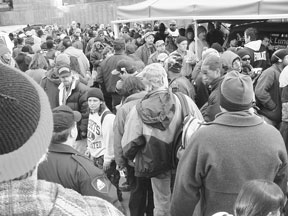
This year Operation: Sack Lunch gave Christmas to 1,000 homeless people down on the streets of Seattle. They ate hot roast beef and provolone cheese sandwiches, chips, chocolate milk, pizza, cookies and hot coffee. There were also gifts, Christmas presents for children who had no tree to put them under or chimney for Santa to come down.
But Christmas day was just one day in a week that sees 3,500 of the city’s homeless line up for what may be their only real meal of the day.
The number is a far cry from the 30 sack lunches that Beverly Graham, who lives in Clinton, packaged up one day in 1989 and took from Whidbey to Seattle to hand out to homeless people on the streets.
“I had no intention of starting a program like this,” Graham said. “I’d been a competitive body builder, living life on adrenalin.” Then Graham was diagnosed with multiple sclerosis, and found herself unable to do all the physical activities she’d been so used to.
“It was while I was recovering that I would have flashes of intense visions of people eating half a sandwich from a dumpster,” she said. “It was really to make myself feel better that I decided to make some sandwiches and drive them to Seattle.” She opened up the hatchback of her car and gave lunch to people who came by.
Until then it was all “lip service,” Graham said: compassion without action.
“I was talking the talk, but not walking the walk.”
This was the start of Operation: Sack Lunch, which grew from the 30 sandwiches to 50, then 100, then 800, first one day a week, then two and three, until today the OSL van delivers food five days a week, serving 3,500 meals a week.
It is now, of course, a great deal more than a one-woman effort. Operation: Sack Lunch encompasses a nonprofit organization of a few paid staff, a board, and a plethora of volunteers who prepare meals in donated space in church kitchens that are fully health department compliant, buying state and federal commodities and even purchasing the food for other organizations and shelters, such as Tent City, PSKS (Peace on the Streets by Kids from the Streets) and Angeline’s Day Center for Women.
But it took over a decade to reach this level.
“In the beginning, the police detained me every day for three years,” Graham said. “One day I was being accused of encouraging loitering and was about to be ticketed, when suddenly this great white van with TV antennas drove up. This big man got out, came over and actually picked me up and took me away.”
The man was Ken Schram (the former “People Helper” of KOMO-TV), who had heard Graham at one of her benefit concerts. Shortly afterward he aired a television segment on whether Seattle was losing its compassion.
Following the TV show, Seattle’s city manager suggested Graham and the city work together. Operation: Sack Lunch was allowed to set up its food distribution in the plaza of the Public Health and Safety Building. The city hired security, and in 1999 gave OSL a $17,000 grant. It also eventually provided a canopy for the food distribution.
“The people waiting for lunch still have to wait outside, even in the rain,” Graham said.
Today, Operation: Sack Lunch serves a sack lunch on Tuesday, Thursday and Friday, and a hot meal on Sunday and Monday. The effort is aided by volunteers ranging from senior citizens to students from at least 30 area schools, including many from St. Hubert Catholic Church in Langley and the Whidbey Island Waldorf School.
“We have five to 10 kids a day helping,” Graham said.
The dinners are not “industrial” food, she added. One menu included lamb stew with rice, green salad, a vegetable dish, garlic bread, hot cider and bottled water.
Another featured turkey gumbo with roasted potatoes, a hot fruit medley, fruit salad and steamed green beans.
“The food is as good as I would want to eat,” Graham said.