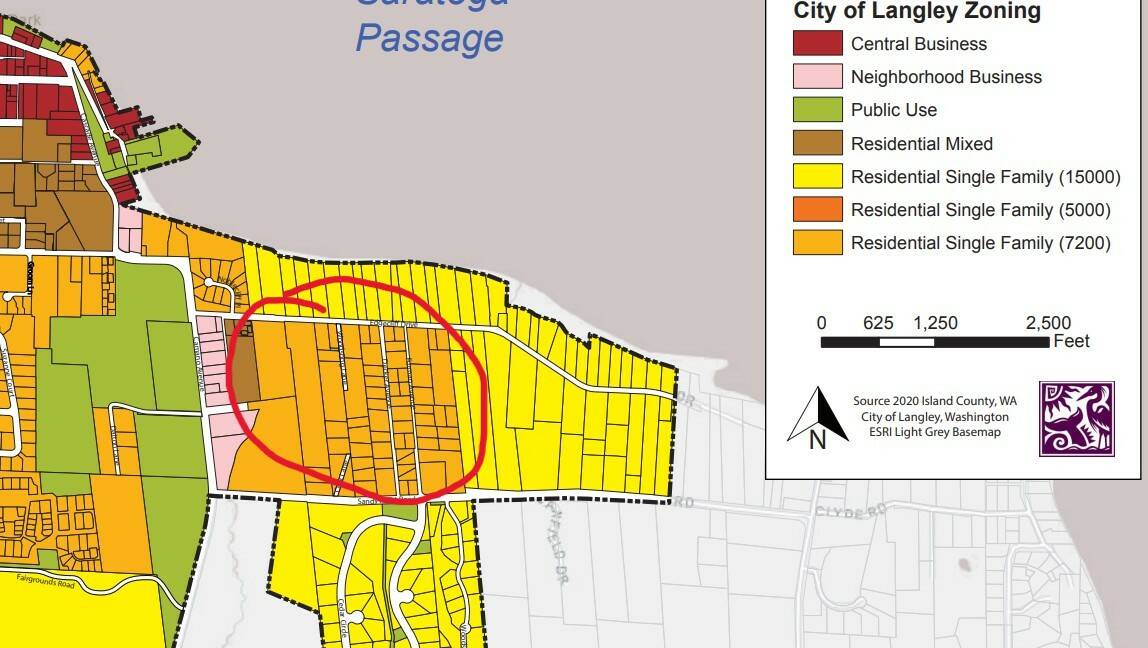
A divided Langley City Council could not agree on an environmental-related proposal that would change the zoning for a certain area of the city.
During a city council meeting last week, Councilmember Rhonda Salerno presented her case for rezoning parcels on the south side of Edgecliff Drive to Residential Single Family 15000, or RSF 15000. The bulk of the properties in question are currently zoned as RSF 7200, so the action would represent “downzoning” because less density would be allowed in the area. It would also match the zoning on the north side of Edgecliff Drive.
Salerno reasoned that this would protect the nearby bluff from further landslide activity, which has been a big concern for residents and neighbors. Past articles in the South Whidbey Record have documented this as recently as 2022.
“By aligning zoning policy with the geological and hydrological realities of the Edgecliff area, we can ensure that future development supports financial integrity, safety and sustainability — for our community today and for generations to come,” Salerno wrote in a memo that was accompanied by a white paper on the subject.
She indicated that the zoning change would not preclude new development. With the installation of sewer lines thanks to the Langley Infrastructure Project, every parcel on both sides of the street can be subdivided into three parcels per acre, permitting cottage housing, duplexes, tiny homes and up to two accessory dwelling units, or ADUs.
Councilmember Chris Carlson called into question the primary sources cited in Salerno’s memo, pointing out that those sources do not actually suggest any causal relationship between housing density and groundwater infiltration, let alone bluff failure.
“This is not an issue about density,” he said. “It is about holding water on site, reducing or limiting lawn and landscape irrigation, getting homes off septic systems and connected to the sewer system, tightlining runoffs to the beach.”
He suggested looking at recommendations in the material about managing water and said downzoning will not solve this problem and causes a false sense of security.
Removing the option of multi-family housing, he added, means less homes for people who currently cannot find them.
“I believe it is our moral imperative to remove unnecessary burdens and barriers to the creation of homes for people in our community that need them,” he said.
Later in the meeting, Salerno read back some quotes that were said in a previous meeting that were supportive of decreasing high density development at the site. She asked if any of the council members recognized them, then revealed they had been said by Carlson himself in June. Carlson responded by saying he had done more research since then and changed his mind.
Much concern was recently expressed over the removal of six large trees along Edgecliff Drive that were impeding progress of the city’s major infrastructure project. Whether the zoning is RSF 15000 or RSF 7200, Planning Director Meredith Penny said there are gaps in city code that leave large trees at risk. She hopes to put strengthening the city’s tree ordinance on the work plan for next year.
Several members of the public provided comments during the meeting, with some in favor of the downzoning and others against.
Councilmember Gail Fleming voiced support for the downzoning, while Councilmember Craig Cyr appeared to be on the fence and said he wasn’t prepared to vote on the issue until he had asked more questions and walked the bluff. Councilmember Harolynne Bobis was absent from the meeting, and with only four voting members present, the decision could have easily come to a tie, a rarity in Langley.
In the end, the council tabled the motion, agreeing to revisit it at a future meeting before the end of the year.