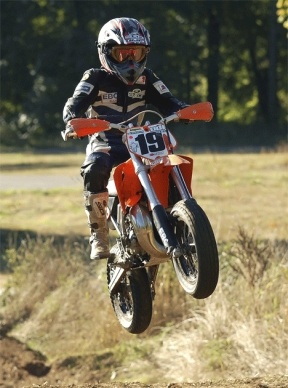
At first glance, Blake Deilke is just your average 6-year-old South Whidbey second-grader.
He likes rock ‘n’ roll and watches Sponge Bob Square Pants on television. His favorite subjects in school are math and recess, but not necessarily in that order.
Oh, and one other thing. Last summer Blake won Supermoto USA’s 2006 season championships in both the PeeWee and Formula Mini classes.
That’s right — Blake is a motorcycle race champion.
“When I was 3, I started riding bicycles,†Blake said in a recent interview as his parents, Michael and Alison, watched proudly.
“My dad raced and I couldn’t wait to try it out,†he said.
Michael Deilke recounted his son’s progression from training wheels to motorcycle sports.
“Alison and I enjoyed motorcycle racing, and rode dirt bikes before he was born. He would come to the track with us and fell in love with the sport,†Deilke recalled.
Deilke runs a business called Techstyles from a warehouse near his home south of Freeland. His company makes prototype backpacks and sporting gear for designers and the military, using computer-aided equipment and software he designed himself.
The space also is a convenient spot to store the bikes he and his son race on the weekends.
Supermoto is a crossover of motocross and road racing. Races are commonly held on tracks with an off-road section in the infield; approximately 70 percent tarmac and 30 percent dirt. The motorcycles used are frequently custom-created combinations of off-road motorcycles and road-racing rims and tires. Riders also wear a combination of road race and offroad equipment, normally leathers and a motocross helmet and boots.
Unlike normal motorcycle racing, the emphasis lies on slower, short and twisty tracks where skill matters far more than outright machine performance.
Blake rides eight laps to qualify, then 10 to 12 in each main event.
The most important skill?
“Listen to my dad,†Blake said.
The bikes used in motocross range from 50 to 550 cc. and compete in individual races according to their engine size. The bikes are much lighter than normal motorcycles because lighter metals are used in their construction.
Motocross bikes can be bought in ready-to-race condition or adapted to the rider’s taste. Highly-tuned professional bikes are called “factory†bikes.
Blake rides a 2003 KTM SX65 with a 65cc engine that propels him up to 60 or 70 mph.
It features a brake guard — “It keeps my hands safe if I hit a tree†— and shock absorbers.
The shock absorbers come in handy.
“When you land hard off a jump, if there no shocks, you’d land and break your arm. You usually are standing when you land, though,†Blake said.
“The ‘bark buster’ gloves help if I get too close to a tree or the ground,†he added.
Safety on the track is a prime concern, his father said.
“There’s always an ambulance nearby. I wouldn’t let him ride if I thought it was unsafe,†Deilke said.
Deilke added that the growing sport really is a family affair. “We ride hard, do our best, then discuss how it went on the drive home,†he said.
From early spring until October, the family travels up to several hundred miles. They estimated they spend up to $60 for fuel, $75 for an inexpensive motel and $45 for Blake’s entry fee, plus $120 for his dad.
“This sport isn’t cheap. We had to go out and find sponsors,†said Alison Deilke.
“We can easily go through a set of tires, up to $200 for brake pads. Once, Blake crashed and the cost to repair the brakes and replace his helmet cost $1,100,†she said.
With 11 races on the schedule, summer is a busy time. Blake’s club is based in Seattle but the nearest track is in Port Angeles. His dad would like to see a motocross track here on Whidbey Island and he has an idea.
“The Navy’s practice field in Coupeville is perfect and no one could complain about the noise. We’re a lot quieter than jets landing,†he said.
With 100 competitors bringing their family and friends, Deilke said the economic impact for the county could be significant.
For Blake, the sport was a natural choice, and Deilke is proud his son got interested in the sport.
“We don’t want to be the kind of parents that push our kid in a particular way,†he said.
Will Blake continue riding?
“As long as my parents can afford it,†he said.
Blake looks forward to racing with the No. 1 plate in 2007 with continued support from his sponsors: I-90 Motorsports, HJC helmets, and AXO clothing.
Information about local Supermoto racing can be found at www.supermotousa.com.
Jeff VanDerford can be reached at 221-5300 or jvanderford@southwhidbeyrecord.com.