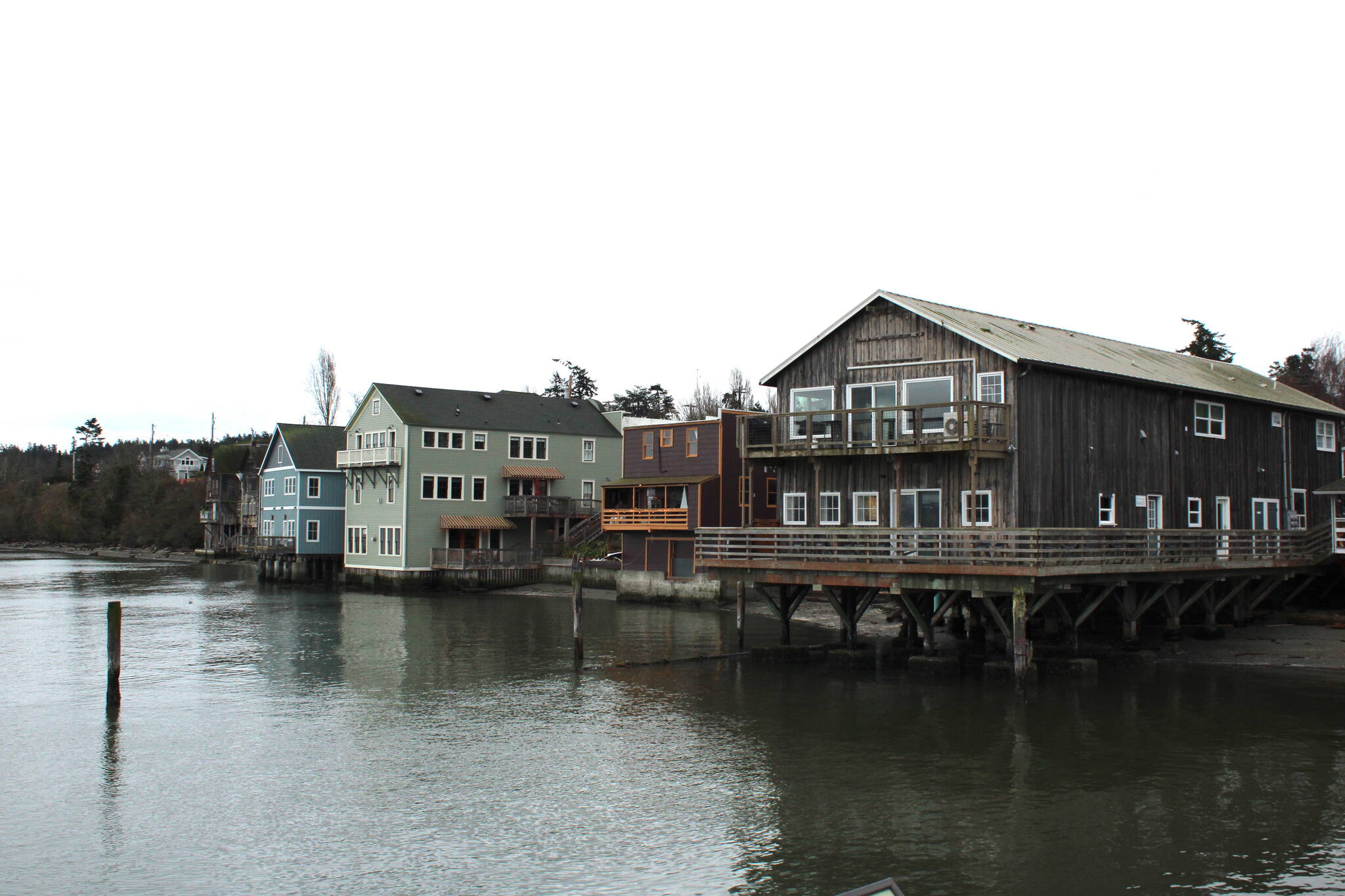
Coupeville received its first — and likely not its last — request to elevate an over-water building due to the threat of rising sea levels. Preserving this component of the town’s historic identity may not be easy.
“It all comes down to how much do we truly cherish these historic structures and their unique character?” Community Planning Director Josh Pitts said. “Both sides of the street are historic, but the over-water structures are a defining characteristic of Coupeville.”
Barbara Summers, co-owner of the historical Coupeville Cash Store located at 12 Northwest Front Street, is seeking a shoreline variance permit to elevate the building at least 20 inches. Historical buildings like the Cash Store, built in 1886, are considered highly vulnerable to flooding caused by rising sea levels; king tides flooded the lower level of the building in 2022.
Following a hearing on Monday, Coupeville’s hearing examiner has 10 days to decide whether the proposal complies with town code. If so, the Washington State Department of Ecology has 30 days to provide a final decision on the matter, which can be appealed during an ensuing 21-day period.
So far, Summers’ bid is supported by the Historic Preservation Commission, which unanimously passed a motion to approve a “certificate of appropriateness” in prerequisite, as well as that of the town.
Elevating the building is Summers’ last resort, though not her preferred option. But relocating it is impossible, she explained in an interview, and constructing a sea wall may not be permitted.
Should her proposal be green-lit, the building will be jacked up anywhere from 7 to 10 feet to fix failing pilings and then elevate it. Summers said lifting the building alone could cost just under $100,000, and the elevation process may take up to 90 days to complete.
That total does not consider other costs which could arise in the lifting process.
“We are expecting damage inside the building,” Summers added, which underwent a $3.5 million renovation just three years ago.
Coupeville’s Coastal Adaptation Strategy, released in June, supports the use of building elevations in mitigating the impacts of sea level rise. Elevations are capable of preserving a “cohesive downtown appearance” but only if a “holistic approach can be agreed upon to maintain a unified character of the downtown,” the document reads.
The town lacks such an approach. At its meeting last week, the Historic Preservation Commission advocated to create one particularly to avoid implementing piecemeal elevations. Pitts explained in an interview that the town got as far as recognizing the need for such a plan, but has not discussed the matter further, likely due to the looming comprehensive plan update deadline.
Part of the trouble of formulating such a plan is understanding where the responsibility for orchestrating it lies: with the property owners, the county, state or possibly even the federal government, given the buildings’ location in Ebey’s Landing, a National Historical Reserve.
Another concern is the cost. According to the Coastal Adaptation Strategy, elevating buildings — depending on their foundations — could cost anywhere from $500,000 to $1 million each. The document notes that “it may not be feasible for the Town to provide funds that benefit private owners.”
Regardless of these challenges, if more over-water elevations take place, Pitts said it is ideal they all occur at once. If that happens, the street level and sidewalks may need to be elevated as well to maintain buildings’ connections to underground utility lines and to meet access requirements.
Buy-in from property owners and the community at large would be crucial to enacting extensive elevations, but it may be worth it to preserve an important element of the town’s identity. Getting the ball rolling on a unified elevation plan may require more property owners, like Summers, to request individual elevations — at least in Pitts’ point of view.
“This is just my personal opinion,” he said. “It’s gonna take a community effort to push the town to do something holistically.”