Homeless advocate films portion of documentary on South Whidbey
Published 2:36 pm Tuesday, September 13, 2016
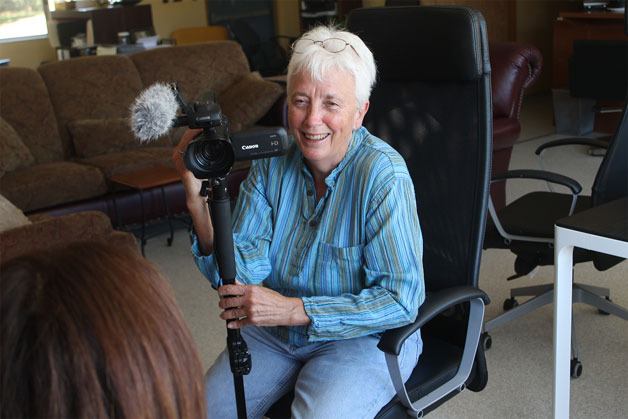
Diane Nilan lives out of a van.
She’s not homeless as the living arrangement is by choice, but she’s not exactly living in comfort either. She said it’s part of an effort to glean a small bit of insight into the lives of the homeless, whom she’s worked with over the past three decades as the founder of HEAR US, an Illinois-based non-profit organization that gives homeless a voice to share their stories through video interviews and books.
Nilan’s work brought her to South Whidbey this week, where she interviewed local homeless families and South Whidbey School District Homeless Liaison Gail LaVassar. She’ll eventually compile footage from South Whidbey as well as a half-dozen other cities around the state into a 15-20 minute documentary that will be used by the Office of Superintendent of Public Instruction for professional development of school district homeless liaisons.
Nilan said the video project will help educate liaisons by raising their awareness on the issue, and imparting a sense of sensitivity when dealing with those affected. Her interviews consist of finding out what led to the person or family being homeless, how they are coping, their struggles to find shelter and the importance of education.
“It will give the audience a chance to hear what the families and the youth have to say about being homeless and how important school is,” Nilan said. “Homelessness is not a fun thing that happens to people. It’s a very painful and complicated circumstance. It causes people to just shatter and you can see the brokenness, but you can also see the resilience. You can see when somebody’s caring has made a huge difference.”
One of the interviewees was 33-year-old Joey Anderson. Anderson and his wife utilize the assistance of the South Whidbey Homeless Coalition and House of Hospitality in Langley. Signing on to be part of the documentary was an easy choice, he said. It’s a chance to help debunk preconceived notions of how people become homeless as well as repay the homeless coalition for providing him shelter while in need. Anderson also admired Nilan’s work, as well as her choice of voluntarily giving up the comforts of home to advance her understanding of what it’s like to be homeless.
“I like the whole concept,” Anderson said.
Anderson said he too used to believe that drug usage and poor choices led to homelessness. It wasn’t until a traumatic car accident hospitalized him for nine months and caused severe internal injuries when his circumstances changed. His condition worsened and forced the pair into the street.
“Once we found out my liver and kidneys were dying, she quit her job after 13 years at Albertsons,” Anderson said. “She was a manager making 20 bucks an hour. My SSI [supplemental security income] wasn’t enough for rent and we ended up getting kicked out.”
“When that happened, it’s when it all kicked into me that maybe there’s something more to this than drug addicts making bad choices,” he added.
Anderson’s story is one of hundreds Nilan has heard over the decades. Traveling the country documenting the lives and hardships of the homeless is emotionally taxing work, she said. But, the reward of sharing their stories and raising awareness makes it worth it in the end.
“Having been in this work for three decades, I know these stories are real,” Nilan said. “There’s always that pressure of doing it right and hoping that it makes a difference in the hearts of the people who view it.”
One of Nilan’s biggest takeaways from her time on South Whidbey was the amount of support the homeless receive from the community.
“What I see are some enlightened leaders who have been able to step forward and say, ‘This is our island and our problem. Let’s own it and see if we can do something for as many people as possible,’” Nilan said. “To me, that is unique. You’re small enough where you can actually do it and see some results, as opposed to Chicago where it would take a concerted effort. You have enough people doing good things and you see the results and that fuels more goodness.”
Judy Thorslund, a South Whidbey Homeless Coalition board member, was also excited about the project and its potential impact.
“It sounds to me like she’s brilliant,” Thorslund said. “This [homelessness] is going to get bigger. It’s not going to get smaller anytime soon.”