
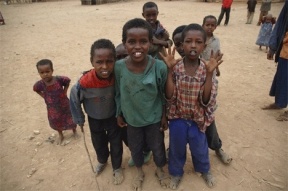
When Renee Bourque speaks of Africa it’s with an almost desperate passion. Her visits to Kenya and Ethiopia reveal an intensity that stems from her connection to a people who walk miles every day for water, who fight everyday for survival.
Yet, she speaks of a people who still have their joy intact. And it is this fact that has obviously made a lasting impression on Bourque.
That joy is eloquently translated through her photographs on display now through Dec. 3 in The Hub at the Bayview Cash Store in Langley.
The show, the second in a series of photographs from the area, is called “More Dust and Courage: The Rest of the Story.†It is a compassionate and beautiful display of life in Kenya and Ethiopia as seen through the eyes of one who strives to be a messenger of a forgotten people.
NGO woes
Bourque, who in addition to her work as an artist, is also a development consultant for her company, Bright Star Grant Consultants. Having been to the areas of Kenya and Ethiopa more than once as a consultant, Bourque quickly learned that the seemingly systematic change that is driven by non-governmental organizations, or NGOs, is a behemoth of disorganization and arbitrary decision-making with a dearth of accountability to boot.
“Africa is being smothered in a lack of commitment to projects by these NGOs,†Bourque said.
She believes these organizations have been entrenched in their own dysfunction for so long that they can no longer see the problems that are staring them in the face.
Water is life. Without water nothing continues. And, according to Bourque, although many of these organizations have a font of funds available, none have been able to create a system of water access that would allow the people to move forward on to a larger, economic sustainability.
“When there is no water there is no school, because everyone must pitch in to see the next day,†Bourque said.
Bourque thinks that the women’s struggles in the area are emblematic of the larger picture of the problem.
According to studies Bourque has researched regarding change in the Third World, the education of girls is crucial. In Indonesia and South Korea, for example, an increase in girls’ education has led to women having children when they are older, women having less children and women being more informed about good hygiene and nutrition, Bourque explained.
Women who are educated also tend to network with other women, which leads to empowerment in the community. Investments in the education of girls are inexpensive and grassroot organizations are the go-to groups for effective donations.
These organizations take stock of how to best earmark funds and to remain accountable to the communities they are trying to help.
Such organizations like World Vision and Engineers without Borders work with the large NGOs to elicit real change for real lives, said Bourque.
“I hope that I can inspire people to take heed of that and make investments that count,†she added.
Ever resilient
When looking at her photographs it is plain how much respect Bourque holds for the women of this area.
“Women have a style and grace even while performing punishing work,†she said. Many of the photographs in this collection reveal an attitude of camaraderie and gratitude among women. Even in the dust of their crackling environs, they look beautiful and chic.
Her connections to the region are strong.
On her last trip to Africa the women of the village where she was staying gave Bourque a camel bell.
“This is so you will never forget us and will tell the world our story,†they told her.
“I want to be their messenger,†Bourque said. People with such incentive for survival, such creativity and guts – imagine what they could do if they had the right tools?â€
Bourque will be on hand to answer questions about her exhibit and about the African struggle at the “Second Saturday: Sushi, Art, Music!†from 5 to 8 p.m. Saturday, Nov. 11, at the Bayview Cash Store.
Patricia Duff can be reached at 221-5300 or www.pduff@southwhidbeyrecord.com.