Langley Lift lands low score in public study
Published 3:18 pm Tuesday, September 30, 2014
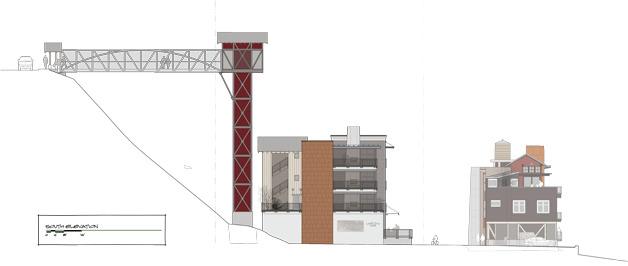
People are not thrilled at the prospect of a long bridge and a towering elevator shaft mucking up their view in Langley.
City officials are considering a proposal for a bridge and elevator that would connect the marina at South Whidbey Harbor to the shopping and residential area from Cascade Avenue. A public meeting regarding the project is set for 3 p.m. Wednesday, Oct. 1, at Langley City Hall.
Dubbed the Langley Lift, the project was a partnership between the city and recently deceased businessman Paul Schell, whose wife Pam Schell is following through on the development. The Schells presented the idea at a council meeting in mid-July, about a week before Paul Schell died from heart surgery complications.
Since then, the city conducted a view assessment and has accepted public input. Director of Community Planning Jeff Arango said the roughly thirty comments are “mostly negative,” with criticism about its aesthetics, view impacts and recommendations about how to do it better.
One property owner is furious with the city’s plan. In a five-page letter written to the city, Charlie Pancerzewski outlined why he thought the project failed to meet the city’s own explanations for use.
“This project is ill conceived,” he wrote in the conclusion. “The elevator is an eye sore and way out of place with the long-standing look and environmental feel of Langley. The words ‘eye sore’ are as appropriate to describe it as any.”
But according to Arango, more “nays” than “yeas” isn’t necessarily a signal of universal rejection. Also, some of the concerns could be fixed simply. Arango noted that the design already underwent a slight change by making the bridge’s exterior transparent, like a mesh or fence enclosure, rather than a full-metal sheet with a few windows. The architect, Eric Richmond of Flat Rock Productions, also added an observation deck that wraps around the elevator shaft at the top. Those types of alterations may mitigate any loss of public view.
“We can make the bridge more transparent by some of the treatments and modifying it,” Arango said. 
Funding has been secured for the project for some time. The Island County Council of Governments set aside $500,000 in grant funding for the project, but has asked the city to move forward sooner rather than later. While no drop-dead date has been set, Arango said the council should make a decision on the waterfront accessibility project by the end of this year. His recommendation may not come until a council meeting in November, but could be as early as its Oct. 13 meeting.
Since at least 2004, the city has looked at pedestrian access from its commercial core and the marina. The current means of walking up and down Wharf Street, a bit of a trek for someone carrying a bag of groceries or a couple of shopping bags, would be circumvented by the bridge and elevator.
Rather than an incline, visitors would walk across the street from the marina, step into an elevator and arrive on Cascade Avenue.
One of the impetuses for the connection is the expansion of the marina. Parking is limited down at the harbor, but deals were reached with nearby lots at the Island Church of Whidbey on Sixth Street and Cascade Avenue, and with the South Whidbey School District for its old bus barn lot at the same intersection.
The problem facing Langley is that it lacks property near the marina, and thus has nowhere to land any kind of transport adjacent to the bluff. But the Schells do, and have offered to donate an easement for the public to get from the elevator to the waterfront area. Near the Langley Lift landing would be a multi-story, mixed-use development the Schells also proposed, which would have its own separate elevator.
On Wednesday afternoon, the Planning Advisory Board will review public input regarding the view assessment.
“Basically I’m just going to walk them through the view assessment,” Arango said.
Some modification suggestions may also be considered by the Planning Advisory Board, the first stop in the public review process. Questions regarding the bridge’s height and where it met Cascade Avenue have surfaced in previous city council meetings, particularly concerning the possibility of building the bridge below street level to limit its view impact. Costs could be higher, essentially because it would add to the landing area to create a stairway or ramp up to the street from the bridge, and there are concerns about mobility-impaired access, Arango said.
Langley’s former plan for a funicular, a pod on a tram up the bluff, was set aside because it was estimated to cost too much, around $800,000.