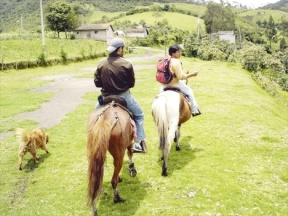
Two young South Enders traded island life for work in the Ecuadorian Andes to get a taste of the world, and to protest the current political climate in the U.S.
“I think our decision to continue traveling was also partly spurred by our disgust with the political conditions in the U.S.†Estevan Munoz-Howard said.
“We felt the need to see if other countries have it just as bad as we do.â€
Munoz-Howard and Elisha Ishii, both 24, are currently working as co-managers of Casa Mojanda, an ecolodge in the Ecuadorian Andes. They live in a mountain village in the Andes along with locals, horses and a llama named Sammy.
Before taking the hotel manager jobs, they traveled and worked during and after college in Asian, European and other South American countries.
“We originally started thinking about traveling in Latin America about a year ago, while we were living in Japan. We debated going back to Italy, but since neither of us had spent much time in Latin America we figured we should go someplace new,†Munoz-Howard said.
Ishii, who is half Japanese, half American, said her desire to travel stems from having parents from two different countries.
“I like observing what is different between my two cultures and what is the same. In experiencing these two things I am better able to understand myself. Traveling helps me to gain a better understanding about human nature,†she said.
As they go about daily life thousands of miles away from home, they have picked up valuable life lessons from natives of all ages.
“Elisha and I walked down the road to introduce ourselves to the staff at the local school and to discuss what we could do to help them improve the children’s scholastic experience. We sometimes have guests at Casa Mojanda who choose to donate materials to the community and volunteer with local projects,†Munoz-Howard said.
“As we entered the schoolyard and approached the principal, we were very quickly surrounded by grinning children who immediately took our hands and began to climb all over us and ask us questions,†he said.
“These are the same children that can be seen working in the fields along with their parents and herding sheep and cattle when school is not in session. These are the same kids who grow up so quickly as they help support their families and often times start their own families before we would be finished with high school,†Munoz-Howard added.
The curiosity and openness toward the strangers stands in harsh contrast to childhood in America, where kids are taught to be cautious of strangers, often for good reason.
“It struck us how this situation would rarely be experienced in American schools, with their armed guards, locked doors and pervading fear of strangers. We are simply taught to perceive people differently; society has become a scary place for us, whereas here strangers are initially seen as good and are only viewed with suspicion if there is cause to do so,†he said.
Munoz-Howard and Ishii plan to stay in Ecuador for a while.
“We are planning on staying just over a year, maybe more,†Ishii said.
“I am planning on going to graduate school within the next couple of years, so we can’t stay away for too long,†Munoz-Howard added.
As managers of Casa Mojanda, they deal with guests by phone and email, entertain visitors, do bookkeeping, payroll and take care of any other needs or random complications.
“Our day usually starts at 8 a.m. for breakfast and ends around 10 p.m. after dinner. For the most part, if guests are here and awake, we are as well,†Munoz-Howard said.
“Weekends for us are few and quite far between during the high season, so we usually take our breaks during the slower periods, although it seems like we work a lot, it doesn’t usually feel like work with the incredibly beautiful scenery and pleasant guest company,†he said.
Traveling and living abroad has not only provided job training, but also has impacted their values and beliefs.
“More than anything, it helps us to put things in perspective — in developing countries especially,†Munoz-Howard said. “You see people living with so much less than 95 percent of the people back home without running water or electricity, without medical attention, in houses with dirt floors and no insulation.â€
“It just serves as a reminder of what is really necessary to live a happy life,†he said.
“The indigenous children here in the Andes laugh and play just like kids in the U.S. — perhaps even more so. The same goes for the street kids we saw in Cambodia. All of them seem to retain a certain innocence as they grow older but at the same time, paradoxically, they grow up much faster than most of us in the States,†he added.
The hard life affects the children, but they seem to have an unconcerned quality about them that Americans usually lack in more developed settings, he said.
“Our possessions or lack of possessions are only marginally related to our respective levels of happiness. Without a doubt these children are at least as happy as those I see back at home, but without exception they have significantly less things. There is something that seems so much more fulfilling and elemental about one’s life satisfaction when it is not cluttered or contaminated by excess belongings, by an exaggerated dependency on material and physical gratification,†he said.
The local political and social landscape has shaped the couple’s life in Ecuador, as well.
“Definitely the most significant issue down here has been the Ecuadorian government’s debate on whether or not to sign the U.S.-Andean Free Trade Agreement,†Munoz-Howard said.
“Yeah, that has been a very volatile issue in recent months,†Ishii agreed.
In the middle of March, the entire country was paralyzed by nationwide strikes and roadblocks instigated in an effort to prevent the passage of AFTA. Rural communities and their AFTA opponents chopped down trees and laid them across the road. Protesters parked buses and trucks in the middle of intersections, they recalled.
Many oppose the treaty because they fear it would change life as they know it.
“The reality of free trade would not be a positive one for most families that rely on the success of Ecuador’s agricultural sector. Much of the agricultural production in Ecuador still depends on smaller, more family-run farms which could never survive open competition with large-scale U.S. factory farms,†Munoz-Howard explained.
Many local Ecuadorian farming groups would die, just as American family farms have disappeared in past decades.
“Sure, national paralysis is bad for business in general, but the indigenous and lower-income population which makes up over a third of the total population would suffer considerably more under the economic domination of big business,†he added.
Still, there is another distinct lesson to be learned amid the protests.
“I would like the American public to be as mobilized as the people are here,†Ishii said.
“When the local people are upset about something the government is thinking about doing, they stand up and go against it. It doesn’t matter that they will be missing their work for the day and maybe their kids will have to join them on the streets to protest, or that they will have to work overtime in the fields to feed their families,†she said.
“The important thing is that they sacrifice now to prevent bad things from happening to them later. In our culture, we are unaware of what is happening until it is too late, and only then do we protest,†Ishii said.
“I want to take this proactive approach to preventing possible issues back to the U.S. with me and personally be more willing to make sacrifices to help the causes I believe in,†she added.
Munoz-Howard said he hopes to take some of this spirit with him upon his return to the United States.
“We hope to retain the stripped-down, unembellished, very basic perspective on life that so many people here experience and they have it out of necessity — because they simply cannot live any other way. Specifically, we hope to hang on to this somewhat better understanding of what is truly important in life — what is necessary to just live and be happy,†he said.
He also hopes not to get caught up in the materialism that is deeply rooted in developed societies, he said.
Even though he believes, when given the choice, many Ecuadorian families would trade what they have with the riches of the U.S. society, the Ecuadorian way of life is a valuable example.
“That’s what’s so ironic about all of this, it’s not like they’re so much purer and content with less out of choice; many simply don’t have the means to have the sort of experiences we do in the states, and certain parts of Ecuador, for that matter,†Munoz-Howard said.
“They live this way and make do with what they have because they must, because they would be unhappy if they don’t. But they’re still just trying to get by and improve life for their families just like the rest of us,†he added.