
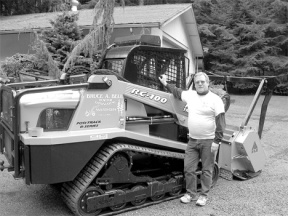
Like a hunger-crazed monster, the machine chomps through the dense brush and trees along East Harbor Road in Freeland, leaving a fully cleared lot in its wake.
Landscaper Bruce Bell sits inside the enclosed cabin of his ASV FAE Mulcher, driving it through the dense underbrush as it takes a deep bite out of the thick blackberries and small trees. The vegetation is ground up and turned back into the ground as bark and mulch.
Manufactured by ASV, Inc. in Minnesota, this powerful, cutting-edge machine has been popular in the southeast part of the country. Bell, a Freeland landscape contractor, is one of the first people in the state to own one of these newfangled land-clearing machines.
“It’s like mowing grass, but it’s actually mowing trees,†Bell said. “People can’t believe what it will do.â€
“These machines can be used for environmental maintenance, clearing away shrubs, bushes and small trees including most of the roots,†he said.
Bell said the mulcher has streamlined his business.
“We have fewer man hours on clearing projects, no debris to haul, and it mulches trees with trunks up to 8 inches in diameter,†Bell said.
Bell said he was impressed with it because it is more environmentally friendly compared to other methods.
“It eliminates the need for large burn piles,†he said.
For the consumer, projects take less time.
“Bruce cleared our three and a half acres in six hours,†said Melissa Russell, a Freeland resident.
Russell, who is studying to become a Master Gardener, said the environmental aspect of the machine was important to her.
“The machine puts everything back into the soil, including alders that are high in nitrogen. Now the area is ready to plant,†Russell said.
Bell said the Russell project would have taken his crew about two weeks to clear instead of a day.