
Life after high school can be daunting. New places, new people, new ideas. Many feel unsure, excited, scared and overwhelmed — all at once.
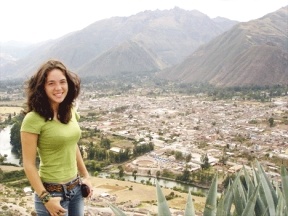
Mosa Collins, a 2005 graduate of South Whidbey High School, turned her hesitation about college into a nine-month adventure in Peru.
“People get caught up in themselves and their plans to the point where they are so focused on their goals that they are blind to the opportunities around them,†Collins said.
“My plan was to go straight to college after high school, but instead of ignoring this little inkling of an opportunity, I followed my heart and it was the best thing I could have done,†she said.
Collins was uncertain about her future plans and taking a year off to travel seemed like the perfect solution.
She began researching and planning during her junior year of high school. Encouragement and information provided by her Spanish teacher, Jenny Gochanour, played an important role in her decision to travel abroad.
After doing some research online, finally she signed on with Travel and Projects Abroad (TAPA), a program based in England. With her program and destination in mind, Collins started fundraising in her senior year; she needed $7,000.
Volunteers came from all over the world as part of the TAPA program. Most came from Western Europe, one from South Africa, and the group had only about 10 Americans total.
There were four aspects to the program in Peru: “care and teaching,†“teaching English,†“the Jungle Project†and “Inca projects.â€
Most volunteers served for three months, and different groups worked on each project. Making connections with so many new and interesting people was a great part of the experience, Collins said.
For the Care and Teaching project, Collins lived in Urubamba and taught in Media Luna, a town in southern Peru. She spent her days in a kindergarten classroom, playing with the children and helping to supervise. It was amazing how happy the children were to have the volunteers there, she said.
“Rosa, one of the kids in school, she was awesome,†Collins said, recalling the little girl with a smile as big and bright as the moon.
Then, in January and February, Collins taught English in Cusco in collaboration with the Ministry of Education. The classes were open to anyone, but many who participated were Peruvian English teachers.
“I was not only teaching English, but also teaching another way to teach,†Collins said. Most lessons came straight from the board, because teachers were unable to provide another way to reach children, she said.
But the English classes, taught by about 30 volunteers, gave Peruvian educators a deeper understanding of their subject and alternative methods of instruction.
Collins said she obtained a greater appreciation for her own teachers, and a better understanding of some rules of the English language.
Her next adventure, the Jungle Project, was one of the more demanding.
Collins described the Jungle Project in one word: intense.
Volunteers were based in Puerto Maldonado where they had to adjust to the hot, humid climate, no hot water, and electricity only between 6 and 9 p.m.
Volunteers observed wildlife in the morning and at night, a measure taken to prove they weren’t “damaging the land†while living there, from the tallest canopy in South America.
Other activities included clearing land to help local farmers, and taking care of animals orphaned by hunters.
“Sometimes a farmer would kill an animal, and it would have a baby,†Collins explained.
“They would care for it for awhile until it became a pest, and then we would get it,†she said.
Collins cared for jaguars, monkeys, macaws and turtles.
During the Inca projects, Collins and other service members walked through the mountains, cleaning ruins and learning about Incan history. The experience provided an in-depth understanding of local history.
But there was more to the experience than just work.
When she wasn’t volunteering her time, Collins was making connections with fellow service members, as well as locals, by immersing herself in Peruvian culture.
“Because volunteers cycled through about every three months, and I was there for nine, I got to know a lot of people,†she said. “The benefit of volunteering is that you really get to know the people you are with, versus just traveling randomly.â€
One thing that really stood out to Collins was the integration of Incan and Spanish heritage, she said.
The locals celebrate both Spanish and Incan holidays. Collins recalled celebrating the Carnival-a holiday. It is celebrated throughout all of South America in February.
“There are water fights 24 hours, seven days a week,†she said. “You can’t go out in the street without getting soaked.â€
Although it was difficult for Collins to narrow her trip down to one favorite experience, she recalled the road from Udabamba to Cusco as one of the most memorable. It was a one-hour journey through the mountains.
“It’s so beautiful and when you are there it strikes you that it is such a different world,†Collins explained. “It encompassed how the people really knew how to take advantage of what they are given.â€
Collins emphatically recommends students to study abroad at some point during their education. She said volunteering provides a much more satisfying experience — not only from helping people, but also through the relationships developed with locals.
“They connect with you much better than if you are a tourist,†she said.
Collins’ experience in Peru was life changing, she said.
“Through the opportunities and the people I have met, I have so much more faith in life,†she said.
Collins is getting ready to share her experiences in Peru and studying abroad at a talk next week. She will be presenting a slide show at 6 p.m. on Saturday, Aug. 5 at Fellowship Hall in the United Methodist Church. It will follow a Peruvian dinner at 5 p.m. of rice, potatoes and chicken.