
Shop local, invest local, think local and thus make the Whidbey Island economy the backbone of a healthy community.
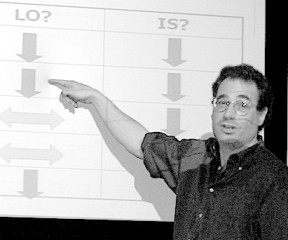
Michael Shuman, a nationally known attorney and economist, spoke before a captivated South Whidbey audience Tuesday morning, providing tips and tricks to turn the local economy into a success story.
Shuman emphasized the importance of supporting local business. Local ownership provides greater wealth for the community, because profits remain in the community, Shuman said. The dollars spend circulate in the community instead of leaking out of town or out of state.
“We are on the verge of a ownership revolution,†Shuman told about 50 audience members at the Bayview Cash Store Front Room.
Shuman used the NFL team, the Green Bay Packers, as a good example of successful community initiative as the franchise was turned into a locally-owned, community-shared business a few years ago. The move guaranteed that the team wouldn’t move out of Wisconsin any time soon. This way jobs and money stay put as well as the pride and joy that the team gives the community.
Shuman also said that a community becomes less vulnerable with a strong local economy because it is more self-sufficient, self-reliant and independent from outside influences.
Shuman pointed out that communities with a diversified, strong economy are less likely to be devastated by catastrophic exits of large corporations — who may choose to move production into cheaper labor countries. Just imagine the economic impact the exit of Boeing, Naval Air Station Whidbey Island or Nichols Brothers would have for South Whidbey.
Shuman said communities have emergency plans for how to evacuate and help if a large employer suffers a fire, but most are unprepared for a much more devastating catastrophe — the move-out or closing of a major employer.
Besides security, local businesses have higher standards for quality and on economic and environment issues. After all, the location of the business is also the home of the owner.
Local businesses are also often considered a better place to work.
Many young college graduates choose a local career over a job at a Fortune 500 company, because they feel less alienated and anonymous and see better chances for advancement, Shuman said.
Money can be saved and kept in the community by smart growth planning, Shuman said. If a community plans sufficiently, less cars are used and land is used more efficiently and eco-friendly.
A healthy local economy also helps communities form a strong identity and draws intellectuals and creative people who will keep the community flourishing.
Shuman pointed out that the voter-participation is usually higher in places where citizens own stock in their community. Also, greater social stability and less welfare have been observed in such communities. Local business support their neighbors and give more to charity.
It is beneficial for communities to take initiative.
“Markets move slow,†Shuman said.
“If these strategies are implemented, they can have a dramatic effect on a community,†he said.
Communities who plan ahead can be winners.
“You on Whidbey Island can do almost everything if you embrace the right model,†he said.
Keeping it local is not as hard as it appears at first, Shuman said. About one third of consumption is very easily localized. Grocery shopping and dining out are good examples.
One-fourth of the consumption is hard to localize, he said. Examples are pension funds, cars, fuel and even some brand name products that don’t have local counterparts.
The rest depends on choice, preference and geography.
During a question-and-answer session afterward, a very pro-local and engaged group of listeners wanted to know more about strategies to engage the wider community in such “go local†efforts. They also asked about island specific issues such as geographical isolation, transportation and a shrinking agriculture industry.
Shuman was the second speaker in The Exchange, a series of informational programs to stimulate dialogue and the exchange of ideas. The Exchange is co-sponsored by The South Whidbey Record and Goosefoot Community Fund.
“It was great to see a really diverse group of people attend Michael’s presentation,†said Record Publisher Sherry Mays. “It’s not often that you can get elected officials, members of the business community and non-profit representatives all in one room to just listen. I was really proud of our community members who are willing to invest time with their neighbors to help strengthen our community.â€
Those who want to brainstorm on how to make a local revolution reality on South Whidbey have a chance tonight.
Goosefoot Community Fund and The South Whidbey Record are inviting residents to a conversation cafe, an opportunity to mix and mingle and discuss Shuman’s ideas and strategies candidly in an intimate setting.
The event will be held tonight from 7 to 9 p.m. at the Bayview Cash Store Front Room.
Vicki Robin, co-author of “Your Money or Your Life†and co-creator of the Conversation Cafe, will facilitate the first of many engaging Community Conversation Cafes.
“I encourage our everyone who is passionate about the health of South Whidbey and our island community as a whole to attend tonight’s cafe,†Mays said. “It is going to be a productive session where I’m hoping to see a prioritization of our desired outcomes and overall community building. I want to see South Whidbey be the best it can be with our incredible pool of creative thinkers and doers.â€