
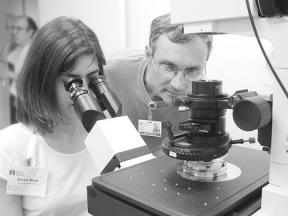
When Langley Middle School Science teacher Greg Ballog returns to school in the fall, he’ll have quite the “what I did this summer” story to tell.
Ballog is among two dozen middle school and high school science teachers attending the Science Education Partnership program at the Fred Hutchinson Cancer Research Center and other research sites throughout Seattle. So when he gets back to his classroom in September, he’ll be able to tell his students what it’s like to work with real scientists in real research laboratories.
This “summer school” experience began July 7 and runs through July 23, and provides professional development for teachers, which they in turn take back to their classrooms.
Ballog teaches advanced-placement biology at South Whidbey High School, where in the fall he will begin his 10th year at the school. Students in his class spend three weeks studying genetics. They extract some of their own DNA and perform lab experiments that include transferring of DNA information from one organism to another.
It’s not as complex as cloning, but the work has a satisfying result.
“We take the gene from a jellyfish that enables it to glow and place it in a bacteria. When the bacteria glows, we know the transfer is complete,” he said.
Projects such as this mirror those performed on a daily basis, only at a higher level, at The Hutch. As Ballog points out, it is because of DNA transfer research that artificial insulin was made possible for diabetics.
“The insulin they use isn’t from humans, it comes from yeast and bacteria,” he said.
Working in labs at Fred Hutchinson and partnering local academic research institutions and biotechnology firms, this summer’s crop of teachers will update and hone their lab techniques and teaching strategies in life sciences, particularly genetics and molecular biology.
“Teaching science is like teaching a foreign language,” said program director Nancy Hutchison, Ph.D. in a news release. “By participating in the Science Education Partnership, teachers explore the whole country; they get immersed.”
Ballog hopes the partnership and his daily class offerings help his students become more informed so they can better deal with biotechnology.
“Biology has come a long way from identifying plants and animals,” he said. “Many of our foods are genetically altered and people don’t even know it, and cloning technology is advancing and people need to help decide how to proceed.”
Two years ago, Ballog was a participating teacher in the program and now he’s stepped up as a lead teacher, acting as a liaison between the educators and scientists.
His role as a lead teacher allows him to float between five different labs, and to work with five teacher and scientist-mentor pairings.
In these lab situations, Ballog and the teachers are active participants in research studies on prostate cancer, the development of embryos, and other biotechnical research.
After a jumpstart session to learn laboratory basics, the teachers spend about half their time working one-on-one with scientist-mentors. Lab work over the past several years has focused on such topics as protein structure, DNA sequencing, oncogenes, yeast genetics, and fruit-fly development.
Ballog remains in frequent contact with his mentor from two-years ago, Dave Elzi, a UW graduate student studying molecular and cellular biology.
“The mentorship is great because it enables researchers to broaden our education outreach and give a public awareness to what we are doing here at The Hutch,” Elzi said. “It’s so innovative that things previously only seen in the realm of a research lab are now being taken into a high school classroom setting.”
A field trip will probably be in Elzi’s future, as the grad student hopes to see the Ballog’s classroom curriculum in action this coming school year.
“I graduated high school in 1991, and things have changed so much. Back then I didn’t think any of this existed on this level, but now it’s pretty standard that high school students are doing basic molecular biology.”
The other half of the educators’ time is spent in the teaching laboratory at Fred Hutchinson, where they work as a group with lead teachers, such as Ballog, focusing on effective ways to use scientific techniques in the classroom and refining curricula for the coming school year.
There are also goodies for the teachers to take to their home schools. The SEP’s science-kit loan program allows teachers to borrow science kits — assembled and maintained at Fred Hutchinson — containing the equipment for experiments in such areas as DNA gel electrophoresis, bacterial transformation and fruit-fly genetics. The kits are geared toward student use.
And they’re the real thing: The equipment in each kit — ranging from microcentrifuges to plastic wrap — is worth about $10,000.
SEP director Hutchinson estimates that each group of teachers in the program influences more than 3,000 students annually. Last year, more than 10,000 Washington students worked with SEP kits in their science classes.
SEP also provides teachers with $500 stipend and graduate-level credit through the University of Washington. For the classroom, teachers are offered surplus lab supplies donated by labs from throughout the research community, and access to a resource library.
Since the SEP began in 1991, more than 250 teachers have participated, thus affecting the education of more than 115,000 students.
“These scientists are pretty far-sighted,” Ballog said. “They can see how their work with the teachers is passed onto the students, who go on to study to be the scientists of the future.”
Ballog’s involvement with the partnership and his knowledge of the opportunities to learn at The Hutch has spread to his students. South Whidbey junior Megan Roosen-Runge was recently selected to participate in this summer’s two-week HutchLab, which brings student into the lab to use professional technology on genetic and biomedical projects
This fall, Ballog plans to hold an open house for the community at which parents and others can come into his classroom and participate in the experiments students do daily.