By BILL WALKER
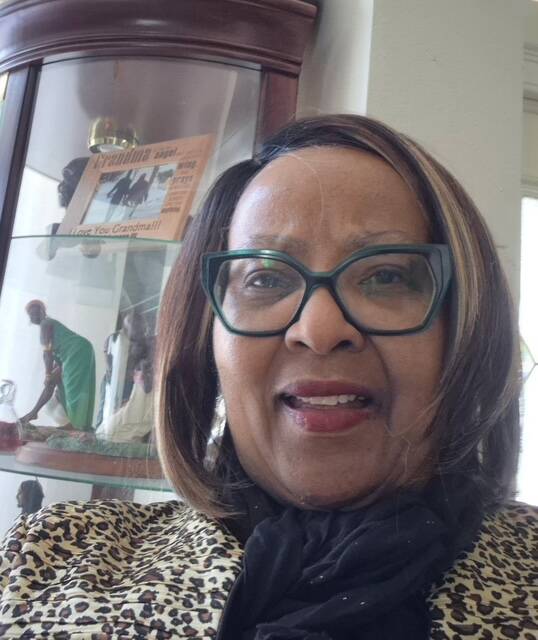
When Pastor Fannie Dean looks out across her Mission Ministries congregation Sunday mornings, she sees the differences. They’re obvious if she chooses to dwell on them. Black and white, young and old, exuberant and reserved in worship. But none of those divisions matter to her.
“If we get hurt, our blood is all red,” she says. “God created everything! All of us were made for his glory.”
Pastor Dean and her husband, Randy, grew up in Georgia. They were married soon after Randy’s Navy service brought them to Oak Harbor over 50 years ago. Since then, as an outspoken pastor of a mostly Black congregation, she has faced an arson at her home, rocks through windows at her church and thrift shop, and threatening notes left for her. Vandals even beheaded a treasured African statue.
Through it all, Pastor Dean still believes that love can override all the hate. Those traumas just made her stronger, she says, as she calmly speculates on what might drive a person to act that way. “Where does it come from? Some people are just raised different. I can tell when I go in a place, and all I have to do is say hello. I can tell.”
It isn’t always criminal behavior. Sometimes it’s just attitude. Dean is well aware of pushback from some white folks who wonder why we need Black History Month, or Martin Luther King and Juneteenth celebrations. She’s heard “when do we get our month?” from white friends. People have insisted to her that racism is behind us, that it’s divisive to focus on race today.
“People don’t know what we went through,” she says, her voice rising with passion as if from the pulpit, even in a quiet one-on-one with a columnist. “I come from a time and place where we had to work twice as hard and be twice as good to even have the slightest chance to get ahead. In Georgia when I grew up, there were no mixed-race couples. It was too dangerous. Today, we take progress like that for granted.”
It’s exactly that taking-for-granted that makes Black history so important to Dean. Sixty years removed from the height of America’s civil rights movement, we are losing the real-life voices of people who lived through Jim Crow, segregated schools, redlined neighborhoods and deadly violence committed against those who protested. Dean herself barely remembers the day Dr. King was killed. She was just a grade schooler. “People were crying,” she recalls, “but I was too young to understand who this man was.”
Dr. King was a complex human, his years of good work so much deeper than the convenient sanitized lines we like to quote today. As her generation has become today’s elders, Dean says King’s lessons and sacrifices are crucial to teach to young people. “He was driven to say what was right, and he gave up his time with his family to do it. He sacrificed so much — for us! The next generations need to know that.” Dean says Black children in particular have a thirst for those lessons. “They want to learn who he was, and they want to know what their parents did to help the cause.”
But Dean says it isn’t just about teaching Black kids. She believes it’s up to all of us, regardless of race, to learn those stories, those hard-to-hear histories. We naturally want to resist accounts of generational, systemic persecution in a nation that prides itself on freedom and equality. Those ideas rankle some who may call it “woke” or unAmerican, but community leaders like Oak Harbor Councilman Bryan Stucky are fully on board.
Stucky grew up in Sequim, on Washington’s Olympic Peninsula, with limited opportunity to meet people from different cultural backgrounds. Here on Whidbey Island, he says, “four years ago, I first attended the Juneteenth event hosted by Pastor Fannie. I admit that I was naïve about what the day represented and the impact it held for members of the community whose ancestors were enslaved generations ago. Interacting with those whose historical roots were different than mine was an eye-opening experience. Each year, I attend these events and learn a little more, and I slowly begin to understand perspectives beyond my own.”
Stucky doesn’t find divisiveness in events like Black History Month and Juneteenth. On the contrary, he sees a chance for progress, for healing and understanding. “I believe,” he says, “the best way to honor Black History Month is to intentionally take time to listen and learn. In doing so, we as a community can take steps toward unity rather than division.”
Pastor Dean is grateful for citizen leaders like Stucky, whose willingness to learn sets a strong example to the community. She understands it’s hard for some to open their hearts and minds, especially in today’s polarized world. She wonders, as she reads her bible, if we’re in the end times.
“There is something in the atmosphere,” she says. “There is prophecy about seeing the truth right before us and refusing to believe it, leading us to the last days. Jesus is soon to come, and all we can do is watch and pray.”
End times or not, there’s an exuberance about Pastor Fannie Dean and her congregation that’s impossible to deny. It’s there in the tone of her voice in everyday conversation. It’s there on Mission Ministries’ website, where they proclaim, “We Holla Jesus!” It’s there in the “Amen!” responses during Sunday services. Dean sees that joyful release as a grateful reaction to God’s undying love through the traumas and struggles that Black Americans have experienced for centuries.
“As long as I know how much God hears my prayers,” she says, “then even on my weakest day, that memory comes back.” We may be facing big trouble in the world, but Dean knows it’s in our power to change it. “Jesus teaches love and kindness,” she reminds us. “He teaches us to love unconditionally. To love the ones in jail … unconditionally. To love the homeless … unconditionally. That brings the temperature down. That’s the Word of God. Unconditional love.”
Pastor Dean hopes the community will come out for a Black History Month celebration at 3:30 p.m. on Sunday, Feb. 22, at House of Prayer, 620 Erin Park Rd., Oak Harbor. For details, call 360-679-1003.
William Walker’s monthly “Take a Breath” column seeks paths to unity on Whidbey Island in polarized times. Find his opinions on sports, politics, and culture at playininthedirt.substack.com/.