
I just returned from our annual week in Taos, New Mexico, which is a very special place up about 6,000 feet high and filled with artists of all kinds and galleries everywhere. I saw young artists walking along with brushes and canvas in hand and wood carvers working in a park. And I saw some happy old hippies who live there and were probably artists at some point.
When I got back to our Rock, I began to realize that Whidbey also shares a love for art and artists, even though it’s expressed a bit differently.
Consider this: Taos, with a population of 6,500 has 70 art galleries within its borders showing mostly art by local artists. When you stroll around town, it seems like there is a gallery at every other door. Then there’s Whidbey, with a population of 70,000 and just a few art galleries — one each in Oak Harbor and Coupeville, and a handful in Langley. Unless you are specifically looking for a gallery here, you might never find one.
Taos, of course, is a compact space which covers about 12 square miles. Whidbey is a long island that covers about 169 square miles. Our Rock art is much more spread out and takes somewhat different forms.
Lisa Bernhardt, long-time executive director of the Pacific Northwest Art School in Coupeville, sees the Whidbey art scene clearly.
“I know hundreds of artists live here,” she said. “Some do it full time, others part time.” And what attracts them to do art on Whidbey? “It’s an inspiring place to be, visually. Also I think there is a lovely sense of isolation — someplace special, someplace unique that isn’t like anywhere else. You get off the ferry and it feels different.”
In Taos, you don’t take a ferry but you drive at least an hour or two to get there from any other big spot in New Mexico, and you climb to an elevation of 6,000 feet, which keeps the temperature cooler than in Santa Fe or Albuquerque.
Taos has at least half a dozen art competitions every year, from painting to carving to sculpture. It draws hundreds of people from all over the world, hoping to win a juried award.
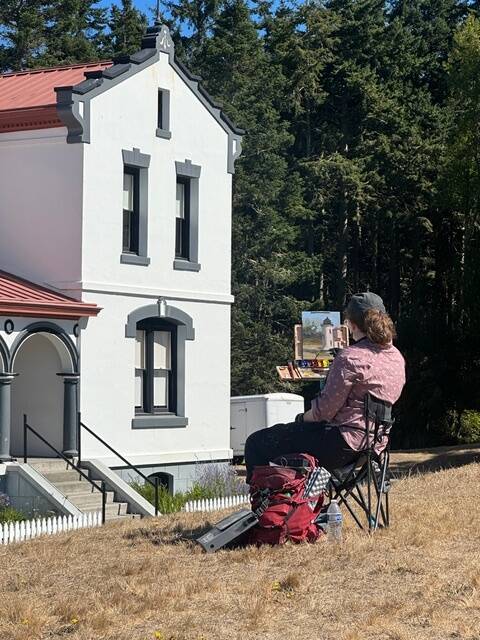
Similarly, Whidbey just held the annual Plein Air Painting Competition, sponsored by the Art School. Bernhardt said this year’s competition attracted 72 painters — about 60% of whom had also done it in prior years. It’s a significant commitment for a painter, who needs to find a place to stay and have the money for food and transportation for the four-day event.
“We are the largest Plein Air Painting Competition that is open to everyone,” she said. There are other competitions but most are by invitation. By the way, “plein air” is an impressionist style of painting done outside with available light.
All the paintings done this year were put up for sale by the Art School and almost all of them sold within a week, with the Art School getting a commission on each sale.
This weekend, Whidbey is also hosting its annual Woodpalooza, where wood artists show off their fine works at the Whidbey Island Center for the Arts in Langley. And earlier this month, the Rock had its annual artist studio tour, where as many as three dozen local artists open their studios in their homes to the public, from Deception Pass to Clinton.
For both Taos and Whidbey, the creative arts are an important part of the local economy, generating perhaps as much as 9% of retail sales. And both Coupeville and Langley now have been designated as Creative Districts by the Washington State Arts Commission, as a tribute to the art and artists in their communities.
So, I feel proud to be living in place that compares with Taos as a center for art and artists. I guess I better give it my support and go buy a painting.
Harry Anderson is a retired journalist who worked for the Los Angeles Times and now lives on Central Whidbey.