Langley eyes funicular, walkway for marina access fix
Published 4:03 pm Friday, May 15, 2015
From April’s charrette, Langley’s mayor and planning chief are recommending the construction of a funicular and building a waterfront walkway that may require the taking of private property through eminent domain.
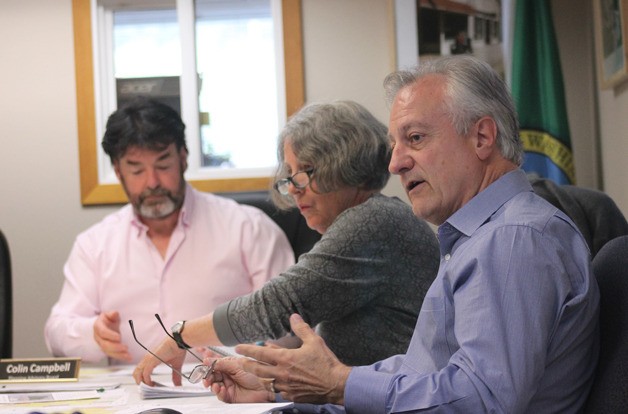
Michael Davolio, director of Langley Community Planning, presented the city’s preferred options to the Planning Advisory Board on Wednesday. About 20 people, including Mayor Fred McCarthy and mayoral candidate Sharon Emerson, also attended the meeting. Davolio’s report followed an April charrette in which 130 people gave input on ways to improve access to the marina, from making use of golf carts and trolleys to building an elevator and bridge.
His proposed solution included an interim patch and a long-term project.
Island Transit is considering the city’s request for bus service to the marina, which Davolio said was the short-term solution. The construction of a waterfront walkway and funicular were proposed as the long-term solution to Langley’s marina access issue.
Both projects were supported by McCarthy, who cited public support for the walkway and a last-minute idea of bus service to the marina.
“They’re very creative and might emerge as a much better solution than buying the golf carts and calling it square,” McCarthy said in a phone interview Friday morning.
Davolio said the once proposed bridge and elevator was clearly the public’s least favorite option, based on matrices filled out at the charrette. Adding electric golf carts was the top choice of residents but not included in the planner’s recommendation. Leasing them was not a readily available option and the cost involved in hiring and training drivers made them unsuitable as a short-term solution.
“It’s not the end game answer,” McCarthy said. “It’s not been easy to staff one golf cart with volunteer drivers.”
After a 45-minute presentation by Davolio on his findings from matrices filled out at the charrette, another 45 minutes of comments were offered from the crowd. One of the more common opinions, and an ongoing request from other people in past meetings and letters to the editor, was that the city had to identify a need first, then find the best solution. That very thought was first presented by board member Colin Campbell, who said he spent the past weekend speaking to boaters at South Whidbey Harbor, commonly called the Langley marina.
“Eighty percent of them walked up the hill,” he said.
“By doing something on a temporary basis, it gives us time to document the need,” Davolio said in response.
Resident Jonathon Moses said people needed to agree on a function or goal of the funicular before pursuing a form. He also recommended the city purchase properties at the south end of Wharf Street for more parking space.
Bus service
Other ideas with support, such as having Island Transit take a smaller shuttle-style bus to the marina, were reviewed and proposed by the planning director. The route, said Davolio, would go between the Clinton Ferry Terminal and Langley. That would be the city’s short-term solution to improve access this year, but it is entirely dependent upon Island Transit finding the expanded service feasible following a financial crisis in 2014.
Taking a year would let the city further study how effective bus service was at connecting the South Whidbey Harbor with Langley’s commercial core. That time would also be spent researching the possibility of acquiring property along Sunrise Lane, the private road off Wharf Street, that could serve as a marina and Seawall Park connector. From the park, Davolio said, a smaller funicular could carry people up to First Street and drop them off in the heart of the business district.
“I’m cautiously optimistic we could put something in place through July and August,” he said.
McCarthy said he looked at 16-passenger and 23-passenger buses, smaller than the long ones that typically run along Highway 525, that were small enough to turn around near the marina. He envisioned a service that would make morning, noon and night runs each day between the ferry and city. Costs involved were not readily available, and McCarthy said Davolio is working to present the option to the Island Transit board later this month. But a possible combination of fares and a city subsidy could cover the operations and maintenance costs associated with the new route.
“I think tourists are willing to pay to ride an interesting looking bus with a sound system, and stops along a scenic route into Langley,” McCarthy said, adding that it may become a pilot program for Island Transit as the agency looks for new revenue from advertising and fees.
Waterfront walkway
In order to build a walkway bridging the marina to Seawall Park, Langley would have to acquire private property, either tideland or the Sunrise Lane road along the bottom of the First Street bluff.
Davolio’s choice is for the city to connect Wharf Street to Seawall Park, currently accessible by emergency vehicles via Anthes Avenue, to Sunrise Lane, a private road off Wharf Street. Building anything over the water would be a lengthy, costly process, he said.
A pair of Sunrise Lane property owners cited a deed between the handful of properties that states none may give any part of their property away for public use. The two women also said they had been through this discussion before with the city, and were upset at going through it again. 
“We have made it abundantly clear we don’t want a public walkway on our property,” Connie Marcucci said, adding that they don’t like the traffic and accompanying litter.
When asked how the city would gain easements or acquire the property without willing sellers, Davolio said the city could invoke eminent domain and take it.
When later asked about eminent domain, McCarthy said it was “worth having a courageous conversation” and that this was the appropriate venue to float the concept. He conceded, however, that it may prove to be another contentious issue in what’s already been a divisive project.
“I’ll grant you it’s a controversial topic,” he said.
The mayor added that the words eminent domain mean “the city would take the right to have a walkway through there, not taking property, for a public purpose. That can be done whether the property owners agree with it or not if the overriding needs of the many outweigh the proprietary needs of the few.”
The funicular
Having been both consistently criticized and championed by residents, the funicular was part of Davolio’s recommendation for the long-term fix. A pod on a track that would move along the bluff, it was ranked third in Davolio’s report, which used a weighted tally system. In popular choice, it took 23 first-place votes, 10 second-place votes and 10 last-place votes.
But one resident questioned Davolio’s method in counting the matrices. She said more than 80 chose the funicular as the last-place option by crossing it out, blacking out the selection, writing “No,” next to it and other means other than numbering it with an “8” or “0”.
Marianne Edain, a co-founder of Whidbey Environmental Action Network and a member of the city’s Parks and Open Space Commission, cited Langley’s shoreline master program that states new development, uses and activities must be designed and operated to avoid “blocking, reducing or adversely interfering with the public’s physical or visual access to the water and shorelines.”
Another consistent suggestion from planning board members was the need to hear from the Port of South Whidbey. The public agency owns and operates the marina of South Whidbey Harbor and has more buildout phases in its plans, but more dock space would likely require having somewhere to park or better access to existing parking.
Currently, parking down on Wharf Street around the boat launch is tight, with only a handful of spaces available. Up above the harbor along Cascade Avenue and in town, however, parking lots have been marked as places for boaters to leave their cars. Making that trek easier for pedestrians is one of the goals of the proposed projects.
Davolio said he would request that port officials meet with the planning board.
Busy board meeting
Hearing from the crowd that most had attended the 3 p.m. meeting to listen to and comment on the marina access solutions, board Chairwoman Sue Walsh asked the group to move it to the top item on the agenda.
“I want to make sure all will get to make comments before we take any action,” Walsh said.
The planning board originally had several items on the agenda to discuss, but was only able to address the marina access recommendation. Even that was pushed back to another meeting for members to consider public input before supporting a recommendation for the city council.
In all, 13 different people gave public comment to the planning board, and many of them spoke more than once. A couple of men asked for the city to put it on a ballot or referendum.
The planning board scheduled a special work session to further address other items on the agenda that were not covered at the May 13 meeting.