Gray whale strandings near record high in state
Published 1:30 am Tuesday, July 14, 2026
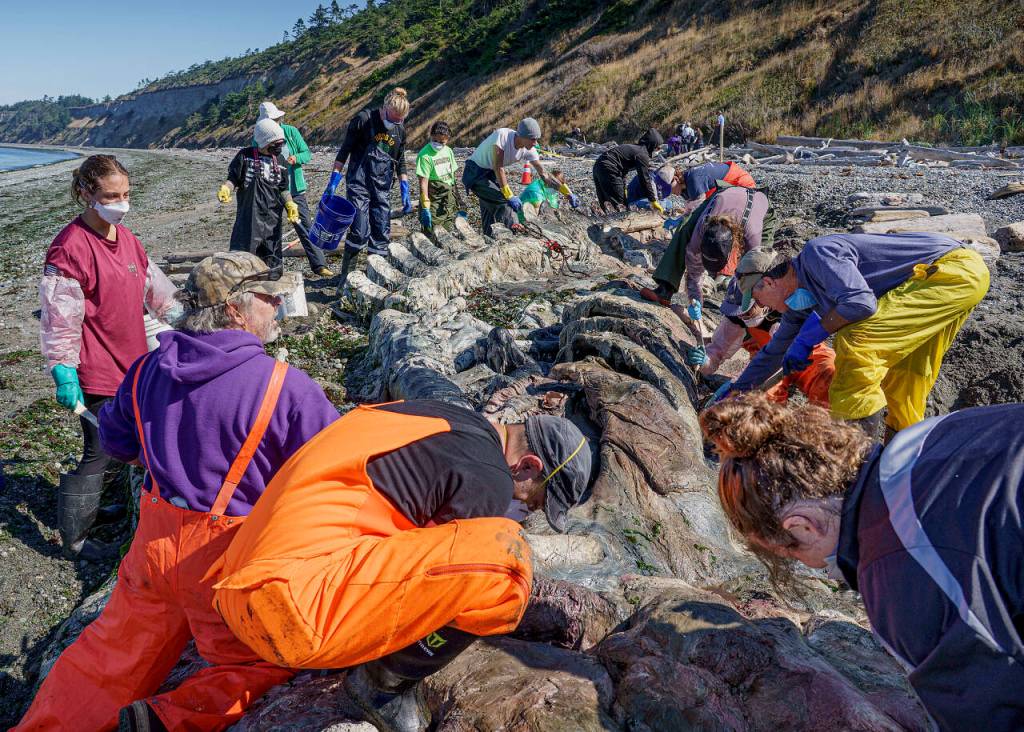
Washington has already recorded its second-highest number of gray whale strandings on record this year, alarming researchers who say the prolonged die-off shows no sign of ending.
Public Employees for Environmental Responsibility recently described the die-off as a “Catastrophic Mortality Event.” However, John Calambokidis, a senior research biologist with Cascadia Research, said no such formal designation has been made.
PEER is also urging federal action. It is pressing NOAA to act on a 2023 petition aimed at reducing ship strikes and has filed a separate petition seeking to return gray whales to the federal endangered species list.
“The loss of thousands of whales in just two years from a population at significant risk should be of concern to us all,” Rick Steiner, an Alaska marine ecologist and chairperson of PEER’s Board of Directors, said in a press release.
Two whales have died and washed up on the shores of Whidbey since July of last year. Washington has recorded 30 gray whale strandings so far this year, according to Cascadia Research, making 2026 the state’s second-highest year for strandings in five decades of monitoring. Only 2019, with 34 strandings, recorded more, but this year is only half over. Calambokidis said the number is especially concerning because it extends a years-long pattern.
“What’s troubling about that is that this now represents the seventh year since 2019 where we’ve had elevated numbers of gray whale deaths occurring,” Calambokidis said.
The rising strandings come alongside a steep population decline. The National Oceanic and Atmospheric Administration estimates the gray whale population has fallen by roughly half over the past decade, while calf production has dropped to record lows, Calambokidis said.
“It’s clear to me that gray whales are in grave peril,” Calambokidis said. “They’re at a crisis point. A decline of over 50% in 10 years is catastrophic for a long-lived, slow-reproducing species like gray whales.”
Two-thirds of the dead whales in Washington have been adult males, baffling researchers, Calambokidis noted, as usually when a population is in peril it’s the babies that die off first. He said a theory is that the gray whales aren’t reproducing enough babies in the first place.
Researchers increasingly point to dramatic environmental changes in the Arctic, where most gray whales feed, as the underlying cause.
“At the heart of this issue are very profound changes occurring in the Arctic ecosystem,” Calambokidis said, which have reduced the whales’ primary food source. He added those changes are “driven by human-induced climate change.”
Howard Garrett, president of the Orca Network board in Langley, agreed that starvation is the primary cause of the deaths. He said shrinking Arctic sea ice has disrupted the food web gray whales rely on, leaving many whales without enough food to survive their migration.
Despite the grim overall outlook, researchers say one local group of whales has provided a rare bright spot.
Around 20 gray whales known as the Sounders spend part of the year feeding around Whidbey and Camano islands instead of traveling to Arctic feeding grounds. Those whales are faring better than the broader population.
“Those numbers have steadily increased,” Calambokidis said.
Because of that, he said, protecting local feeding habitat from vessel strikes and entanglements is increasingly important.
Garrett also pointed to the Sounders as a hopeful sign, noting the whales feeding in Possession Sound and Saratoga Passage continue to return year after year.
The continuing losses have been difficult for those who have spent decades watching gray whales recover from commercial whaling, only to see their fortunes reverse.
“It’s tragic. It’s horrible,” said Garry Heinrich, response coordinator for the Central Puget Sound Marine Mammal Stranding Network. “It’s hard to describe the feeling.”
Heinrich said the gray whales’ decline should serve as a warning to all Whidbey residents.
“It’s my canary in a coal mine for what is happening worldwide,” he said. “We just can’t bury our heads in the sand anymore.”