Reflective Reels begins with ‘Sweet Crude’
Published 9:00 am Wednesday, October 10, 2007
CLINTON — Good food, neighbors, conversation and thought-provoking movies; ingredients that when mixed together, could foster world change, one personal connection at a time.
At least, that’s the hope at Whidbey Institute. The education center kicks off its second annual film series Reflective Reels tonight with the documentary “Sweet Crude,” a film that even in its incomplete state has begun to raise awareness about the African country of Nigeria and its Niger Delta.
The series was designed to invoke meaningful conversation with the idea of promoting a cascade of change, said Dianne Shiner, director of the Whidbey Institute.
“One of our points of mission is to convene community discussion about the common good in regard to earth, environmental issues, spirituality in a broad sense and to social and economic justice,” Shiner said.
For Shiner, the documentary about the human toll of big oil in the Niger Delta region could fulfill many of the reasons to foster dialogue between Whidbey neighbors.
But there is another reason “Sweet Crude” was chosen to headline the series. The documentary has a special connection to Whidbey Institute.
“This year, ‘Sweet Crude’ is precisely a film that was developed because of energy here on the island that originally came out of a retreat that was scheduled here at the institute,” she said.
That retreat, called the “Practice of Peace,” took place in November 2003 and served as an international peace conference, said Mary Ella Keblusek, a Spirited Work volunteer.
“We had 130 people from all around the world come for about 10 days. It was pretty amazing,” she said.
“Joel Bisina of Nigeria and Prosper Ndabishuriye of Burundi came to the conference and blew us all away in terms of the depth of their experience and their commitment and what they were doing,” she said.
That was also when Keblusek fell in love with Bisina.
“I was really moved. I think he was totally different from anyone I had met; his experience, his perspective his depth of heart, the way he would speak so eloquently,” she said.
“To a large extent, it was love at first sight, but I wasn’t able to go there in a deep way until I went to Nigeria to visit him two months later.”
Keblusek discovered much more than a love relationship in Bisina. She discovered a country that had been corrupted and fractured from a 50-year relationship with oil.
Bisina and many of his fellow Nigerians longed for freedom from the multi-national oil companies that pillaged their lands and brought one environmental disaster upon another in the name of profit. They also longed to be free of a corrupt government that had promised time after countless time to provide reparations for taking tribal lands along the delta.
When Keblusek met with locals, she was surprised that they knew more about America and its politics than she did.
They also asked her why America did not come to their rescue.
“They would say to me ‘We don’t understand why Americans aren’t helping us. We’re trying to be a democracy,’” Keblusek said. “I would tell them in general, Nigeria is not on our radar screen; that Africa really wasn’t on our radar screen.”
When “Sweet Crude” is released, Keblusek hopes Americans will finally start thinking about the Niger Delta.
“If people knew more about the reality of individual people and their plight, their attempts to try and change their situation, Americans would care more, because as a whole, we are a very caring people,” she said.
In an effort to spread awareness, Keblusek and friend Susan Partnow joined together for a “Global Citizen Journey” and in November 2005, the organization brought a 20-person delegation to not only witness firsthand the devastation in the delta, but also to build a library for the area.
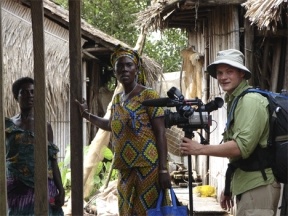
Sandy Cioffi, a Seattle-based film and video artist, tagged along and filmed the construction of the library and other aspects of the delegation’s visit.
What she saw prompted a decision to return to Nigeria and film a documentary about the people and how they sought their freedom, said screenwriter Leslye Wood.
Cioffi also sought to change the way American media looked at Nigeria.
“The few news reports that filter out to the United States talk about the Niger Delta as a source of energy, as a source of oil, in terms of dollars or barrels,” Woods said.
“Or, more recently, in terms of militancy. We wanted to show the great beauty of the region, the humanity of the people, the real suffering that is occurring there — the real life of real people and how they are struggling to survive,” she said.
For Cioffi, Wood and the rest of the film crew, telling the most accurate story has been a challenge because nothing is simple in Nigeria, Wood said.
“We captured about 110 hours of footage and then we came back and really thought through how to pick out a storyline from that footage,” she said.
“We looked at what footage we can put together that will really portray the issues, the people, the ideas and to tell the story from all sides, which was one of our main goals,” she said.
“The story is so complicated. There are so many sides, so many stakeholders. The issues are not simple.”
While a few Americans are sounding the clarion about the Niger Delta, Nigerians have been waiting for years for anyone to take notice, especially Bisina. “Sweet Crude” brings Bisina and his fellow Nigerians the hope of a better future.
“To me and the ordinary people in the Niger Delta, this documentary means a lot as it will help to highlight the complex social situation in the region, the level of poverty and underdevelopment,” he said. “I am sure the government will be very uncomfortable because they will feel that the film is an indictment on the government.”
Bisina said, however, that the documentary could have a much greater impact — impact of the kind seen with the movie “Hotel Rwanda.”
“On the Rwanda genocide, people hear about the genocide and the destruction of properties, but they could not come to terms with the reality until the movie ‘Hotel Rwanda’ hit the screen,” he said. “Only then did people come to appreciate the magnitude of the genocide.
“My expectation is that ‘Sweet Crude’ will help to educate and inform Western policy makers and people of good will on the real issues the ordinary people of the Niger Delta in Nigeria are grappling with,” he said.
South Whidbey residents will get a chance to see the film when “Sweet Crude” plays at Reflective Reels tonight.
“When you see this film, it sort of exposes the human and environmental impact on a people and a country half a world away,” Shiner said.
“That’s directly related to our hunger for more oil. And what that means relative to the corporations that seek to satisfy that market. I see it as a consciousness-raising about our inter-dependency with these people in the Niger Delta. We are related.”
Spencer Webster can be reached at 221-5300 or swebster@southwhidbeyrecord.com