
Sculptures, a gazebo, a fountain, an eternal fire, and perhaps a better way for mobility impaired access are all part of the Langley Arts Commission’s robust, six-year, $800,000 master plan for Seawall Park.
And it will cost the city nothing.
The citizen board responsible for developing public art in Langley presented its master plan to the city council at its Oct. 19 meeting. The council declined to give it an informal OK, having only then just received it for review. But arts commission Chairman Frank Rose is champing at the bit for the go-ahead, which he hopes to receive from the council at its Monday, Nov. 2 meeting.
The commission wants to see the potential of Seawall Park, from a largely undeveloped and raw landscape, realized into a gleaming jewel that looks out over Saratoga Passage and the city’s waterfront. Cost for the Seawall Park improvements is roughly estimated by the arts commission at $800,000, and is planned to be funded externally through grants and donations.
Such a proposal, though described by some as ambitious and aggressive, has supporters on the city council.
“The things that are mentioned in this plan are really wonderful,” said Councilwoman Rene Neff at the Oct. 19 council meeting.
Rose eagerly laid out the group’s vision from the access at Anthes Avenue in a later interview with The Record.
“Entrance, there’s a problem,” he said, looking down the steep hill of the emergency vehicle access between the Dog House Tavern and Hladky/Whale Bell Park. “It’s not wheelchair accessible.”
He moved from the sidewalk, past the old oak tree, and toward the semicircular overlook. This could become a switchback path for the mobility impaired. It won’t be as automated or easy as an elevator or a funicular, he said, but it is doable.
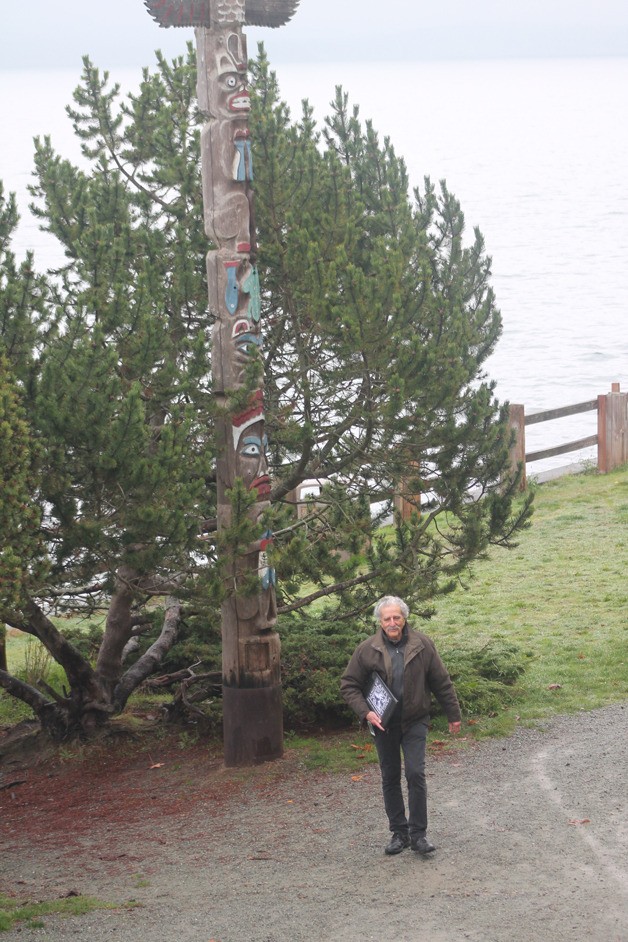
Down at Seawall Park, he pointed to the pair of non-tribal Native American-style totem poles at the western set of beach stairs and the Native American-inspired designs and artwork etched into the concrete bulkhead. 
Adding more pieces in the form of sculptures or metal stencils installed along the railing at shin height, Rose said, could enhance the area without overdeveloping the 1.44-acre park strip below First Street.
“The idea is not to disturb this place, or to take away in any way the natural beauty,” he said.
Finding a way to encourage more use of the waterfront park has been a goal for the city’s Parks and Open Space Commission. The parks group in Langley has pushed for better signage through town for all of the open spaces and parks, but Chairwoman Nancy Rowan said enticing people to walk down the stairs from Boy and Dog Park or down the steep slope of Anthes Avenue has proved challenging.
Adding art to the area may be the trick.
“Anything that we can do to capitalize the waterfront is going to be such a benefit,” said Rowan, who is also president of the Langley Chamber of Commerce. “It’s exquisite. It’s beautiful. It’s what people come from all over the country to see. Right now, other than standing at Boy & Dog Park, there’s nothing to draw people to see it.”
Creating something out of nothing at Seawall Park is the top long-range priority in the public art master plan. Dubbed the Salish Seawall Sculpture and Event Park Master Plan, it is the first of two capital campaign projects in the document.
Rose already took the plan, without much detail, to the city’s Parks and Open Space Commission. It was well received, parks commission member Gail Fleming said. As the plan becomes more specific, the parks commission will take greater interest in what exactly is proposed for the public space it is entrusted with preserving.
“I think all of us were really happy to hear about it,” Fleming said.
“If they wanted to turn it into Disneyland, I wouldn’t be happy,” she added.
Funding such a project would come from external sources procured by a consortium of interested groups and individuals. The sole purpose of the consortium is to be a fundraising arm for the arts commission and the Salish Seawall Park project.
Langley’s Comprehensive Plan, the guiding document for projects and what the city can and should do, includes a section titled “Arts, Culture and Education.” Stated within the section is: “Langley has the opportunity to build on its existing strengths by strengthening the arts, culture, and education part of its economy,” and that in so doing it would be “the most promising way to increase activity and draw more visitors outside of the summer season.”
If approved and implemented, the Langley Arts Commission’s plans would essentially double down on the city’s reputation as an arts hub. Asked if that would distract from the other identities Langley has cultivated or tried to cultivate — Village by the Sea, a whale watching destination — Councilwoman Robin Black said those identities work in concert.
“All of those things feed well into each other,” she said. “We are already all of those things.”
“Enhancing the park is a wonderful idea,” she added. “I’m in full support of it, as long as it’s not going to cost the taxpayers any money.”
The Langley Arts Commission was created in 2014 with the intent of utilizing funds from capital projects to finance art in public places. The 1 percent for the arts funding morphed, and the first major task the group accomplished was the selection of sculptures for the Second Street plaza.
Ambition and vision in the group outgrew that simple task, and the commission has since looked into identifying every piece of public art already on display with the goal of creating a public art trail/walk in Langley. Conducted by Michele LaRue, it was previously reported that she had counted more than 127 pieces. Langley’s population is about 1,000 residents.
The Langley City Council meeting is at 5:30 p.m. Monday, Nov. 2 at City Hall, 112 Second St.