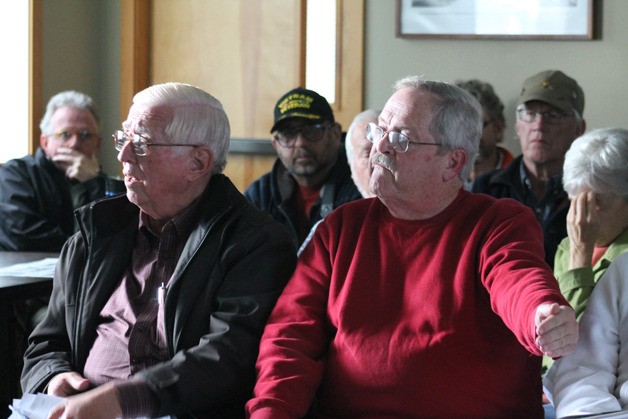
What was scheduled to be a normal, quiet Langley Planning Advisory Board meeting became a packed, comment-filled and at times unruly spat over a proposed elevator and bridge on Cascade Avenue.
Two dozen people filled the council chamber at City Hall to attend the citizen board’s meeting and hear about the $500,000 project. Most voiced their displeasure with the cost, lack of need and look of the bridge and elevator, dubbed the Langley Lift.
“It’s a self-inflicted aesthetic wound,” said Brian Lowey, a Clinton resident.
Of the more than 25 people at the Wednesday afternoon meeting, only two spoke in favor of the project. Pam Schell, widow of Paul Schell who initially proposed the project and offered the city a place to land the elevator and an easement on Wharf Street, defended the plan. She noted that it would make the marina more accessible to mobility-impaired pedestrians and allow better access for boaters to the city.
Both of those points were quickly countered. One man said his friend, a paraplegic, was able to get from South Whidbey Harbor up to the city with the help of Port of South Whidbey’s harbormaster.
Nell Anders, who identified herself as an avid sailor, said fellow boaters would neither need nor use the elevator. She described the sailing community as people who would come up for a meal or to grab snacks from the grocery store, but would not be lugging anything unwieldy around that would necessitate an elevator rather than strolling down Wharf Street.
“This makes no sense,” she said. “There would only be a couple of bags of groceries, and they would carry those downhill. Down hill.”
For years, Langley has looked at connecting its commercial core to the marina. Currently, it’s accessible only by Wharf Street, a narrow road with a single sidewalk up a steep hill. With the recent expansion of the dock space and further expansions planned in the years to come, the port district and the city are looking at ways to make it easier for people to get from their boats to parking areas atop the bluff and around Langley.
Grant funding for the project was secured from Island County’s Council of Governments. At first, about $242,000 was earmarked for the city to widen Wharf Street, the only vehicle access to the marina. That was scrapped in favor of a pedestrian transport, initially a funicular — a pod on a track that clung to the bluff and moved adjacent with it, rather than straight up and down. City officials previously reported that the cost of the funicular was too high at around $800,000.
Eventually, the funicular idea was abandoned when the private partner group that used to own the property at the base of the bluff dropped its development plans for the Drake building. The Schells ended up buying the lots and have development plans for a four-story building adjacent, but not connected, to the Langley Lift. It would have a street-level restaurant and three stories of suites for rent as a water-view inn.
Langley secured another $260,000 in Rural Economic Development money for use in its pursuit of pedestrian access down the bluff. One man at the planning board meeting chastised the city for seeking to use it like “free money,” when it came from taxpayers.
The funicular, which hasn’t been considered in months and was largely the pursuit of former mayor Larry Kwarsick, resurfaced at the Sept. 30 meeting. Eric Levine, a Langley resident, said the city could get a top-of-the-line model from Hill Hiker, a Minnesota-based company, for under its budget of $500,000 and have money leftover for a maintenance fund — the topic of which was a sticking point for several people in the crowd: How would the city fund its regular maintenance and use?
Questions were also raised about why the city was not instead choosing to invest in the Langley Main Street Association’s electric golf cart shuttle program. Planning Board Member Aaron Simpson, who is also on the board of the Main Street Association, said getting volunteers to run the shuttle has been difficult, especially during the busy summer months. During summer, the association has hired an intern to run the shuttle that loops around Langley’s commercial core, including the marina.
Simpson also defended the Langley Lift’s utility as a general benefit to residents and visitors. He noted that even as a young, able-bodied male, it’s an undesirable stroll up and down the Wharf Street hill.
After nearly 90 minutes discussing the Langley Lift, and with several people having spoken multiple times and interrupting one another, Simpson called for an abrupt shift of topics to the city’s Comprehensive Plan update. His motion was seconded by Board Member Roger Gage. That prompted all but a few people to get up and noisily leave in the middle of the board’s action.
Sue Walsh, the board chairwoman, said the Planning Advisory Board would need more time to consider the issues before giving a recommendation to the city council.
Next for the project, Arango will present the project to the city’s Design Review Board. Previously, Arango said the Council of Governments has requested progress on the project by year’s end, or Langley could lose the funding. The city will continue to accept public input on the view assessment, which may be submitted in writing to City Hall, Arango’s email jarango@langleywa.org or online at designlangley.org.